Paper-Thin Chip Steers Light Without Moving Parts
Scientists created a microscopic chip that converts invisible infrared light into visible colors and aims it like a spotlight, all without any moving parts. This breakthrough could transform everything from self-driving car sensors to quantum computing.
Imagine a spotlight the thickness of a sheet of paper that can change colors and point in any direction without physically moving a single part.
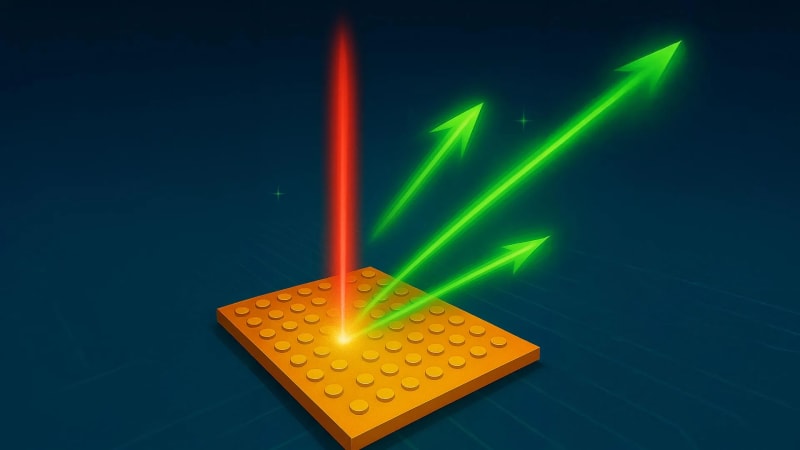
Scientists at the CUNY Advanced Science Research Center just made this a reality. Their new chip is covered with structures smaller than a light wavelength itself, and when infrared light hits it, something remarkable happens: the chip converts that invisible light into visible green and steers it precisely wherever needed.
The secret lies in how the team solved a problem that has stumped engineers for years. Most light-controlling devices face an impossible choice: you can either have precise control or high efficiency, but not both. Devices that adjust light at individual points offer great control but waste energy. Systems that let light waves interact across the entire surface work efficiently but lose precision.
This chip does both. It uses a technique called a quasi bound state to trap and intensify infrared light across the whole surface while carefully rotating each tiny structural element in a planned pattern. The result is like having a built-in lens and prism working together.
In lab tests, the device converted fiber optic infrared light at 1530 nanometers into visible green light at 510 nanometers. The beam's direction changes simply by adjusting the incoming light's polarization, making it 100 times more efficient than similar beam-shaping devices.
Lead researcher Michele Cotrufo, now at the University of Rochester, explains that the chip produces "third harmonic light," meaning the outgoing light vibrates three times faster than what goes in. Even better, the design works with many different materials and light colors, including ultraviolet.
The Ripple Effect
This breakthrough reaches far beyond the laboratory. Self-driving cars rely on LiDAR sensors to see their surroundings, and this technology could make those sensors smaller, cheaper, and more powerful. Quantum computers need precise light sources to process information, and these chips could be built directly into their circuits.
The applications extend to optical signal processing, where data travels as light instead of electricity. Since the chip works with the same infrared wavelengths used in internet fiber optics, it could speed up everything from streaming video to cloud computing.
Because the technology depends on geometry rather than specific materials, researchers can adapt it for different uses. Future versions might stack multiple chips together, each tuned to different wavelengths, creating ultra-compact light sources that work across a rainbow of colors.
The research received support from the U.S. Department of Defense, the Simons Foundation, and the European Research Council. The team's findings appear in the journal eLight.
Andrea Alù, founding director of CUNY's Photonics Initiative, sums it up perfectly: "Think of it as a flat, microscopic spotlight that not only changes the color of light but also points the beam wherever you want, all on a single chip."
The door to ultra-compact, super-efficient light technology just swung wide open.
Based on reporting by Science Daily - Technology
This story was written by BrightWire based on verified news reports.
Spread the positivity!
Share this good news with someone who needs it