Physics Professor's Team Approach Powers Clean Energy Wins
Cinzia DaVià credits collaboration over solo genius for her breakthrough work at CERN and beyond. Her team-focused approach is now tackling everything from cancer treatment to climate solutions.
A physics professor who helped revolutionize particle detection technology says her secret weapon isn't brilliance. It's teamwork.
Cinzia DaVià, a senior member of IEEE and professor at the University of Manchester, has spent decades proving that collaboration beats competition. From groundbreaking discoveries at CERN to portable clean energy solutions, she's built a career on connecting the right minds to solve big problems.
Her journey started unexpectedly. Growing up in the Italian Dolomites, young DaVià watched "Astronomia," Italy's version of Carl Sagan's "Cosmos," and dreamed of studying stars. She enrolled at the University of Bologna planning to become an astrophysicist.
Then a summer internship at CERN changed everything. She helped build experiments for the Large Electron-Positron collider, a massive 27-kilometer underground accelerator that would validate the standard model of physics. One summer turned into ten years.
During that decade, DaVià contributed to discoveries that transformed particle physics. She helped develop a process to "resurrect" radiation-damaged silicon sensors by cooling them below -143°C, a phenomenon scientists call the Lazarus effect. The sensors act like cameras capturing millions of images per second during particle collisions.
Her proudest achievement came next. Traditional flat silicon sensors couldn't handle the extreme radiation at collision centers in newer, more powerful colliders. Working with inventor Sherwood Parker, DaVià helped develop revolutionary 3D silicon sensors that could withstand punishment that destroyed their predecessors.
These radiation-resistant sensors opened doors for more sophisticated experiments at CERN. Scientists now use them in detectors positioned closest to collision points, where conditions are harshest.
Why This Inspires
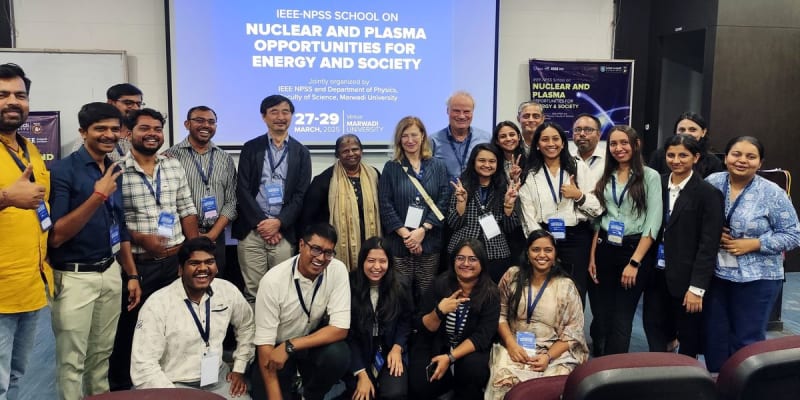
DaVià's work proves that the biggest scientific breakthroughs don't happen in isolation. She's now applying that collaborative spirit to new challenges, including improving cancer treatments and developing sustainable energy solutions. She credits IEEE for connecting her with the diverse network of experts who make her projects possible.
What makes her approach special is her insistence on celebrating teams over individuals. "The people involved in any project are really the ones to be celebrated," she says. In a field often dominated by ego and individual recognition, DaVià's focus on collective achievement stands out.
Her career path wasn't carefully planned. "Nothing was programmed," she reflects. "It was always an opportunity that came after another opportunity." That openness to collaboration and new directions took her from childhood dreams of studying stars to helping unlock the universe's fundamental building blocks.
Now she's using those same collaborative skills to address climate change and advance clean energy research. The physicist who once helped prove the standard model of the universe is working to ensure humanity has a sustainable future on this planet.
Her message resonates beyond physics labs: the most complex problems require diverse minds working together, not lone geniuses working in isolation.
More Images

Based on reporting by IEEE Spectrum
This story was written by BrightWire based on verified news reports.
Spread the positivity!
Share this good news with someone who needs it