Pittsburgh's New Robotics Center Powers Economic Boom
Carnegie Mellon University just opened a massive 150,000-square-foot Robotics Innovation Center that's already attracting million-dollar investments and creating jobs in Pittsburgh. The facility brings together university researchers, tech companies, and government support to solve real-world problems with cutting-edge robotics and AI.
Pittsburgh just became ground zero for America's robotics revolution with the opening of Carnegie Mellon University's Robotics Innovation Center, a facility that's already transforming an old industrial neighborhood into a tech powerhouse.
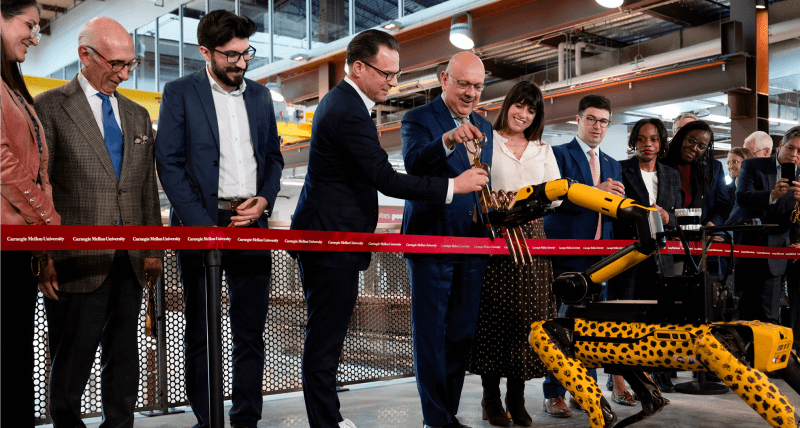
The 150,000-square-foot center officially opened in February 2026 in Hazelwood Green, a redeveloped area that's quickly becoming Pittsburgh's answer to Silicon Valley. Drones hovered overhead and four-legged robots flanked the stage as Governor Josh Shapiro announced a $1.5 million state investment in a new Physical AI Accelerator inside the building.
"We are all in on innovation, and Pittsburgh, in particular, as being a center of that," Shapiro said. "Here we are poised for explosive growth in technology and innovation."
The building houses testing grounds for robots designed for land, water, air, and even space exploration. Carnegie Mellon researchers are working on everything from a lunar rover set to launch in 2029 to soft robots that mimic octopus tentacles for delicate manufacturing tasks.
FieldAI, a billion-dollar robotics company, became the center's first corporate tenant before the doors even opened. The company is setting up a 2,500-square-foot lab on the second floor, creating jobs and bringing its "autonomy brain" software that helps robots work reliably in real-world conditions.
The Ripple Effect
This isn't just about cool technology sitting in a lab. The center focuses on solving pressing challenges in healthcare, agriculture, national security, and transportation.
Companies choosing to set up shop alongside university researchers means faster breakthroughs and more local jobs. Sebastian Scherer, who leads both CMU research and FieldAI's Pittsburgh operations, will oversee talent exchange between the company and university.
"What excites me most about the RIC is the density of talent," said Shayegan Omidshafiei, FieldAI's president and Chief Scientific Officer. "Having our researchers and engineers in the same building as CMU's world-renowned robotics leaders creates the kind of daily collaboration that leads to real breakthroughs."
The opening celebration featured over a dozen live demonstrations showing robots that could assist in factories, explore dangerous environments, and perform complex medical procedures. These aren't science fiction concepts but working prototypes that companies are already testing for commercial use.
For Pittsburgh, a city that rebuilt itself after steel industry decline, the Robotics Innovation Center represents more than economic development. It's proof that investing in education, research, and innovation can write an entirely new chapter for a community's future.
Based on reporting by Google: robotics innovation
This story was written by BrightWire based on verified news reports.
Spread the positivity!
Share this good news with someone who needs it