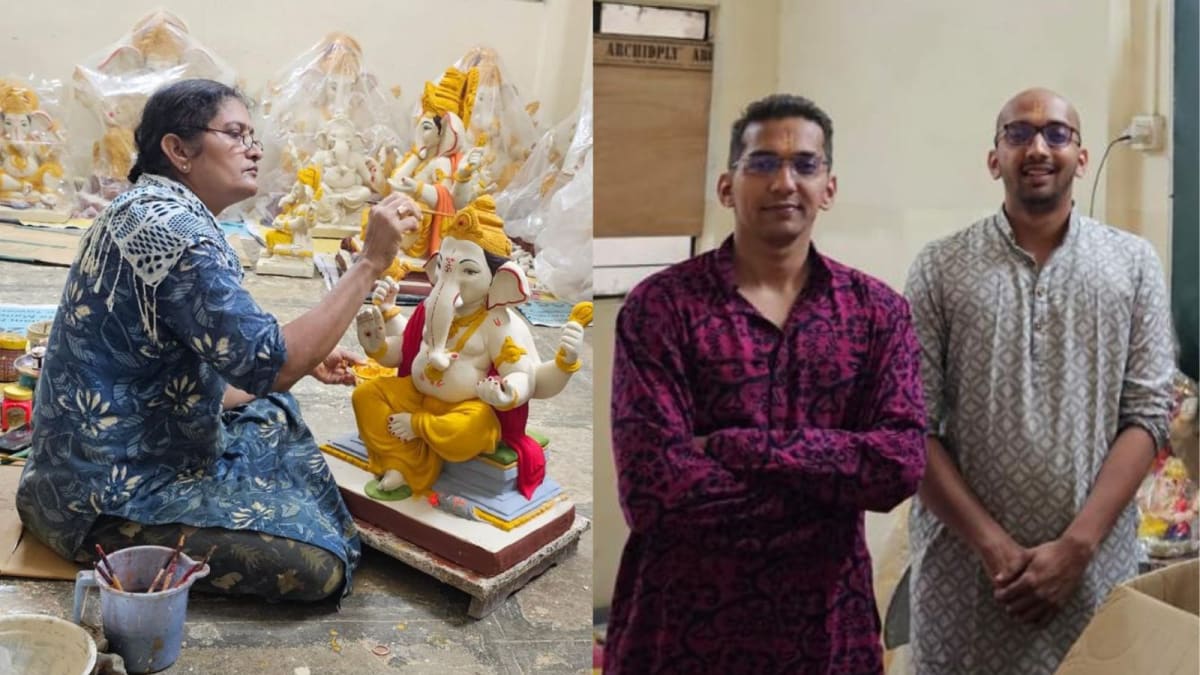
Pune Lawyers Make 200 Ganesh Idols That Dissolve in Minutes
A family of lawyers in Pune spends their evenings creating eco-friendly Ganesh idols from recycled paper that completely dissolve in water within 15 minutes. For 20 years, they've handcrafted up to 200 idols annually, turning their spiritual practice into a sustainability mission.
While most lawyers spend their evenings buried in case files, the Agarkar family gathers in a small Pune workshop to sculpt something that disappears in minutes by design.
Surekha Agarkar, 54, and her sons Ashish, 36, and Adesh, 31, are all practicing lawyers who dedicate months each year to handcrafting paper mache Ganesh idols. Since 2004, they've made every idol entirely by hand, without hiring any help.
Their eco-friendly creations dissolve completely in water within 15 minutes, a stark contrast to the Plaster of Paris idols that pollute waterways during festival immersions. The family's spiritual guru, who champions environmental causes, inspired them to find a better way.
The materials come from an unexpected source. Devotees at their religious community write God's name repeatedly on paper as a spiritual practice, creating mountains of used paper. The Agarkars realized they could recycle these sacred papers into the idols themselves.
Surekha's husband Pramod, a goldsmith, and her 78-year-old mother Vijaya Gade join the production line. The process stretches nearly a year, beginning after Diwali with soaking paper and designing molds. By early spring, they're casting, sanding, and attaching separately molded hands before painting with natural pigments.
They use only sustainable materials: Multani Mitti, red ochre, turmeric, and organic glue. No chemicals touch their creations. The idols range from seven inches to five feet tall.
The family admits their early attempts in 2004 looked rough compared to clay or Plaster of Paris versions. Many people initially rejected the eco-friendly option despite its environmental benefits. Two decades of refinement changed that.
The Ripple Effect
Today, the Agarkars produce 150 to 200 idols annually, selling almost all through word of mouth alone. They have no social media presence and no formal marketing strategy. Many idols sell through Eco-Exist, an environmental organization they've partnered with since 2014.
Profit has never been their focus. Ashish says they've deliberately avoided formalizing pricing structures because commercializing too much might dilute their real message. They worry that treating it purely as a business could overshadow the sustainability mission.
Surekha's commitment runs deep enough that she earned a law degree in 2019, long after her sons graduated. She completed it specifically to understand environmental regulations and how authorities implement them. She'd already earned degrees in commerce, arts, and other fields after getting married young.
The family views their idol-making as a form of service that happens to fund itself. What started as a small community effort among fellow believers has quietly grown into a two-decade mission that proves sustainability and tradition can coexist beautifully.
Based on reporting by Indian Express
This story was written by BrightWire based on verified news reports.
Spread the positivity!
Share this good news with someone who needs it