Radio Survey Maps 13.7 Million Cosmic Objects
Astronomers just completed the largest radio survey of the universe ever, revealing 13.7 million previously hidden cosmic wonders including black hole jets, colliding galaxies, and exploding stars. The breakthrough could transform our understanding of how supermassive black holes shape entire galaxies.
Scientists using the world's most powerful low-frequency radio telescope have just unveiled a cosmic treasure map revealing nearly 14 million objects and events we've never seen this clearly before.
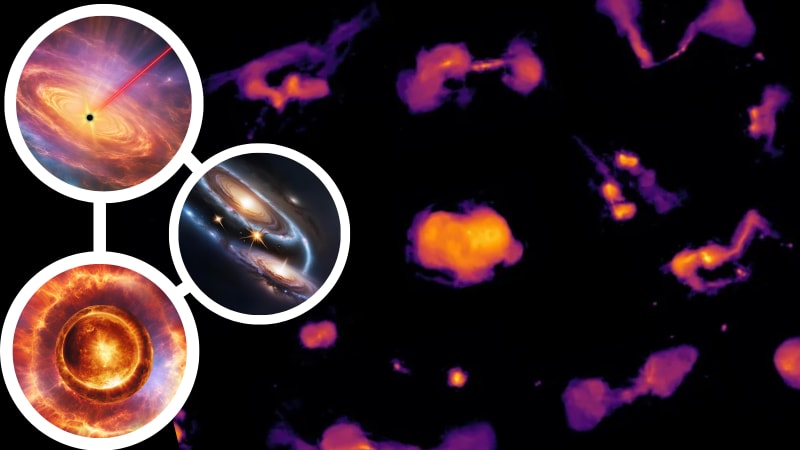
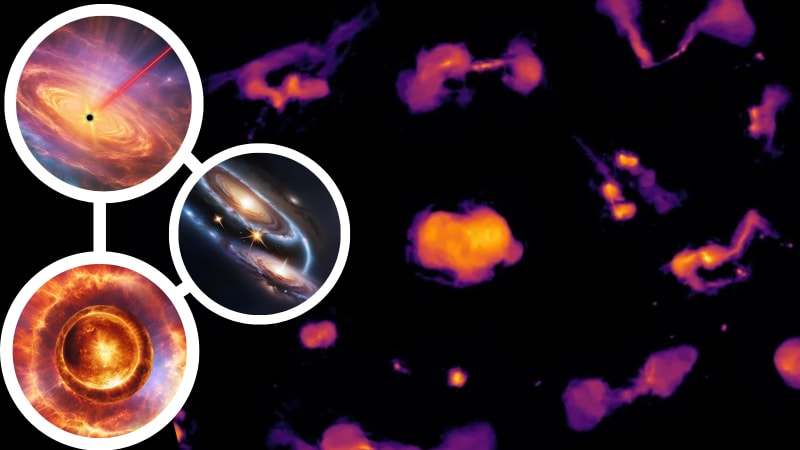
The Low-Frequency Array (LOFAR) captured stunning images of black hole jets shooting across space, galaxies crashing together, and supernova explosions marking the births of neutron stars. This survey shows us a completely different universe than what our eyes can see, opening a window into invisible radio waves that tell extraordinary stories about space.
"We can study a diverse population of supermassive black holes and their radio jets at different stages of their evolution," said Martin Hardcastle of the University of Hertfordshire. The survey reveals how these cosmic giants don't just depend on the black hole itself, but on the entire galaxy and environment surrounding it.
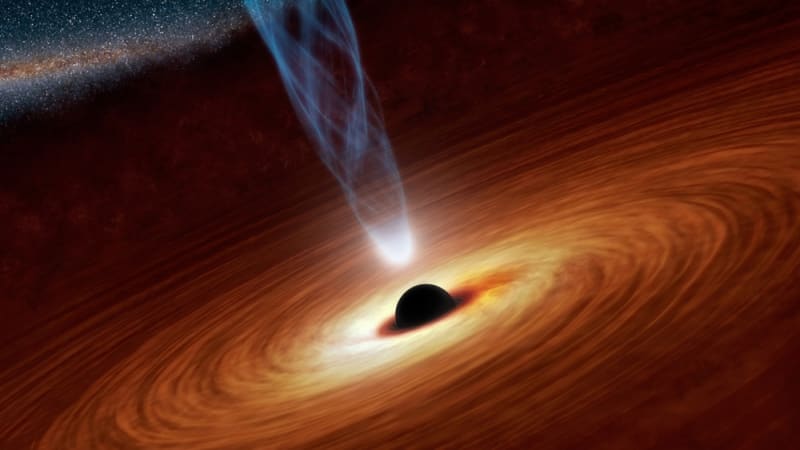
The breakthrough comes from switching our view from visible light to radio waves. Supermassive black holes millions of times heavier than our sun sit at the center of large galaxies, and when they feed on surrounding matter, they create spectacular twin jets of particles that blast out at nearly the speed of light.
These jets can stretch far beyond their home galaxies, and LOFAR's survey helps scientists understand how this energy injection influences galaxy evolution. The data also captured some of the largest and oldest radio-bright galaxies ever recorded.
But black holes aren't the only stars of this cosmic show. The survey traced radio waves from merging galaxies and other powerful events that accelerate particles to near light speed, helping scientists measure star birth rates across millions of galaxies.
Why This Inspires
This discovery reminds us that there's still so much wonder left to uncover in our universe. By simply changing how we look at the sky, scientists revealed millions of cosmic phenomena we didn't know existed.
Closer to home, the data revealed hidden magnetic fields in our own Milky Way galaxy and even detected possible interactions between distant planets and their stars. Scientists can now study galaxy clusters to understand how shocks and turbulence strengthen magnetic fields across millions of light-years, something happening far more often than previously thought.
The team plans to build on this milestone with LOFAR 2.0, which will survey twice as fast and deliver even sharper images. "LoTSS-DR3 is not an endpoint, but a major milestone," said scientist Wendy Williams about the survey that anyone can explore online right now.
Every time we develop a new way to look at the universe, we discover it's far more spectacular than we imagined.
More Images


Based on reporting by Space.com
This story was written by BrightWire based on verified news reports.
Spread the positivity!
Share this good news with someone who needs it
%2Fhttps%3A%2F%2Ftf-cmsv2-smithsonianmag-media.s3.amazonaws.com%2Ffiler_public%2F3f%2F55%2F3f5579c8-c4a7-43a5-bb54-6498478792fd%2Fhelix1940__fitmaxwzk3mcw2ntbd.jpg)