Rajasthan Villagers Exposed Corruption, Won India's RTI Law
Semi-literate villagers in rural Rajasthan held public hearings to expose ghost projects and wage theft, sparking a grassroots movement that gave India its landmark Right to Information Act. Their simple question changed democracy: if public money belongs to the people, why can't people see how it's spent?
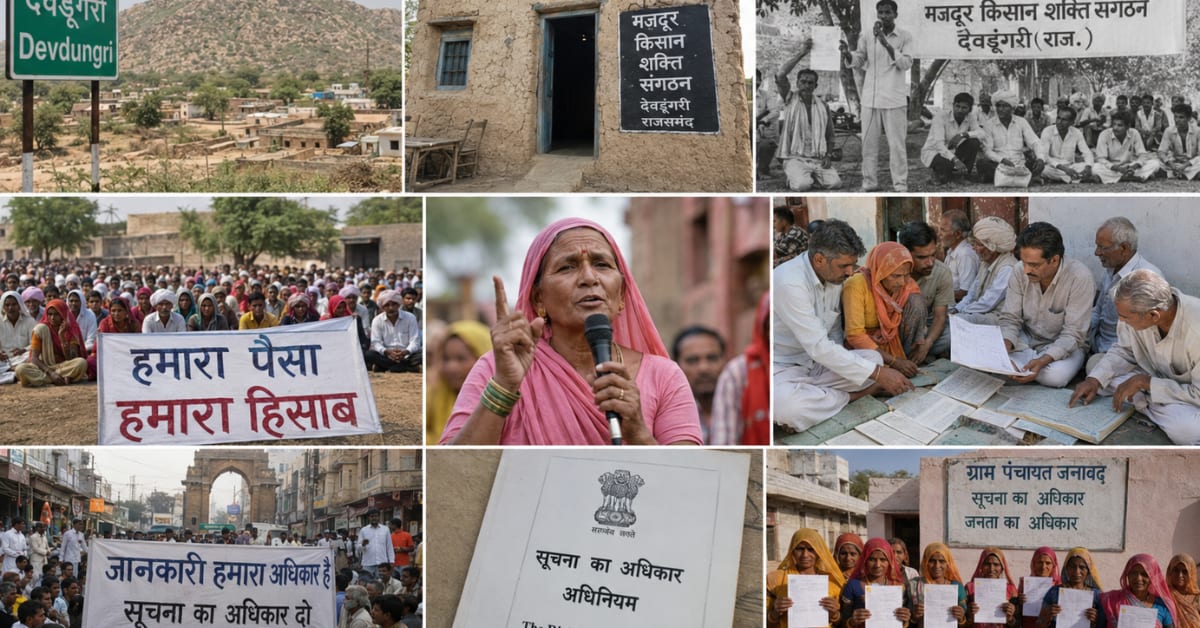
In 1987, three activists moved into a mud-and-stone house in Devdungri, a small village in Rajasthan's Aravalli hills. They had no idea their conversations with local workers would reshape Indian democracy.
Aruna Roy, a former civil servant who quit to work with the rural poor, teamed up with local activist Shankar Singh and Nikhil Dey, who had returned from the United States with a mission. They lived simply alongside villagers, listening to their frustrations about government relief work.
Rural workers had no way to verify whether projects were real or whether their wages had actually been paid. Official records stayed locked away. When villagers complained about missing payments, the activists realized something fundamental: access to information wasn't just useful. It was essential to basic rights.
In 1990, they formally launched the Mazdoor Kisan Shakti Sangathan (MKSS) during a rally of 1,000 people from 27 villages. Their most powerful tool was beautifully simple: the jan sunwai, or public hearing.
Here's how it worked. Government officials brought their account books to a public space. The records were read aloud, and villagers could speak up, comparing what the paperwork claimed against what had actually happened on the ground.
The first jan sunwai happened in December 1994 in Kot Kirana village. More followed across Rajasthan. What emerged was remarkable: semi-literate villagers, including many women, proved entirely capable of scrutinizing complex government records when given the chance.
Shankar Singh, who had given up a teaching job to join the movement, spread the message through art, puppetry, theater, and music. His Ghotala Rath Yatra, a satirical street performance built around a decorated handcart, traveled from village to city, making governance conversations accessible through song and irony.
The hearings revealed ghost projects, inflated costs, and wages that existed only on paper. More importantly, they demonstrated something officials had long doubted: ordinary citizens could hold power accountable if given transparency.
On April 5, 1995, Rajasthan's Chief Minister pledged in the state Assembly to grant public access to development records. It was the first official acknowledgment that transparency wasn't a privilege but a right.
The Ripple Effect
What started in one village didn't stop at Rajasthan's borders. The movement grew into a nationwide campaign for transparency. Activists, journalists, and citizens from across India joined the call for a law guaranteeing access to government information.
After years of advocacy, Parliament passed the Right to Information Act in 2005. Today, any Indian citizen can file an RTI request to access government records, holding officials accountable from the local to national level.
The law has exposed corruption worth billions, helped recover wrongfully denied benefits, and given millions of Indians a tool to question power. Villages across India now hold jan sunwais, using the model pioneered in Devdungri.
Lal Singh, a dismissed police constable who joined the activists in those early days, now leads the School for Democracy in Rajasthan. The mud-and-stone house where it all began still stands, a quiet reminder that profound change often starts with the simplest questions asked by ordinary people demanding answers.
More Images
.png)
%2Fenglish-betterindia%2Fmedia%2Fmedia_files%2F2026%2F05%2F20%2F1-2026-05-20-19-26-47.png)


Based on reporting by The Better India
This story was written by BrightWire based on verified news reports.
Spread the positivity!
Share this good news with someone who needs it