Rice Engineers Make Surfaces Repel Near-Boiling Water
Scientists created a cheap coating that keeps water bouncing off surfaces even at temperatures hot enough to brew coffee. The breakthrough could transform how we process food, purify water, and sterilize medical equipment.
Imagine pouring scalding hot coffee onto a table and watching it bead up and roll away without leaving a trace. Rice University engineers just made that possible with a surprisingly simple fix to a problem that's plagued scientists for years.
Superhydrophobic surfaces, the "never wet" coatings that make water dance off like tiny mercury balls, have always had an Achilles heel. Once temperatures climb above 104 degrees Fahrenheit, the magic fails and hot water starts sticking instead of sliding.
The culprit? Heat transfer creates condensation inside the surface's tiny texture, forming liquid bridges that trap droplets in place. For industries dealing with hot liquids daily, from food processing plants to medical sterilization facilities, this failure point has been a major headache.
Daniel Preston and his team at Rice University tackled the problem by adding a thin insulating layer beneath an ordinary superhydrophobic spray coating. This multilayered insulated superhydrophobic coating, or MISH, blocks heat flow and prevents the condensation that normally kills water repellency.
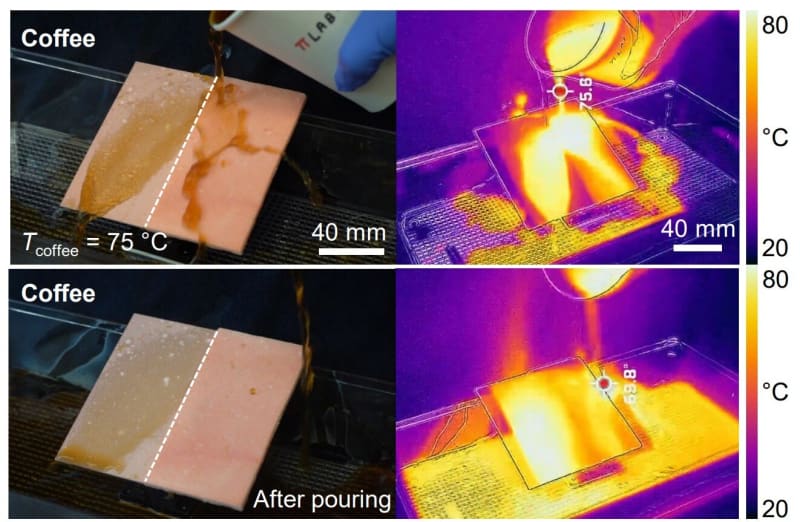
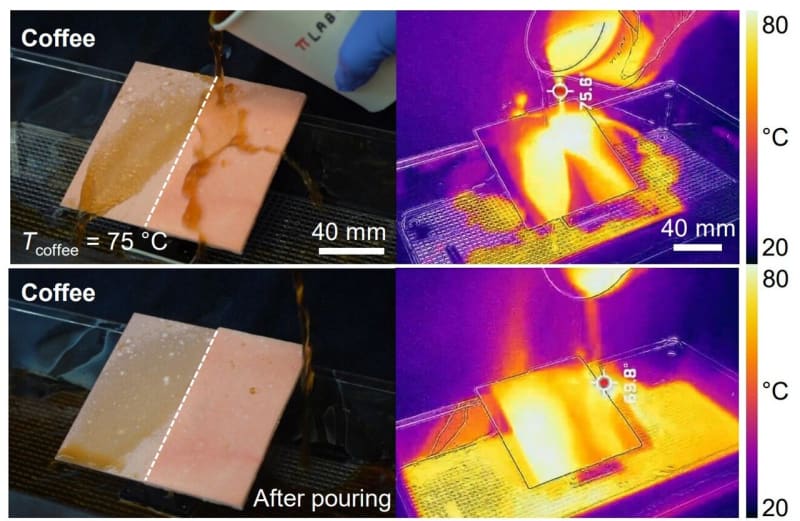
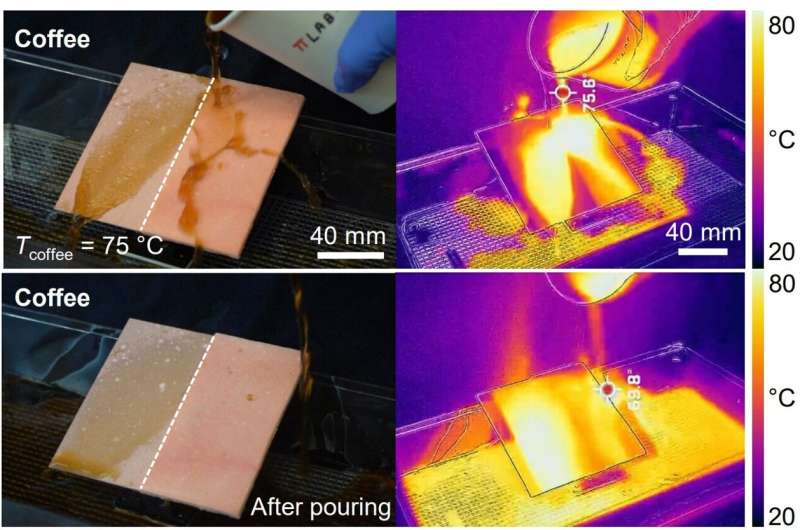
The results were dramatic. While conventional coatings failed around 104 degrees, MISH surfaces kept repelling water up to 194 degrees Fahrenheit, nearly hot enough to boil. The team tested their coating by pouring hot coffee, shooting water jets, and even filling soup bowls to prove it works on curved surfaces and real world scenarios.
What makes this breakthrough especially exciting is the cost. Previous attempts to solve this problem required materials 4,000 times more expensive than this approach. The Rice team used affordable spray on polyurethane foam and commercial superhydrophobic coatings, materials anyone can buy.
The researchers published their findings in ACS Applied Materials & Interfaces, showing that performance can be fine tuned simply by adjusting insulation thickness. No expensive clean room fabrication. No specialized chemistry. Just a smart layering strategy that addresses the root cause of failure.
The Ripple Effect
This innovation could ripple through multiple industries struggling with hot liquid management. Desalination plants could reduce energy costs. Chemical manufacturers could prevent contamination. Food processing facilities could maintain cleaner equipment with less water waste.
Zhen Liu, who led the research, points out that the coating works outside laboratory conditions on large and curved surfaces, from industrial pipes to cookware. The team demonstrated it by coating a bowl and pouring hot soup into it, watching the liquid bead up and slide around without sticking.
The beauty of the solution lies in its accessibility. By understanding exactly how heat transfer causes coating failure, the engineers created a predictable, scalable fix that doesn't require reinventing the wheel each time.
Hot liquids that once spelled failure for water repellent surfaces may finally have met their match, and it came wrapped in an unexpectedly affordable package.
More Images
Based on reporting by Phys.org - Technology
This story was written by BrightWire based on verified news reports.
Spread the positivity!
Share this good news with someone who needs it