Rice University Prints Circuits on Living Plants and Bone
Engineers just solved a decade-old problem that lets 3D printers add electronics to living tissue without burning it. The breakthrough could mean smart implants that warn doctors before they fail.
📺 Watch the full story above
Imagine printing a working sensor directly onto a living leaf, or adding a wireless circuit to a knee implant while it's already inside someone's body.
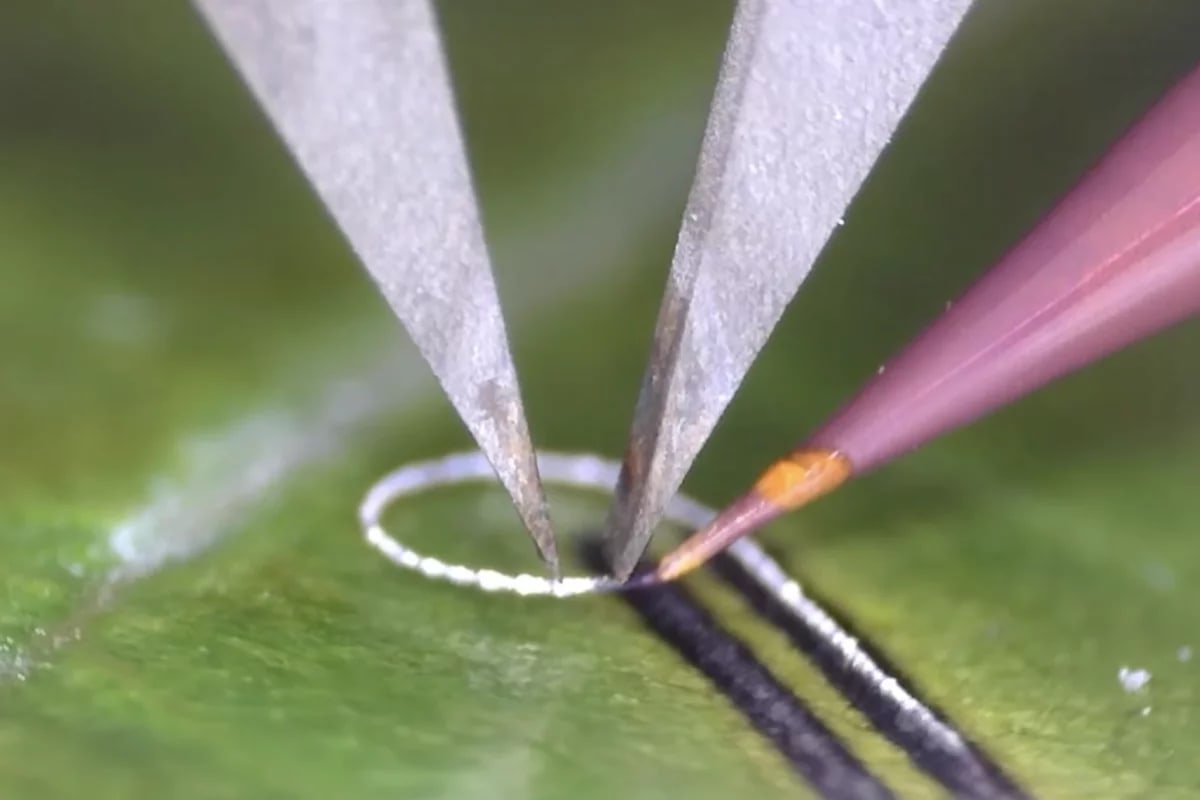
Engineers at Rice University just made that possible by inventing a device that heats only what it needs to heat. Their Meta-NFS tool focuses microwave energy into a spot smaller than the width of a human hair, fusing conductive ink into working circuits without cooking the delicate surface underneath.
For over a decade, printed electronics hit the same wall. Traditional methods used furnaces or lasers that heated everything in their path, which works fine for metal parts but destroys living tissue, bone, or plastic medical implants. Lasers offered precision but only worked on materials that absorbed their specific light wavelength, ruling out most medical uses.
The Rice team flipped the approach. Instead of heating from outside, their device heats from within the printed material itself. By using a specially designed microwave concentrator paired with graphene ink, they transfer nearly 80% of the energy into the target area compared to just 8.5% with older methods.
To prove it works, they printed conductive patterns onto a living plant leaf, paper, silicone, and most impressively, directly onto a cow's thigh bone. On the bone, they created a wireless strain sensor that could detect tiny deformations and send data without wires.
The real magic happens in how the tool adjusts microwave power on the fly. The team can change the electrical properties of the printed material by more than a thousand times during a single print run, all without swapping materials or stopping the printer.
Why This Inspires
Smart medical implants could finally become practical. The Rice team already printed wireless sensors onto the same tough plastic used in artificial hips and knees. These sensors could monitor wear and stress in real time, warning doctors before an implant fails instead of after someone feels pain.
A protected circuit they built kept working for over five minutes underwater, while an unprotected version dissolved in 2.5 seconds. That durability matters for devices that need to survive inside a human body for years.
The applications go beyond fixing joints. Lead researcher Yong Lin Kong and his team are developing ingestible electronics for personalized health monitoring, bionic devices that connect directly to organs, and soft robots with electronics woven throughout their structure.
This isn't just a better printer. It's a new way to merge electronics with biology, opening doors that couldn't even be imagined before.
More Images



Based on reporting by New Atlas
This story was written by BrightWire based on verified news reports.
Spread the positivity!
Share this good news with someone who needs it