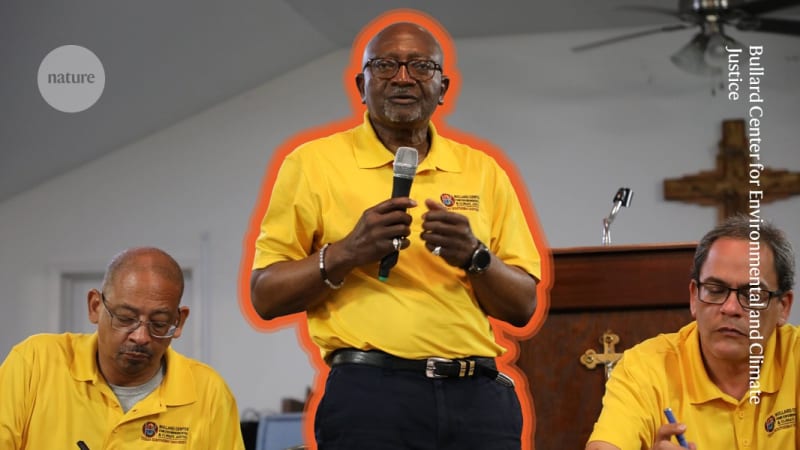
Robert Bullard's 40-Year Fight Wins Justice for Black Towns
A sociologist's research in the 1970s proved Houston placed toxic landfills in Black neighborhoods, sparking a global movement for environmental justice. His work has changed laws, protected communities, and turned 18 books worth of data into real action.
When Robert Bullard mapped Houston's landfills in the late 1970s, he discovered what Black communities already knew: toxic waste sites were deliberately placed in their neighborhoods. His research didn't just document the problem; it armed communities with proof powerful enough to change laws and move mountains of garbage away from Black schools.
Bullard became the father of environmental justice, a field that didn't even have a name 40 years ago. His approach was revolutionary because he treated science as a tool for action, not just academic papers.
His 1990 book "Dumping in Dixie" told the story of five Black communities in the South who fought back against deadly pollution threatening their families. The book became required reading in universities nationwide and gave communities a blueprint for protecting themselves.
But Bullard's biggest innovation wasn't writing books. It was partnering directly with communities who knew they were being poisoned but didn't know how to prove it in ways government officials would respect.
He realized early that the burden of proof fell on residents, not on the industries dumping waste in their backyards. So he worked with Historically Black Colleges and Universities, which were already located in the hardest-hit communities, to build research centers that could package local knowledge into lawsuits and policy changes.
Five HBCU-based centers now provide the research foundation for the entire environmental justice movement. In 2013, Bullard launched the first HBCU Climate Change Conference, which meets annually in New Orleans to keep pushing the work forward.
Growing up in segregated Alabama in the 1950s and 60s, Bullard couldn't even enter his local library as a child. His grandmother read him stories about Black leaders like W.E.B. Du Bois and George Washington Carver who overcame impossible odds.
Du Bois became his North Star, showing him you could do rigorous research while speaking truth to power. After serving in the Marine Corps, Bullard earned his master's degree from the sociology department Du Bois founded at Atlanta University.
The Ripple Effect
Bullard's work proves that community knowledge combined with academic research creates unstoppable change. His methods have spread far beyond Houston, giving environmental justice advocates worldwide a model for turning neighborhood observations into courtroom victories.
Now as founding director of the Bullard Center for Environmental and Climate Justice at Texas Southern University, he continues training the next generation to marry data with action. His 18 books all tell the same essential story: fairness, justice, and equity aren't abstract concepts but measurable realities communities can fight for and win.
Four decades later, environmental justice is no longer an emerging field but a powerful force reshaping how America thinks about pollution, housing, health care, and civil rights. Communities that were once invisible in policy discussions now have seats at the table, armed with research methods Bullard pioneered.
More Images




Based on reporting by Nature News
This story was written by BrightWire based on verified news reports.
Spread the positivity!
Share this good news with someone who needs it
%2Ffile%2Fdailymaverick%2Fwp-content%2Fuploads%2F2022%2F06%2FOpinion-Simelane-SolarTW.jpg)