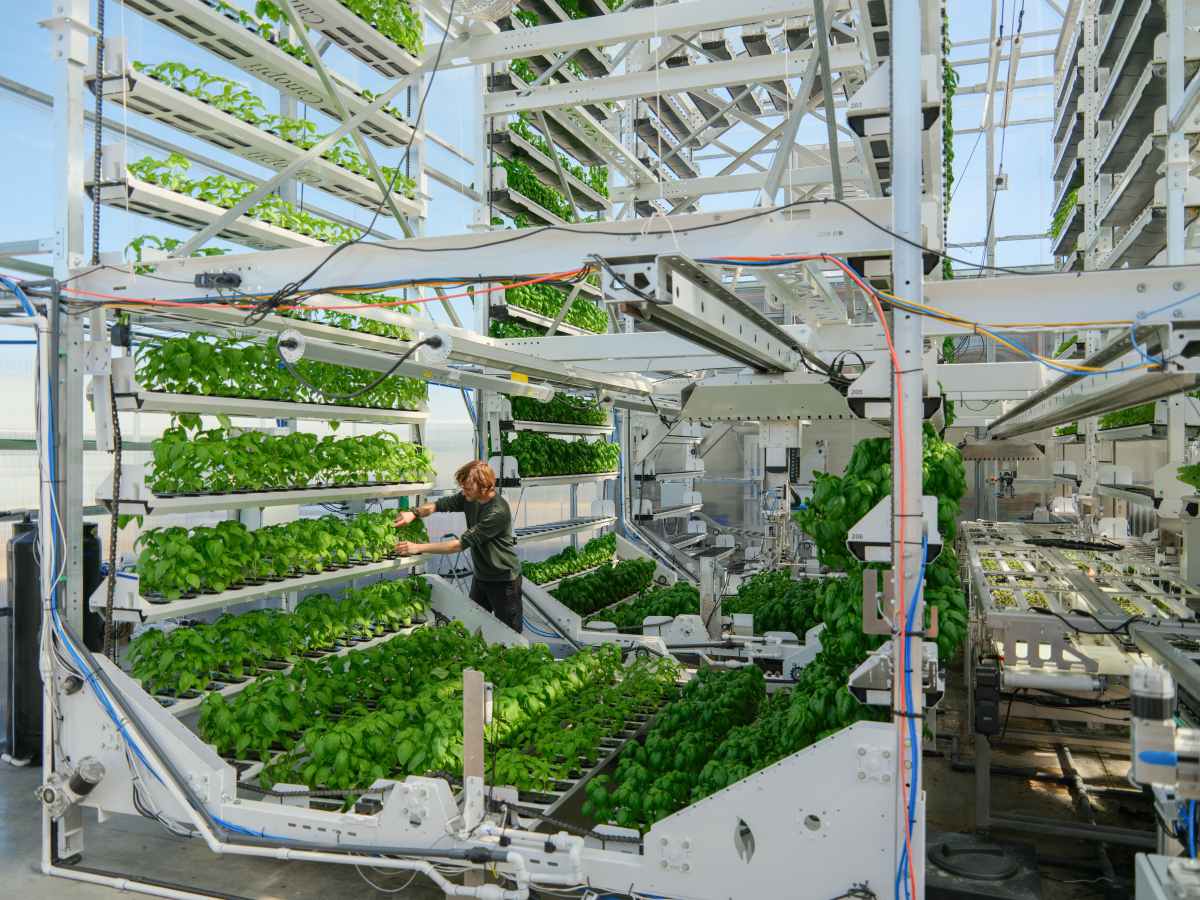
Robot Greenhouse Grows 40K Pounds on Basketball Court
A Portland startup built a fully robotic greenhouse that grows 40,000 pounds of fresh produce per year using just one water spigot and the space of a basketball court. Unlike failed indoor farms that burned through hundreds of millions, Canopii took five years and $3.6 million to perfect its system.
Watching lettuce farms thrive in California's worst drought while precious water got shipped across the country planted an idea in David Ashton's mind. What if fresh produce could be grown right where people need it, using almost no resources?
Five years later, his company Canopii has cracked the code. The Portland startup just hit a major milestone with a fully autonomous greenhouse that handles everything from planting seeds to harvesting crops without any human help.
These robotic farms are remarkably efficient. Each greenhouse produces up to 40,000 pounds of herbs and specialty greens like baby bok choy and gai lan annually while requiring only one water spigot. The entire operation runs on standard household power and fits in the same footprint as a basketball court.
Ashton's journey to this breakthrough had an unexpected start. The agtech company he planned to join went bankrupt as he drove up the coast to Portland for the move. Instead of giving up, he worked on Canopii's plans at night while his wife attended medical school.
His patience paid off. After winning a $250,000 grant from the National Science Foundation to build a prototype, he secured another $1 million to create a full scale version. The company has raised just $3.6 million total, with $2.3 million from grants and the rest from strategic partners.
That modest budget stands in stark contrast to the indoor farming industry's recent history. Companies like Bowery Farming and Plenty raised hundreds of millions before collapsing. Ashton believes moving slowly without heavy venture capital pressure made all the difference.
"We're five years in and still iterating on one farm, which has allowed us to learn so much," Ashton told TechCrunch. "I think if we got VC right away and tried to scale after year one or two, that's not possible with food infrastructure."
The Ripple Effect
Schools, restaurants, and casinos are already reaching out with interest. Canopii plans to build its first commercial farm in downtown Portland, then franchise the design so these greenhouses can pop up in communities nationwide.
The farms are manufactured like cars, making them scalable and affordable. Because they run on household power, they could theoretically fit in someone's backyard while producing thousands of pounds of fresh, local food.
By keeping produce production local, Canopii could help communities reduce their dependence on long supply chains vulnerable to drought, climate change, and transportation disruptions.
Fresh greens grown right where people eat them, using a fraction of the water and none of the shipping miles.
More Images

Based on reporting by TechCrunch
This story was written by BrightWire based on verified news reports.
Spread the positivity!
Share this good news with someone who needs it