Robot Hand Walks on Six Fingers to Reach Danger Zones
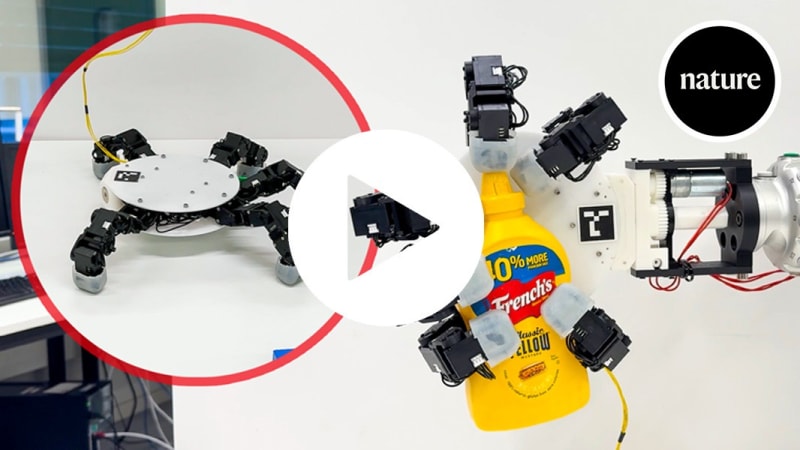
Scientists created a six-fingered robot hand that detaches from its arm and crawls on its own. The design could help rescue workers and engineers reach dangerous places humans can't.
Imagine a robot hand that doesn't need an arm to do its job.
Scientists have built a six-fingered mechanical hand that can detach from its robotic arm and walk away on its own. The innovative design solves problems that have limited traditional robots for years.
Unlike human hands, this robot claw is completely symmetrical. That means it can approach tasks from any angle without awkwardly twisting or repositioning itself.
The six fingers give it another superpower: handling multiple objects at once. While our five-fingered hands excel at many tasks, this design can juggle several items simultaneously without breaking a sweat.
But the real breakthrough is its ability to leave the arm behind. When a situation gets too dangerous or a space becomes too cramped for a full robot, the hand simply detaches and crawls into places its larger body can't reach.
The research team published their findings in a recent Nature paper. They demonstrated how the crawling hand maintains full dexterity even when separated from its base.
The Ripple Effect
This technology opens doors for search and rescue operations where every second counts. Disaster sites often contain spaces too hazardous or confined for human responders, and even traditional robots struggle with tight corners and unstable rubble.
The detachable hand could inspect dangerous chemical spills, navigate collapsed buildings, or reach into machinery that's too risky for human workers. Manufacturing facilities dealing with toxic materials or extreme temperatures could deploy these hands while keeping operators at a safe distance.
Medical applications are also on the horizon. Surgeons might one day use similar technology for minimally invasive procedures, sending a dexterous hand through small incisions to perform delicate work.
The symmetrical design means less time programming complex movements. Engineers can simplify their approach because the hand works equally well from any direction.
This innovation joins a growing wave of nature-inspired robotics that reimagine what artificial helpers can do. By questioning assumptions about robot design, researchers are creating tools that complement human limitations rather than simply copying our biology.
The team continues refining the technology for real-world applications where human hands simply can't go.
More Images

Based on reporting by Nature News
This story was written by BrightWire based on verified news reports.
Spread the positivity!
Share this good news with someone who needs it