Robot System Speeds Up Climate-Ready Crop Development 100x
Scientists at Oak Ridge National Laboratory built a robot that automates plant genetic engineering, making it 100 times faster to develop crops that can handle droughts, feed more people, and produce cleaner fuels. The breakthrough could transform how quickly we adapt agriculture to climate challenges.
A new robot system is slashing the time it takes to create hardier, more productive crops from months to days.
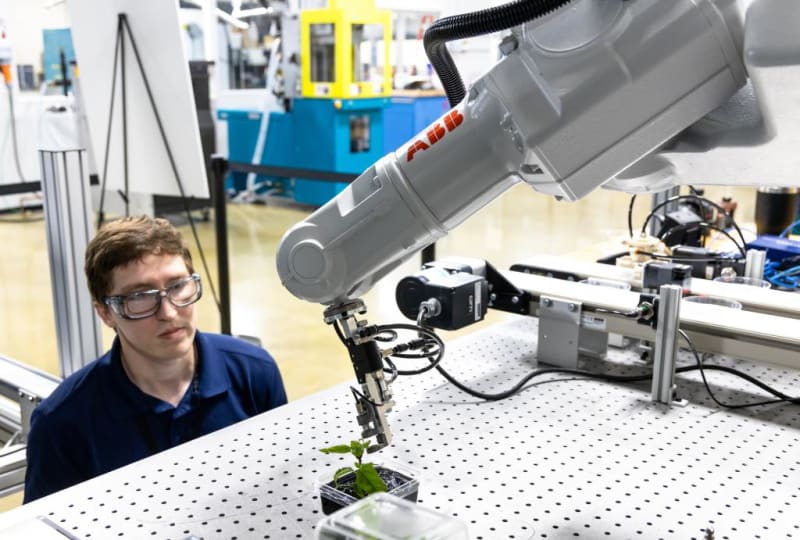
Scientists at Oak Ridge National Laboratory combined robotics with artificial intelligence to automate one of plant science's most tedious tasks: collecting tiny tissue samples from living plants and treating them to grow into new, genetically improved varieties. The SMART Plant 1.0 system uses computer vision to identify the perfect tissue samples, cuts them with precision tools, and places them in nutrient mixtures to develop into new plants.
The traditional process requires technicians to manually punch out plant tissue with scissors, move samples between growing media over weeks, and record everything by hand. It's slow, inconsistent, and limits how many plant varieties scientists can test. The new robot does all of this automatically, with perfect consistency every time.
Project lead Udaya Kalluri says the real game changer isn't just speed. The system generates massive amounts of high-quality data that trains AI models to predict which genetic changes will produce desired traits. That means scientists can validate their theories faster and optimize success rates across thousands of experiments simultaneously.
Engineer Alex Walters, who led the robotics work, calls it the first automation workflow of its kind for plant science. The system eliminates human inconsistencies in tissue selection and handling, making results more reliable and reproducible. It opens the door to on-demand, autonomous plant engineering that runs around the clock.
The Ripple Effect
The technology arrives at a critical moment for global food security and climate adaptation. Farmers worldwide need crops that tolerate drought, resist disease, and thrive in changing conditions. The bioeconomy also needs plants optimized for producing sustainable fuels, materials, and chemicals as alternatives to petroleum products.
The Oak Ridge team is already building SMART Plant 2.0, which will produce transgenic plants at industrial scale while collecting molecular data to enable "agentic AI" that automatically adjusts experiments based on what it learns. The next-generation system will integrate with Oak Ridge's Advanced Plant Phenotyping Laboratory, where robots photograph growing plants with advanced imaging to track development.
These facilities join a nationwide network of plant biotechnology capabilities at Department of Energy laboratories, all aimed at accelerating discoveries for crops suited to biofuels, critical minerals recovery, and food security. The technology is now available for licensing to agricultural companies and research institutions.
What once took a skilled technician weeks of careful handwork now happens autonomously, generating breakthrough insights while researchers focus on the next challenge.
Based on reporting by Google: scientific discovery
This story was written by BrightWire based on verified news reports.
Spread the positivity!
Share this good news with someone who needs it