Robot Unfurls Deep-Sea Banner to Protect Arctic Life
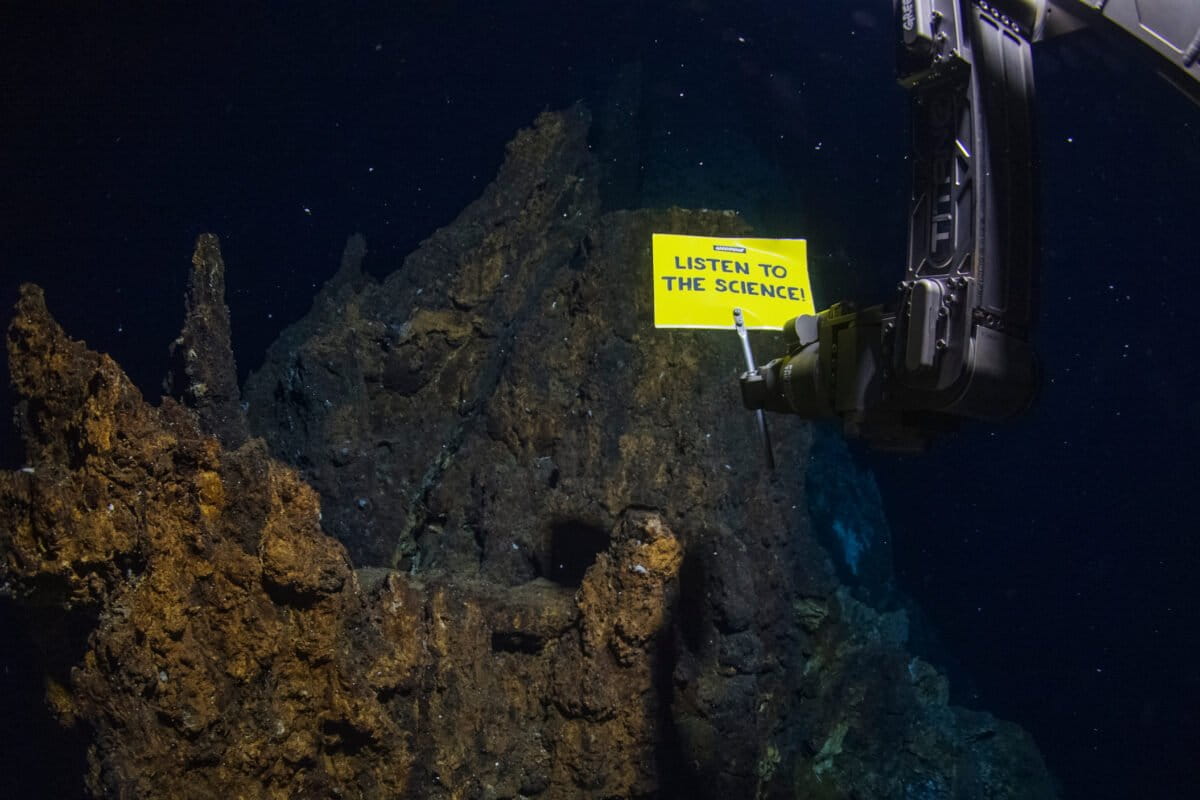
A remotely operated vehicle deployed a protest sign 7,500 feet below the ocean surface to defend newly discovered species near hydrothermal vents. The world's deepest banner protest celebrates new protections that just halted deep-sea mining in fragile Arctic waters.
More than 7,500 feet below the surface of the Norwegian Sea, a small robot just made history by standing up for creatures that can't speak for themselves.
On May 27, a Greenpeace remotely operated vehicle unfurled a banner reading "LISTEN TO THE SCIENCE!" in front of Loki's Castle, a hydrothermal vent field where superheated water pours from mineral chimneys on the seafloor. The vents support an unusual community of life, including microbes that resemble the distant ancestors of all complex life on Earth.
Scientists discovered Loki's Castle in 2008, tucked between Greenland and Norway in the Arctic Ocean. A 2024 study documented the animals living around these vents and identified five species completely new to science. The researchers recommended treating the area as a vulnerable ecosystem deserving protection.
Their timing couldn't have been better. In January 2024, Norway's government opened nearly 108,000 square miles of Arctic waters to mineral exploration, an area almost the size of Italy. The European Parliament condemned the decision, warning it could harm fisheries, biodiversity and even release methane trapped in Arctic sediments.
But scientists and activists didn't give up. In December 2025, Norway's parliament voted to halt all deep-sea mining until at least the end of 2029 and cut public funding for seabed mineral mapping. More than 40 countries now support a global pause on deep-sea mining.
The victory arrived alongside another major milestone. On January 17, 2026, the United Nations High Seas Treaty entered into force, creating the first legally binding framework to protect marine life in international waters.
The Ripple Effect
The high seas make up more than 60% of the ocean and nearly half of Earth's surface. These vast areas hold deep trenches, underwater mountain ranges and ecosystems that help the ocean cycle nutrients and store carbon. Yet less than 1.5% of this critical space has formal protection, even as fishing, shipping and mining push further into remote waters.
The new treaty gives governments the tools to create ocean sanctuaries in areas that belong to no single nation. Combined with Norway's mining pause, it represents a growing recognition that we need to understand deep-sea ecosystems before we disturb them.
The creatures living near Loki's Castle have survived in total darkness under crushing pressure for millions of years. Now they have a fighting chance to be studied, understood and protected before mining equipment ever reaches them.
Science is finally getting the microphone.
More Images

Based on reporting by Mongabay
This story was written by BrightWire based on verified news reports.
Spread the positivity!
Share this good news with someone who needs it