Robot Workers Surge 11% Across Global Factories
Factories worldwide are adding robots at record pace, with global automation density doubling in just ten years. The shift is helping companies build more while addressing persistent worker shortages.
📺 Watch the full story above
Factories across three continents are welcoming millions of new robot coworkers, and the trend is solving real problems for manufacturers struggling to find skilled workers.
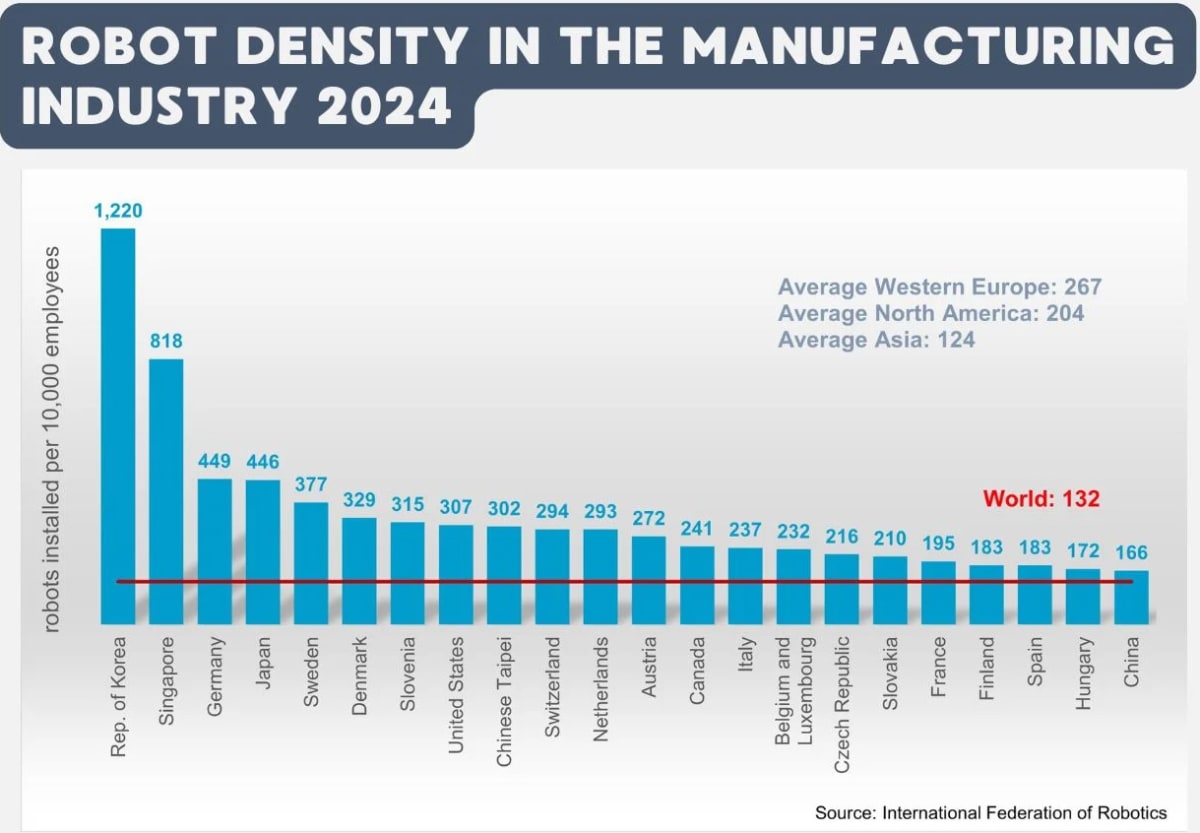
The International Federation of Robotics just released its "World Robotics 2025" report, revealing that robot density has doubled globally since 2014. Western Europe now leads with 267 robots per 10,000 workers, followed by North America at 204 units and Asia at 131 units.
The numbers tell a story of progress meeting necessity. In North America alone, robot density grew 4% in 2024, driven by more than $7 trillion in manufacturing investments and an ongoing shortage of skilled labor.
"Manufacturers still need to build, so they must automate," said Robert Little, chief of robotics strategy at Novanta Inc. He expects the trend to continue for many years as companies balance ambitious production goals with workforce realities.
South Korea claims the crown for highest robot density worldwide, with an impressive 1,220 robots per 10,000 employees. Singapore follows at 818 units, while Germany ranks third with 449 units.
China's robot story got even more interesting this year. Updated data from the country's National Bureau of Statistics revealed China now has about 2 million operational robots, the largest fleet in the world. The country installed 295,000 new units in 2024 alone, representing 54% of all robots deployed globally.
The U.S. ranked eighth worldwide with 307 units per 10,000 employees, largely thanks to automotive manufacturers embracing automation. Canada followed with 241 units, while Mexico reported 62 units per 10,000 workers.
The Ripple Effect
This automation wave isn't just changing factory floors. It's creating new opportunities for workers to move into higher skilled positions while robots handle repetitive tasks. Countries investing in automation are simultaneously building training programs to prepare their workforces for tomorrow's manufacturing jobs.
The European Union as a whole reached 231 units per 10,000 employees, well above the global average of 132 units. Nine Western European nations landed in the global top 20, showing the region's commitment to staying competitive through smart automation.
Industry experts see the revised data from China as a wake-up call for other nations. Despite lower than expected robot density, China's 17% year-over-year growth rate suggests it will climb the rankings quickly.
Jeff Burnstein, president of the Association for Advancing Automation, believes the U.S. needs a national robotics strategy to keep pace with countries adopting automation faster. The conversation is shifting from whether to automate to how quickly nations can adapt.
These millions of new robot workers represent something bigger than efficiency gains. They're helping factories meet growing demand, keeping manufacturing competitive, and creating pathways for human workers to focus on the creative and strategic work that machines can't replicate.
More Images


Based on reporting by The Robot Report
This story was written by BrightWire based on verified news reports.
Spread the positivity!
Share this good news with someone who needs it