%2Fhttps%3A%2F%2Ftf-cmsv2-smithsonianmag-media.s3.amazonaws.com%2Ffiler_public%2F9c%2F58%2F9c5871cb-4f61-4268-80b2-4f390e7338b1%2Fparco-archeologico-del-colosseo_casa-dei-grifi_dettaglio-dellambiente-affrescato-con-pavimento.jpg)
Rome's 2,000-Year-Old House of Griffins Opens Via Livestream
For the first time ever, visitors can explore one of Rome's oldest and most ornate homes—a 2,000-year-old underground residence preserved by accident. The livestream tour protects both tourists and priceless ancient art while solving the city's overtourism problem.
Rome just found a brilliant way to share its hidden treasures without loving them to death.
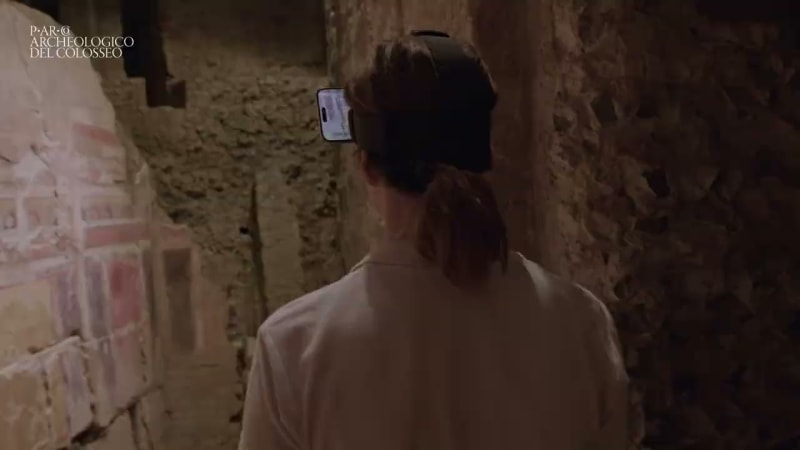
The House of Griffins, a stunning underground home on Palatine Hill dating back to the 2nd century BCE, is now open to visitors for the first time. But there's a twist: tourists watch from above ground while a guide with a head-mounted camera explores the fragile space below, livestreaming everything in real time.
The experience takes groups of up to 12 people into chambers that have remained hidden for millennia. Colorful frescoes cover the walls from floor to ceiling, while intricate mosaic floors feature green limestone and black stone arranged in three-dimensional cube patterns. Two white stucco griffins (the half-eagle, half-lion creatures that gave the house its name) still guard an arched entryway.
These delicate details survived by pure chance. When Emperor Domitian built his palace above the house during Rome's Augustan era, workers demolished the upper floors but filled the lower levels with soil to stabilize the ground. That dirt became a time capsule, preserving the artwork for two thousand years.
Discovery came in the early 20th century when archaeologist Giacomo Boni excavated the site. Researchers found an atrium and pool at ground level, plus eight rooms accessible only by descending a steep, perilous staircase. The home's location at the highest point of Palatine Hill and its Pompeii-inspired art suggest its original owners were extremely wealthy members of Rome's elite society.
The Ripple Effect
This virtual tour represents more than just clever technology. It's part of a larger plan funded by the European Union's $227 billion National Recovery and Resilience Plan to ease Rome's overtourism crisis by drawing visitors beyond the usual crowded spots.
The approach protects both people and priceless artifacts. Limiting foot traffic prevents damage to centuries-old artwork while keeping tourists safe from treacherous ancient staircases. It's preservation and accessibility working together instead of fighting each other.
"Rome is like a big lasagna," says Adriano Morabito of Roma Sotterranea, a company offering underground tours. "There are many Romes, one on top of the other, and each one was influenced by the one that came before it." The city now has a way to share those hidden layers without destroying them.
The tours launch in March and will run every Tuesday in both Italian and English. Sometimes the best way to experience the past is by bringing the future underground with you.
More Images
%2Fhttps%3A%2F%2Ftf-cmsv2-smithsonianmag-media.s3.amazonaws.com%2Ffiler_public%2F9c%2F58%2F9c5871cb-4f61-4268-80b2-4f390e7338b1%2Fparco-archeologico-del-colosseo_casa-dei-grifi_dettaglio-dellambiente-affrescato-con-pavimento.jpg)
%3Afocal(1280x859%3A1281x860)%2Fhttps%3A%2F%2Ftf-cmsv2-smithsonianmag-media.s3.amazonaws.com%2Ffiler_public%2F9c%2F58%2F9c5871cb-4f61-4268-80b2-4f390e7338b1%2Fparco-archeologico-del-colosseo_casa-dei-grifi_dettaglio-dellambiente-affrescato-con-pavimento.jpg)
%2Fhttps%3A%2F%2Ftf-cmsv2-smithsonianmag-media.s3.amazonaws.com%2Ffiler_public%2F40%2F68%2F406884c6-c06b-4b71-aa23-69f9e95967e7%2Fparco-archeologico-del-colosseo_casa-dei-grifi_panoramica-di-un-ambiente-affrescato_foto-simona.jpg)
Based on reporting by Smithsonian
This story was written by BrightWire based on verified news reports.
Spread the positivity! 🌟
Share this good news with someone who needs it

%2Fhttps%3A%2F%2Ftf-cmsv2-smithsonianmag-media.s3.amazonaws.com%2Ffiler_public%2F0d%2F0e%2F0d0e0ba8-ce14-4c35-b544-bc6b508e1f92%2Farchaeologists_excavate_post_holes_and_beam_slots_from_anglo-saxon_longhouses_c_mola-wessex_a.jpg)
