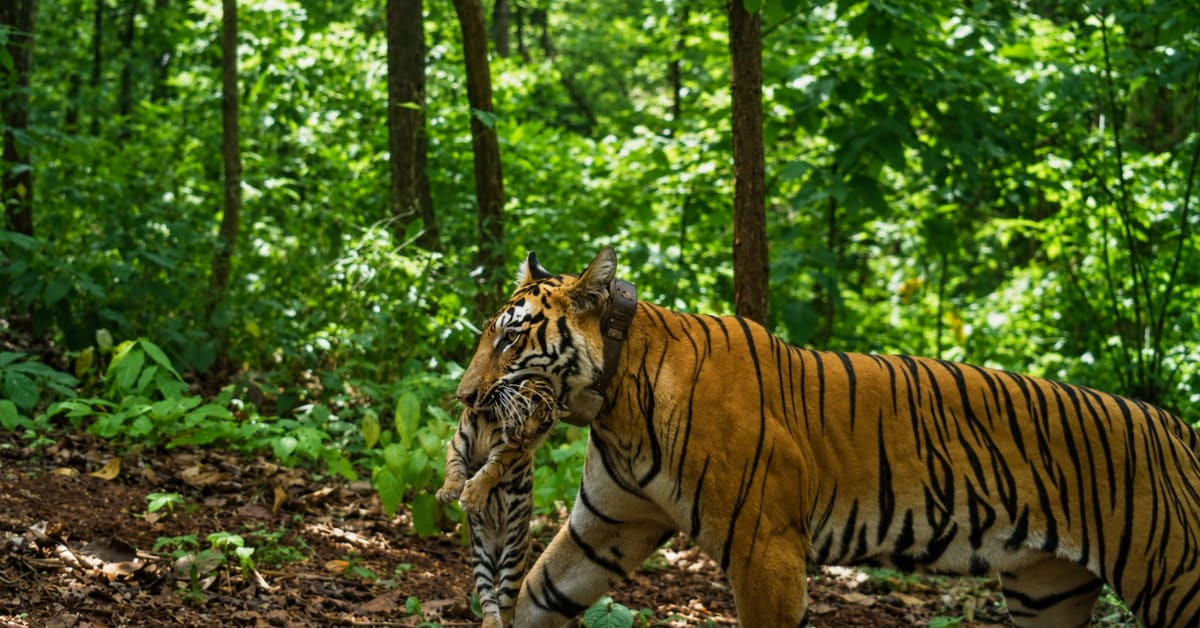
Runaway Tigress Zeenat Now Raises 4 Cubs in Indian Reserve
A young tigress who traveled 300 kilometers trying to escape her new home has settled down and given birth to four healthy cubs, becoming the first success of India's genetic rescue program. Zeenat's journey from "problem tiger" to proud mother shows how patience in conservation can pay off.
The tigress once labeled a "runaway" is now carrying her cubs gently through the forest, exactly as conservationists hoped she would.
Zeenat made headlines in late 2024 when she disappeared from Odisha's Similipal Tiger Reserve just days after arriving from Maharashtra. She traveled nearly 300 kilometers across three states, crossing rivers and dodging tracking teams for three weeks before officials finally tranquilized her and brought her back.
Many feared the experiment had failed. After all, Similipal already had a challenge: its 27 tigers included 13 rare pseudo-melanistic "black tigers" whose striking appearance resulted from inbreeding in an isolated population. The reserve desperately needed fresh genetics, and this three-year-old tigress seemed determined to leave.
Dr. Ravikant Khobragade, the wildlife veterinarian who radio-collared Zeenat before her move, saw it differently. "She was never a trouble-tiger," he told The Better India. "She was simply looking for space."
Eighteen months later, camera trap images prove him right. Zeenat now walks Similipal's forests with four healthy cubs, the first major success of Odisha's tiger supplementation program launched to save the reserve's shrinking genetic diversity.
Her litter increased Similipal's total tiger cubs from 12 to 16. More importantly, her cubs carry genetics from central India, offering the isolated population exactly what it needed: new blood to strengthen future generations.
The Bright Side
Zeenat's story rewrites what looked like conservation failure into a lesson about animal behavior and patience. Young tigers naturally disperse to find their own territories, sometimes traveling hundreds of kilometers. What seemed like rejection of her new home was simply a young tigress following her instincts.
The supplementation program continues, with plans to introduce six genetically unrelated tigers over five years. Jamuna, who arrived just before Zeenat, also settled in the reserve. Three more females and one male are scheduled to join them, each carrying the genetic diversity that will help Similipal's tiger population thrive for generations.
The reserve's black tigers will likely remain, their unique appearance part of Similipal's identity. But with newcomers like Zeenat mixing into the population, future generations will have the genetic variety they need to stay healthy and resilient.
On International Tiger Day, Zeenat's transformation from headline-making wanderer to devoted mother reminds us that wildlife conservation requires trusting natural processes, even when they don't follow our timeline.
More Images
%2Fenglish-betterindia%2Fmedia%2Fmedia_files%2F2026%2F07%2F24%2Fzeenat-2026-07-24-19-16-15.png)
%2Fenglish-betterindia%2Fmedia%2Fmedia_files%2F2025%2F11%2F20%2Fwild-at-heart-banner-image-microsite-banner-2025-11-20-16-17-04.jpg)

%2Ffilters%3Aformat(webp)%2Fenglish-betterindia%2Fmedia%2Fmedia_files%2F2026%2F07%2F24%2Fzeenat-1-2026-07-24-19-18-42.png)
Based on reporting by The Better India
This story was written by BrightWire based on verified news reports.
Spread the positivity!
Share this good news with someone who needs it


.jpg)