Satellite Navigation Breakthrough: How Space Agencies Are Making Orbital Maneuvering Safer
Space agencies are revolutionizing satellite navigation through advanced simulation techniques, developing critical technologies to safely manage Earth's crowded orbital environment. These groundbreaking approaches promise more sustainable and precise space exploration.
As thousands of satellites increasingly crowd Earth's orbital environment, space engineers are developing groundbreaking techniques to navigate this complex technological landscape safely.
Luxembourg-based companies LMO and ClearSpace have conducted a sophisticated simulation using the European Space Agency's Guidance, Navigation and Control Rendezvous, Approach and Landing Simulator (GRALS), representing a critical step in understanding how spacecraft can interact in increasingly congested near-Earth spaces.
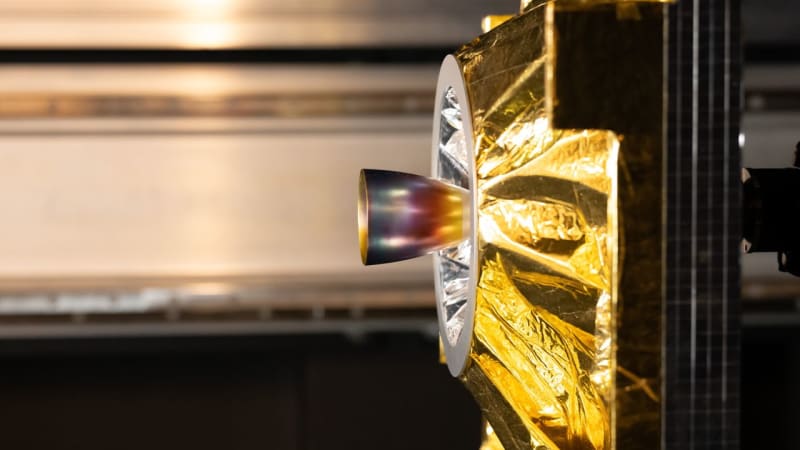
The simulation utilized a meticulously designed satellite model that captured intricate details like crinkled gold thermal insulation, metallic structures, and a cup-shaped reflective thruster. These features are not merely aesthetic, but critically important in understanding how light behaves in space and how cameras perceive objects during delicate rendezvous operations.
Engineers are employing a sophisticated approach that combines computer-generated imagery for AI training with physical testing on increasingly realistic models. Smaller models simulate long-range approaches, while larger, high-fidelity replicas test the most nuanced, close-range phases of satellite interactions, all conducted at ESA's technical center ESTEC in the Netherlands.
The growing number of satellites orbiting Earth presents significant challenges for space sustainability. Before a spacecraft can potentially refuel, repair, or safely deorbit another satellite, it must demonstrate exceptional ability to see, identify, and approach its target. Vision-Based Navigation (VBN) systems are emerging as a crucial technology, functioning similarly to how self-driving cars use cameras and AI to interpret their surroundings.
Facilities like GRALS play a transformative role in bridging theoretical concepts with practical implementation. By testing real hardware against realistic satellite models under space-like lighting conditions, engineers can identify potential weaknesses, validate AI training protocols, and build confidence that autonomous systems will operate safely when deployed in orbital environments.
This innovative work represents a significant advancement in space technology, offering hope for more responsible and sustainable exploration of our planet's orbital realm, ensuring that future space missions can navigate increasingly complex celestial landscapes with unprecedented precision and safety.
Based on reporting by Space.com
This story was written by BrightWire based on verified news reports.
More Good News
 🚀 Innovation
From Sci-Fi to Science: UK Company Pioneers Manufacturing in Space
 🚀 Innovation
Rocket Lab: The Ambitious Startup Reshaping Global Space Exploration
 🚀 Innovation