Saturn's Tilt Mystery Solved by Moon Collision Theory
A scientist may have cracked one of our solar system's biggest puzzles by proposing that an ancient moon collision created Titan's massive size, Saturn's wobble, and even its famous rings. The elegant theory explains mysteries that have stumped astronomers for decades.
Scientists think they've finally figured out why Saturn wobbles and how its largest moon got so big, and the answer involves a cosmic crash that happened half a billion years ago.
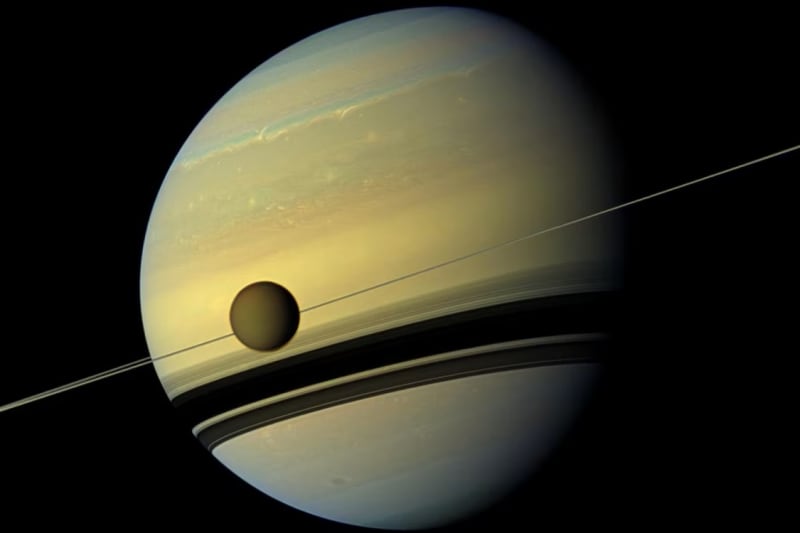
Matija Ćuk, a research scientist at the SETI Institute in California, pieced together data from NASA's Cassini space probe with computer simulations to propose something remarkable. An ancient moon about 1,000 times larger than Saturn's current moon Hyperion once collided with Titan, making it the monster moon it is today.
Titan isn't just big for a moon. It's larger than the planet Mercury, and its gravitational pull is so strong it actually makes Saturn tilt and wobble on its axis.
For years, astronomers thought Neptune's orbital force explained Saturn's wobble through a phenomenon called resonance, where one planet's gravity affects another. But when Cassini visited Saturn between 2004 and 2017, the data showed the two planets weren't synced up quite right for that theory to work.
Ćuk discovered something clever when he worked backward in time. Around when Saturn's rings likely formed about 100 million years ago, the wobble matched Neptune's resonance almost perfectly. Add in one extra moon colliding with Titan before that, and suddenly everything clicks into place.
"I propose that there was an extra moon about half a billion years ago that collided with Titan, that actually became part of Titan," Ćuk told CNN. The collision set off a chain reaction that knocked other moons around, eventually creating Saturn's spectacular rings.
Why This Inspires
While the James Webb Space Telescope keeps revealing distant galaxies and far-off worlds, this discovery reminds us how much wonder still exists right in our cosmic neighborhood. Scientists are solving mysteries about planets we've known since ancient times using patient detective work and brilliant calculations.
William B. Hubbard, an emeritus professor at the University of Arizona who wasn't involved in the research, reviewed Ćuk's theory and found it more convincing than earlier explanations. Carl Murray, an emeritus professor at Queen Mary University of London and former Cassini team member, called the theory "highly probable."
The research shows that major scientific breakthroughs don't always require new telescopes or space missions. Sometimes they come from looking at existing data with fresh eyes and asking the right questions.
Even after decades of studying our solar system, we're still uncovering its secrets one calculation at a time.
More Images



Based on reporting by Good News Network
This story was written by BrightWire based on verified news reports.
Spread the positivity!
Share this good news with someone who needs it