Scientists Boost MXene Conductivity 160x With New Method
Researchers just unlocked a way to supercharge ultra-thin materials called MXenes, making them 160 times more conductive. The breakthrough could transform everything from flexible electronics to high-speed wireless technology.
Scientists have discovered how to make an advanced material so efficient at conducting electricity that it performs 160 times better than previous versions.
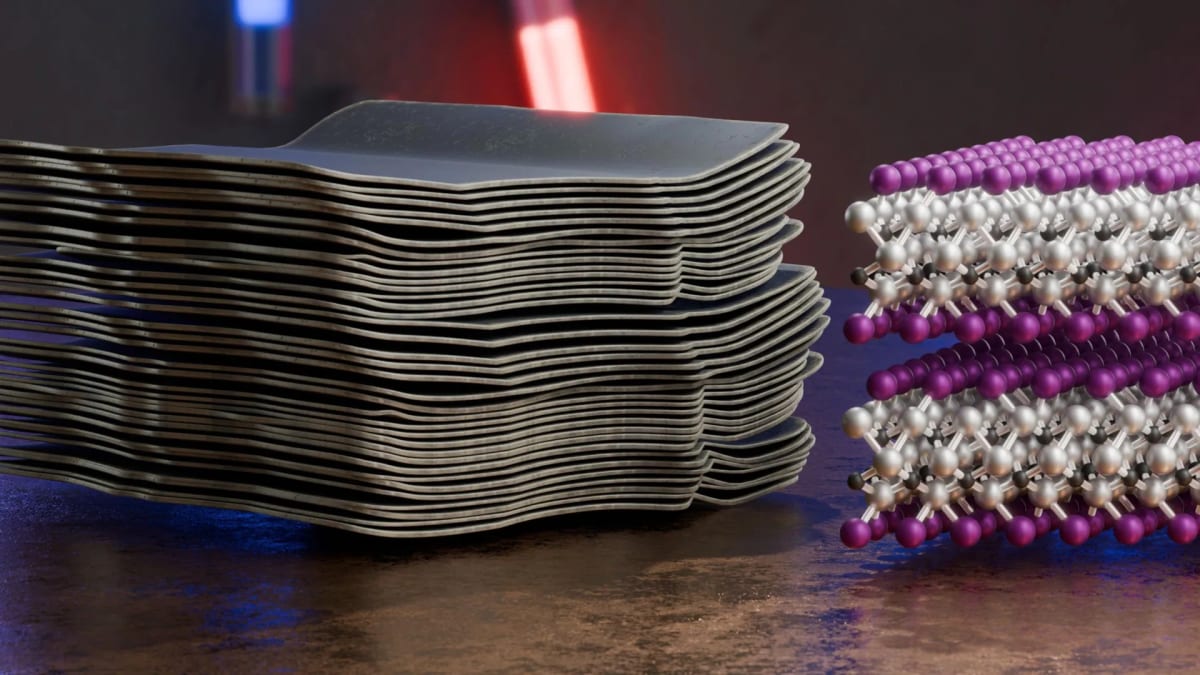
The breakthrough centers on MXenes, ultra-thin materials discovered in 2011 that hold enormous potential for next-generation technology. Until now, these materials have been held back by a messy production process that left their surfaces disordered, like potholes on a highway slowing down traffic.
Researchers at the Helmholtz-Zentrum Dresden-Rossendorf in Germany and TU Dresden developed a cleaner approach called the GLS method. Instead of harsh chemical etching, they use molten salts and iodine vapor to build MXenes with perfectly arranged atomic structures.
The difference is dramatic. When the team created a version of titanium carbide MXene using this new technique, they produced a material with only chlorine atoms arranged in a clean, ordered pattern across its surface. This precise arrangement allows electrons to flow freely without getting trapped or scattered.
The numbers tell the story. The new MXene showed a 160-fold increase in overall conductivity and a 13-fold boost in terahertz conductivity compared to traditionally made versions. Electron mobility, which measures how freely electrons move through a material, jumped nearly fourfold.
Dr. Mahdi Ghorbani-Asl from HZDR explains that surface atoms play a crucial role in how these materials behave. They influence everything from electron movement to how the material interacts with light, heat, and chemical environments.
The team successfully produced MXenes from eight different starting materials, proving the method works broadly. They also discovered they could customize the materials by choosing different surface atoms like chlorine, bromine, or iodine, each responding to different electromagnetic frequencies.
This customization opens exciting possibilities. Chlorine-based MXenes absorb strongly in the 14-18 GHz range, perfect for certain radar and wireless applications. Bromine and iodine versions respond to different frequencies, allowing scientists to design materials for specific needs.
The Ripple Effect
The implications reach far beyond the laboratory. These improved MXenes could accelerate development of flexible electronics that bend and fold, advanced wireless communication systems for faster data transmission, and sophisticated sensors for medical diagnostics.
The method also allows mixing different surface atoms in controlled proportions, giving researchers unprecedented ability to fine-tune materials for electronics, energy storage, catalysis, and photonics. Dr. Dongqi Li notes that combining theoretical predictions with experimental precision opens new paths toward materials with improved stability and tailored properties.
The work represents a fundamental shift from accepting whatever messy surfaces chemical processes produce to deliberately designing materials atom by atom. This level of control could help engineers optimize MXenes for electromagnetic shielding, radar-absorbing coatings, and optoelectronic devices that convert between electrical and optical signals.
A cleaner, gentler production method that delivers dramatically better performance points toward a future where advanced materials can finally deliver on their promise.
Based on reporting by Science Daily
This story was written by BrightWire based on verified news reports.
Spread the positivity!
Share this good news with someone who needs it