Scientists Boost Tiny Chips 20x With Air Cavity Trick
Researchers just made atom-thin computer chips 20 times brighter by carving tiny air pockets beneath them instead of changing the chips themselves. This clever breakthrough could transform quantum computing and sensing technology.
Scientists just found a brilliant workaround to one of technology's tiniest problems, and it involves doing less, not more.
Researchers at the Australian National University discovered they could supercharge ultra-thin semiconductor chips simply by reshaping the empty space underneath them. Instead of trying to modify delicate atom-thick materials, they carved microscopic air cavities into the crystal base below.
The results were stunning. Light emission jumped 20 times stronger, and certain optical signals increased by 25 times.
The team worked with tungsten disulfide, a semiconductor material just one atom thick. These materials are incredibly promising for next-generation tech like quantum computers and advanced sensors, but their extreme thinness creates a challenge. With so little material, light passes through without much interaction, making signals weak and inefficient.
Traditional solutions tried cramming these thin layers inside solid light traps made from materials like silicon. That approach worked okay, but it kept the strongest light fields away from the surface where the atom-thin material sits.
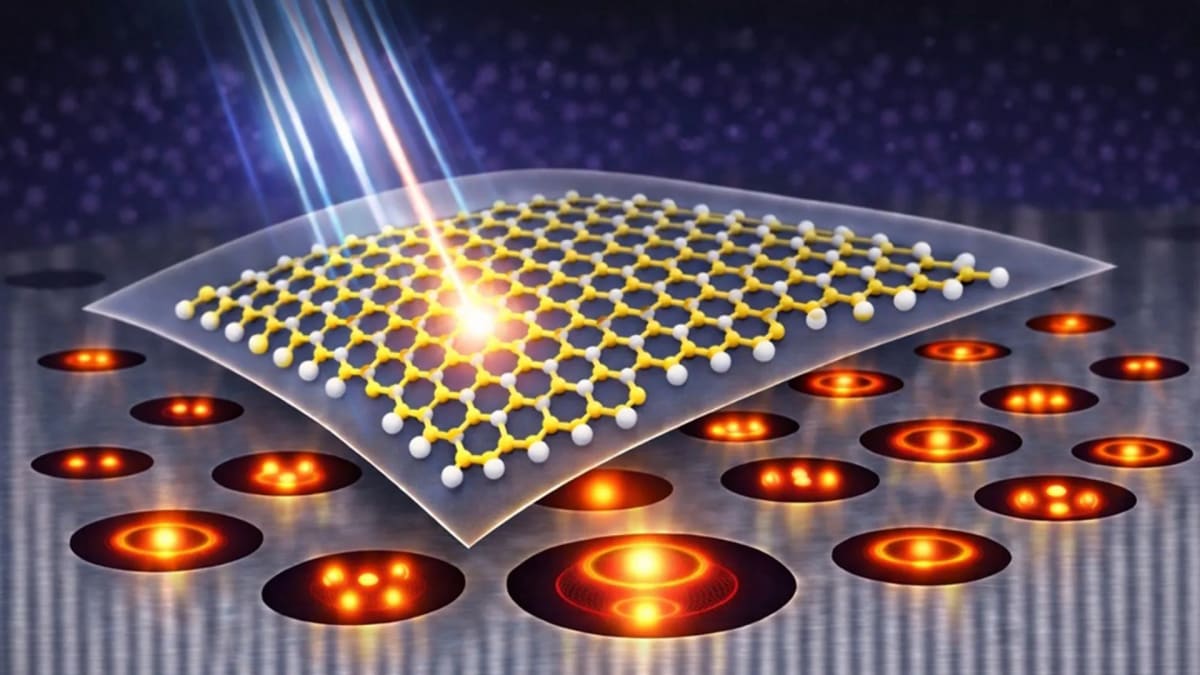
The new design flips this concept completely. The researchers etched tiny air pockets, called Mie voids, into a crystal made of bismuth telluride. When they placed the tungsten disulfide layer on top, these hollow spaces became powerful light traps that concentrated energy exactly where it was needed.
Think of it like creating a small echo chamber that amplifies sound. The air cavities bounce light around inside them, focusing it right at the surface where the semiconductor sits. The light gets trapped in empty space rather than solid material, putting maximum energy exactly where it does the most good.
The team carefully tuned each cavity's size and depth to match the wavelength of light the semiconductor naturally emits. Using focused ion beams, they carved the precise patterns into the crystal, then draped a continuous sheet of tungsten disulfide across the entire surface.
Testing confirmed the design worked beautifully. Regions sitting over resonant cavities glowed 20 times brighter than areas over non-resonant spots. Because the same continuous material covered everything, the team knew the brightness boost came purely from the cavity design, not from differences in the semiconductor itself.
The approach also proved remarkably forgiving. Even when cavity shapes weren't perfect, the resonances remained stable, meaning the technique could work reliably in real-world manufacturing.
Why This Inspires
This breakthrough matters because it solves a major roadblock without adding complexity. Instead of engineering new materials or building elaborate structures, the researchers worked with empty space.
The technique opens doors for practical quantum devices, ultra-sensitive detectors, and compact light sources that could fit on computer chips. Because the design tolerates small imperfections, it's actually feasible to manufacture at scale.
The study, published in Advanced Photonics in March 2026, demonstrates how creative thinking can turn limitations into opportunities. Sometimes the best solution isn't adding more, it's strategically removing just enough.
Based on reporting by Science Daily
This story was written by BrightWire based on verified news reports.
Spread the positivity!
Share this good news with someone who needs it