Scientists Bridge Gap Between Nuclear Theory and Reality
Researchers just solved a puzzle that's stumped nuclear physicists for years, creating a tool that finally matches what happens in labs. The breakthrough helps us understand how atoms swap parts during collisions.
Scientists in China have cracked a code that brings theoretical predictions in line with real-world nuclear experiments for the first time.
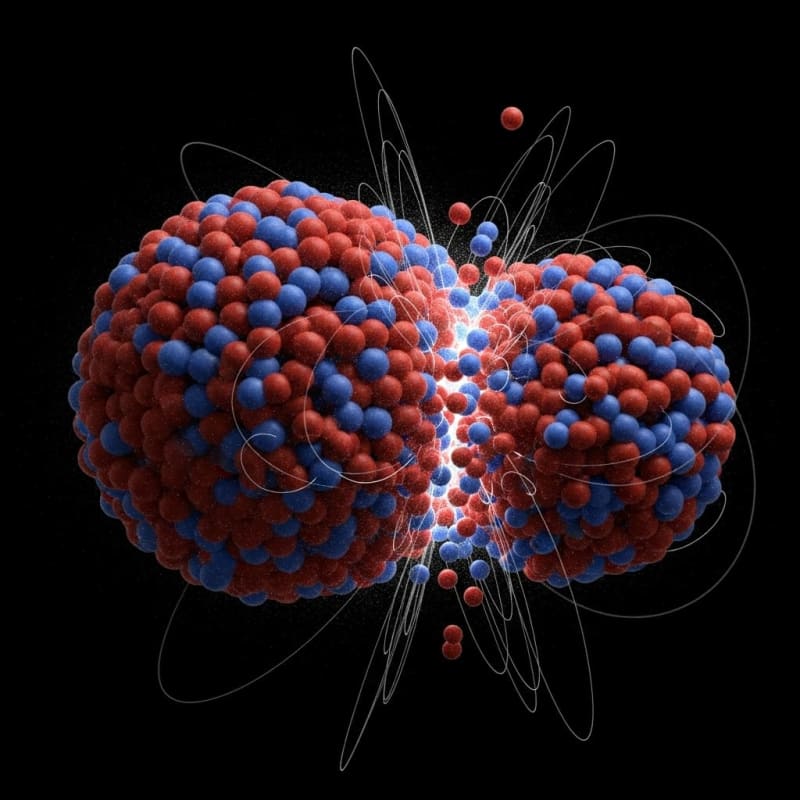
When atomic nuclei collide at high speeds, they can exchange neutrons and protons in a dance scientists call multi-nucleon transfer reactions. Understanding these swaps matters because it helps physicists predict how elements form in stars and could improve nuclear energy technology.
The problem? Computer models showing what should happen never quite matched what actually happened in the lab. The models tracked the initial collision perfectly but missed a crucial step: what happens immediately after.
Scientists Y.C. Yang, D.D. Zhang, and their international team figured out the missing piece. After nuclei collide and exchange particles, they're left superheated and unstable. They cool down by spitting out extra particles, like a boiling pot releasing steam.
Previous research ignored this cooling process, called de-excitation. The new study combined two powerful tools: one that simulates the collision itself and another called GEMINI++ that tracks the cooling afterward.
The results were striking. The cooling process dramatically changed which particles ended up where, shifting the final products toward lighter elements. When the team ran simulations at different energy levels (from 235 to 270 MeV), they found the sweet spot at 249 MeV where reactions happened most efficiently.
The cooling process also scrambled the original relationships between particle groups. Neutrons evaporated more readily than protons, weakening the correlations scientists hoped to measure.
The Bright Side
This breakthrough means physicists can now make reliable predictions about nuclear reactions without constantly playing catch-up with experimental data. The hybrid approach works like adding weather patterns to a climate model: suddenly, predictions match reality.
The research opens doors for more accurate simulations in nuclear physics, from understanding stellar nucleosynthesis to improving nuclear reactor designs. When theory and experiment finally agree, science can move forward faster.
The team acknowledges their model still simplifies some complex decay pathways, but they've laid groundwork for even more refined versions. Each improvement brings us closer to mastering the fundamental forces that built our universe.
After years of near-misses, scientists can finally watch both their calculations and their instruments tell the same story.
More Images




Based on reporting by Google News - Reconciliation
This story was written by BrightWire based on verified news reports.
Spread the positivity!
Share this good news with someone who needs it