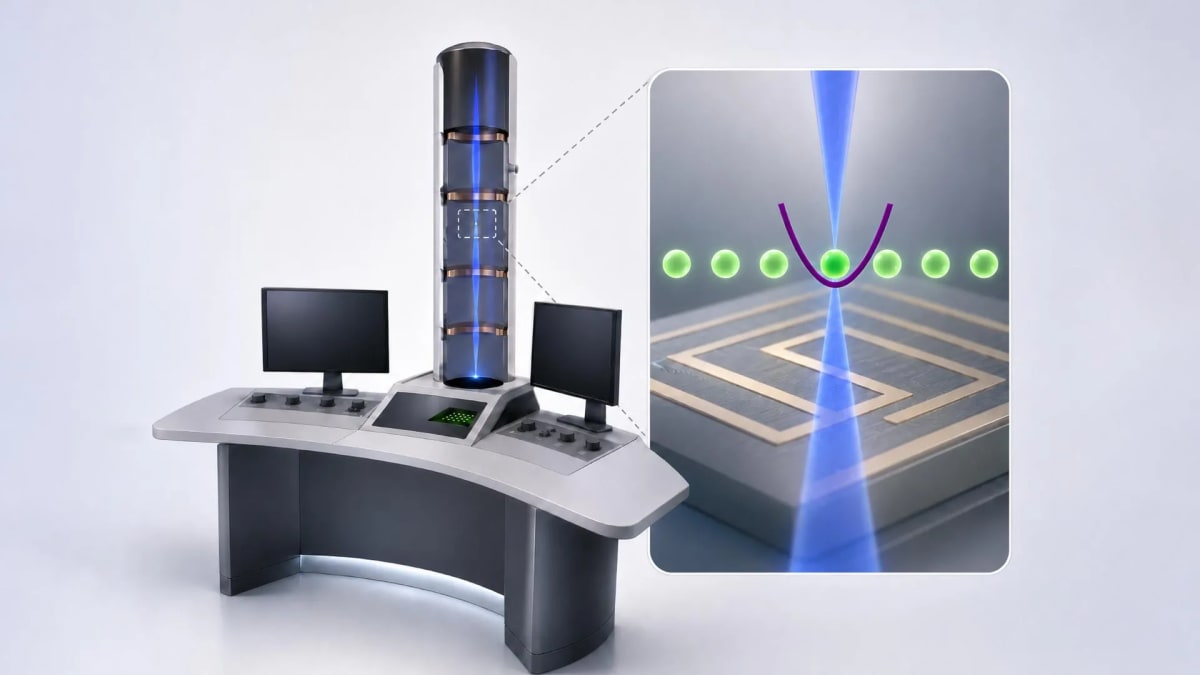
Scientists Build Quantum-Powered Electron Microscope
Austrian researchers are connecting an electron microscope to a quantum computer to extract far more information from each electron. This breakthrough could reveal tiny biological details while using fewer electrons, protecting fragile samples from damage.
Scientists in Austria just solved one of microscopy's biggest challenges: how to see the tiniest details without destroying what you're looking at.
Researchers at TU Wien, working with teams across Austria, are building the world's first electron microscope powered by a quantum computer. The breakthrough could transform how scientists study delicate biological materials like individual proteins.
Today's electron microscopes can already see details at the atomic scale. But there's a catch: creating those ultra-clear images requires bombarding samples with thousands of electrons, and that often damages or destroys fragile biological materials.
"This is often a problem, particularly when imaging biological samples such as individual proteins," says Philipp Haslinger from TU Wien's Institute of Atomic and Subatomic Physics. The team needed a way to learn more from each electron so they could use far fewer of them.
Their solution sounds like science fiction. The team connects electrons passing through the microscope to ions trapped inside a quantum computer, creating something called quantum entanglement. When an electron becomes entangled with an ion, they share a joint quantum state, allowing the ion to store information about the electron.
Here's where it gets clever. After one electron interacts with the trapped ion, another electron can pass through and add its information. The quantum computer then combines data from multiple electrons using special algorithms, turning what would normally look like random noise into a clear signal.
"Quantum physics allows us to overcome the statistical limits that constrain conventional electron microscopes," explains doctoral student Elias Pescoller. Traditional microscopes essentially count electrons to build an image, but each electron carries extra quantum information that normally goes unused and gets thrown away.
The math already checks out. The researchers have proven mathematically that their approach offers significant advantages over conventional electron microscopy.
Why This Inspires
Now comes the exciting part: building it. At TU Wien's electron microscopy center, researchers are preparing to integrate an ion-based quantum computer developed by the University of Innsbruck into a working electron microscope.
The collaboration brings together Austria's top expertise in quantum computing and microscopy. Major funding comes from the Austrian Science Fund through the quantA Cluster of Excellence, coordinated by the University of Vienna.
If it works as expected, scientists could finally study delicate biological structures in unprecedented detail without destroying them in the process. What was once invisible could become crystal clear, opening new frontiers in understanding life at its smallest scales.
The future of seeing the invisible just got a quantum upgrade.
Based on reporting by Science Daily
This story was written by BrightWire based on verified news reports.
Spread the positivity!
Share this good news with someone who needs it

