Scientists Catch Star's Massive Explosion in Real Time
Astronomers captured the exact moment a distant star unleashed a superflare, releasing months of our sun's energy in seconds. This breakthrough observation helps scientists understand these powerful cosmic events and predict how they affect planets.
For the first time ever, astronomers caught a cosmic explosion right as it happened, opening a window into one of the universe's most powerful phenomena.
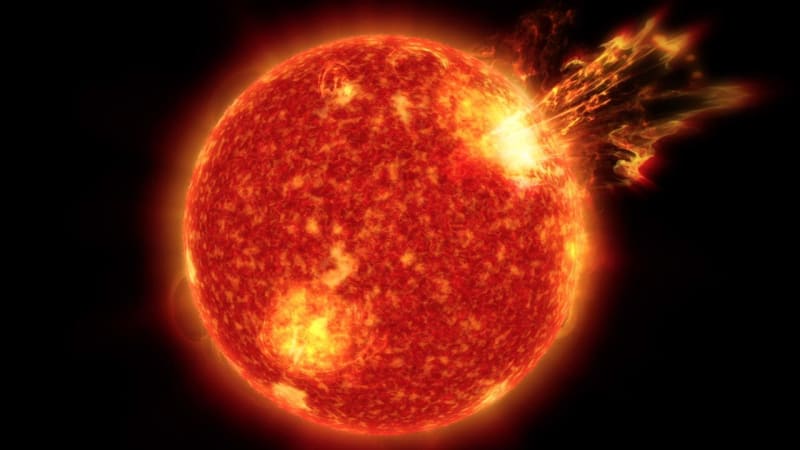
In November 2024, a new space telescope called SVOM/GRM spotted something extraordinary. A star named HD 22468 erupted with a superflare, releasing as much energy as our sun produces in several months, all packed into a few explosive moments.
Think of it like catching lightning the instant it strikes. The universe is enormous and filled with fleeting events that flash and fade quickly. Astronomers usually arrive late to the party, seeing only the afterglow of stellar fireworks.
But this time was different. A global network of telescopes, constantly watching the skies, finally got lucky. They captured the superflare in hard X-rays at its peak energy, marking the first observation of its kind from an RS CVn-type star.
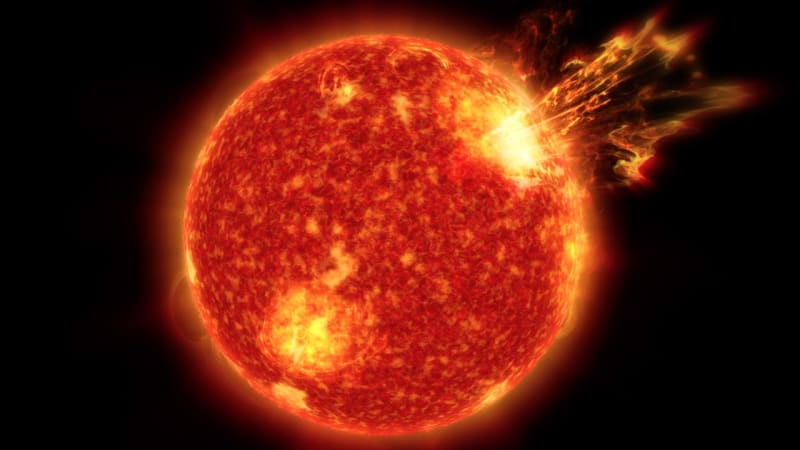
These stellar explosions happen when twisted magnetic fields on a star's surface suddenly snap. The release is violent and immediate, making the star temporarily thousands or even millions of times brighter than normal solar flares. If one occurred close enough to a planet, the radiation could be devastating to any life there.
RS CVn stars are typically close pairs that orbit each other. Their proximity churns up intense magnetic activity in their super-hot outer atmospheres, called coronas. Tension builds in these twisted magnetic fields until finally, boom, a flare releases it all.
Why This Inspires
Scientists analyzing the data discovered something remarkable in the timing. The hard X-ray peak hit first, intense and quick, followed by a longer glow in softer X-rays and visible light. This sequence tells the story of how energy flows during these explosions.
The temperatures were mind-boggling. Stellar material heated to between 10 million and 100 million degrees Kelvin, driven by magnetic reconnection where field lines snap and rejoin like cosmic rubber bands.
This breakthrough gives researchers the missing piece they needed. With detailed timing and temperature data from the explosion's first moments, they can refine their computer models of stellar behavior. Better models mean better predictions about how stars evolve, lose mass, and affect the planets around them.
The observation also helps scientists assess which exoplanets might actually support life. Understanding superflares means understanding which solar systems are safe harbors and which are radiation zones.
The discovery represents years of patient sky-watching paying off in a single spectacular moment. Sometimes the universe rewards persistence with front-row seats to its greatest shows.
More Images


Based on reporting by Space.com
This story was written by BrightWire based on verified news reports.
Spread the positivity!
Share this good news with someone who needs it