Scientists Celebrate Discovery of Cosmic 'Ghost': A Starless Galaxy Validates Decades of Theory
Astronomers have made an exciting breakthrough by discovering Cloud-9, a "failed galaxy" that confirms long-standing predictions about how our universe works. This remarkable finding opens new doors for understanding the cosmos and validates decades of theoretical work about dark matter and galaxy formation.
In a thrilling moment for astronomy, scientists have confirmed the existence of something they've been searching for since the theory was first proposed: a "failed galaxy" that proves our understanding of the universe is on the right track.
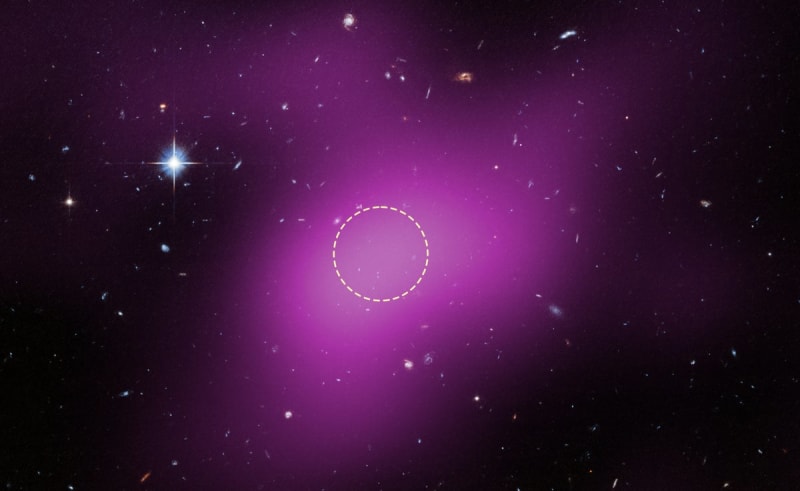
Meet Cloud-9, a cosmic wonder located 14 million light-years from Earth. This extraordinary object has everything needed to be a galaxy—rich reserves of hydrogen gas and a halo of dark matter holding it together—except for one notable absence: stars. Rather than being a disappointment, this discovery represents a major scientific triumph.
"We've finally found one of these elusive phantom galaxies," announced Rachael Beaton, an astronomer at the Space Telescope Science Institute, during the American Astronomical Society's meeting in Phoenix. Her enthusiasm reflects the excitement rippling through the scientific community.
Cloud-9 is what astronomers call a RELHIC—a Reionization-Limited H I Cloud. Think of it as a time capsule from the early universe, a primordial fossil that never quite managed to light up with stars. For years, scientists predicted such objects should exist based on our understanding of dark matter and how galaxies form, but actually finding one proved remarkably challenging.
The discovery journey showcases the power of international collaboration and cutting-edge technology. China's Five-Hundred-Meter Aperture Spherical Radio Telescope first spotted the nearly 5,000-light-year-wide spherical cloud in 2023. Follow-up observations using the Hubble Space Telescope confirmed what researchers hoped: this cosmic oddity is genuinely starless, or nearly so.
The numbers are staggering. Cloud-9 contains about a million solar masses of hydrogen and approximately five billion solar masses of dark matter. Yet Hubble's observations found hints of just one star within its boundaries, with simulations suggesting it couldn't host more than 3,000 solar masses worth of stars—far too few to qualify as even a dwarf galaxy.
What makes this discovery so meaningful is that it validates a fundamental prediction about our universe. "Not every dark matter halo will have a galaxy in it," Beaton explained. This confirmation strengthens our understanding of cosmic evolution and the mysterious dark matter that shapes our universe.
The finding also demonstrates how persistence in science pays off. These objects had been "notoriously difficult to spot," but advances in telescope technology and international cooperation made the discovery possible. It's a testament to human curiosity and our drive to understand the cosmos.
While scientists celebrate this milestone, they're already looking ahead with excitement. Kristine Spekkens from Queen's University notes that Cloud-9's slightly irregular shape hints at more secrets waiting to be uncovered. Better mapping could reveal fascinating details about how it formed and evolved over billions of years.
Ethan Nadler from the University of California, San Diego, points out that finding similar objects will help scientists learn even more. Cloud-9 may be the first of its kind in our catalogs, but it likely won't be the last. Each new discovery will illuminate this previously dark corner of astronomy.
This breakthrough reminds us that the universe still holds wonderful surprises, and that patient, collaborative scientific work continues to reveal the cosmos's deepest secrets. Cloud-9 stands as proof that sometimes what's missing can be just as important—and exciting—as what's there.
More Images

Based on reporting by Scientific American
This story was written by BrightWire based on verified news reports.
Spread the positivity! 🌟
Share this good news with someone who needs it
More Good News
 🚀 Innovation
Scientists Make Exciting Progress Toward Unlocking the Universe's Greatest Secrets
 🚀 Innovation
Private Philanthropy Launches Era of Discovery with Four Revolutionary Telescopes
 🚀 Innovation
Einstein's Legacy Shines Brighter: Scientists Confirm Physics Genius Was Right Again
Joke of the Day
Why did the librarian get kicked out of class?
Explore Categories
Quote of the Day
"Do not go where the path may lead, go instead where there is no path and leave a trail."
— Ralph Waldo Emerson