Scientists Crack 100-Year Cosmic Ray Mystery
After a century of searching, scientists have discovered a universal pattern that explains how the most powerful particles in the universe behave. The breakthrough could finally reveal where cosmic rays come from and how they travel across space.
For more than 100 years, scientists have puzzled over cosmic rays, the most powerful particles ever observed in nature. Now, a space telescope has revealed a hidden pattern that could finally solve the mystery.
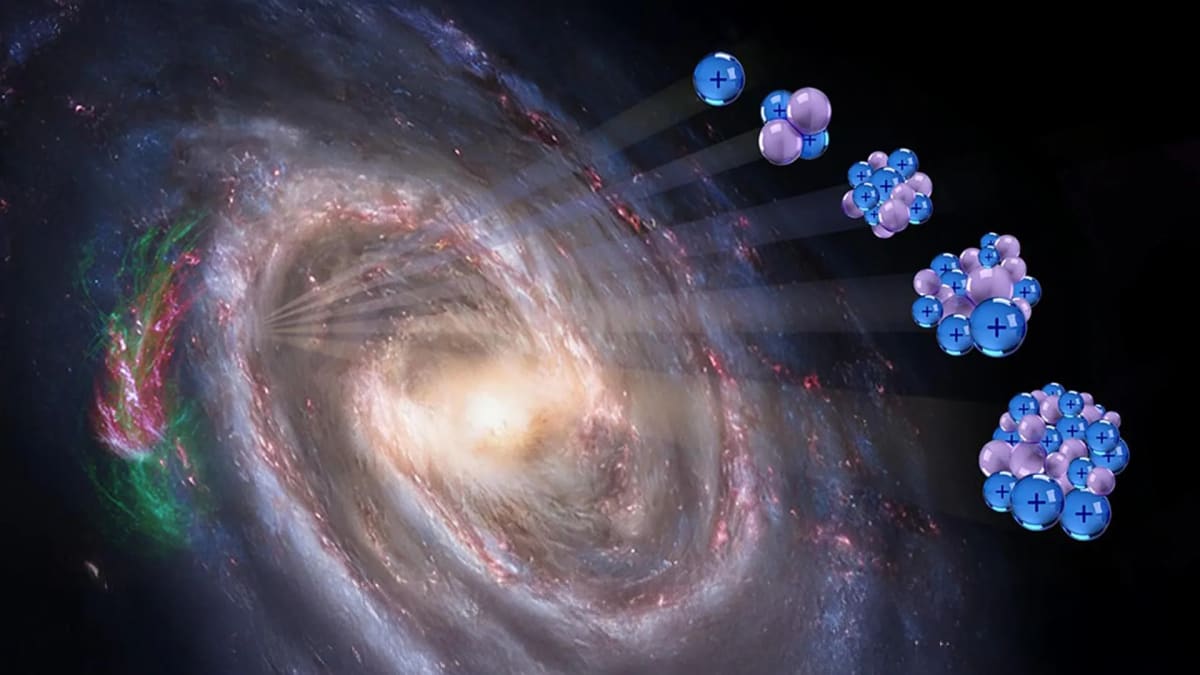
Researchers using China's DAMPE space telescope discovered something remarkable: every type of cosmic ray particle, from tiny protons to heavy iron nuclei, follows the same rule. They all begin fading away more sharply at exactly the same point as they travel through space.
The finding changes everything scientists thought they knew about these mysterious particles. Cosmic rays carry far more energy than anything humans can create in laboratories, and they zip through the universe at extreme speeds after being launched by violent cosmic events like supernova explosions and black holes.
Scientists from the University of Geneva helped lead the breakthrough using advanced artificial intelligence to analyze the telescope data. They found that regardless of what type of particle they studied, the cosmic rays all showed the same dramatic drop-off once they reached a specific energy threshold.
"These particles are categorized according to their energy," explains Andrii Tykhonov, a professor who co-authored the study published in Nature. The universal pattern appears when particles reach about 15 teraelectron-volts of rigidity, a measure of how strongly magnetic fields can bend their path.
The discovery strongly supports the theory that cosmic ray behavior depends on rigidity rather than other factors. The data rules out competing explanations with 99.999% confidence, giving scientists the clearest picture yet of how these particles accelerate and move through the galaxy.
The Geneva team also built one of the telescope's key instruments, a silicon-tungsten tracker that traces particle paths with extreme precision. This detector made it possible to spot the subtle pattern that had eluded researchers for a century.
Why This Inspires: This breakthrough shows what happens when international teams combine cutting-edge technology with patient scientific work. The same space telescope launched to study dark matter ended up revealing secrets about the universe's most energetic particles, proving that curiosity-driven research often leads to unexpected discoveries. Scientists can now build better models of how our galaxy works and where its most extreme phenomena occur.
The findings place tighter limits on existing theories and open new paths for understanding how particles behave in the wildest corners of space. What started as a century-old mystery now has a clear direction forward, bringing scientists closer to understanding the forces that shape our universe.
Based on reporting by Science Daily
This story was written by BrightWire based on verified news reports.
Spread the positivity!
Share this good news with someone who needs it