Scientists Crack 800-Year Mystery of Narwhal's Tusk
Advanced X-ray technology has finally revealed why the narwhal's tusk twists the way it does. The discovery could inspire breakthrough materials for construction and medicine.
Scientists just solved a mystery that has puzzled humanity since the Middle Ages when narwhal tusks were sold as magical unicorn horns.
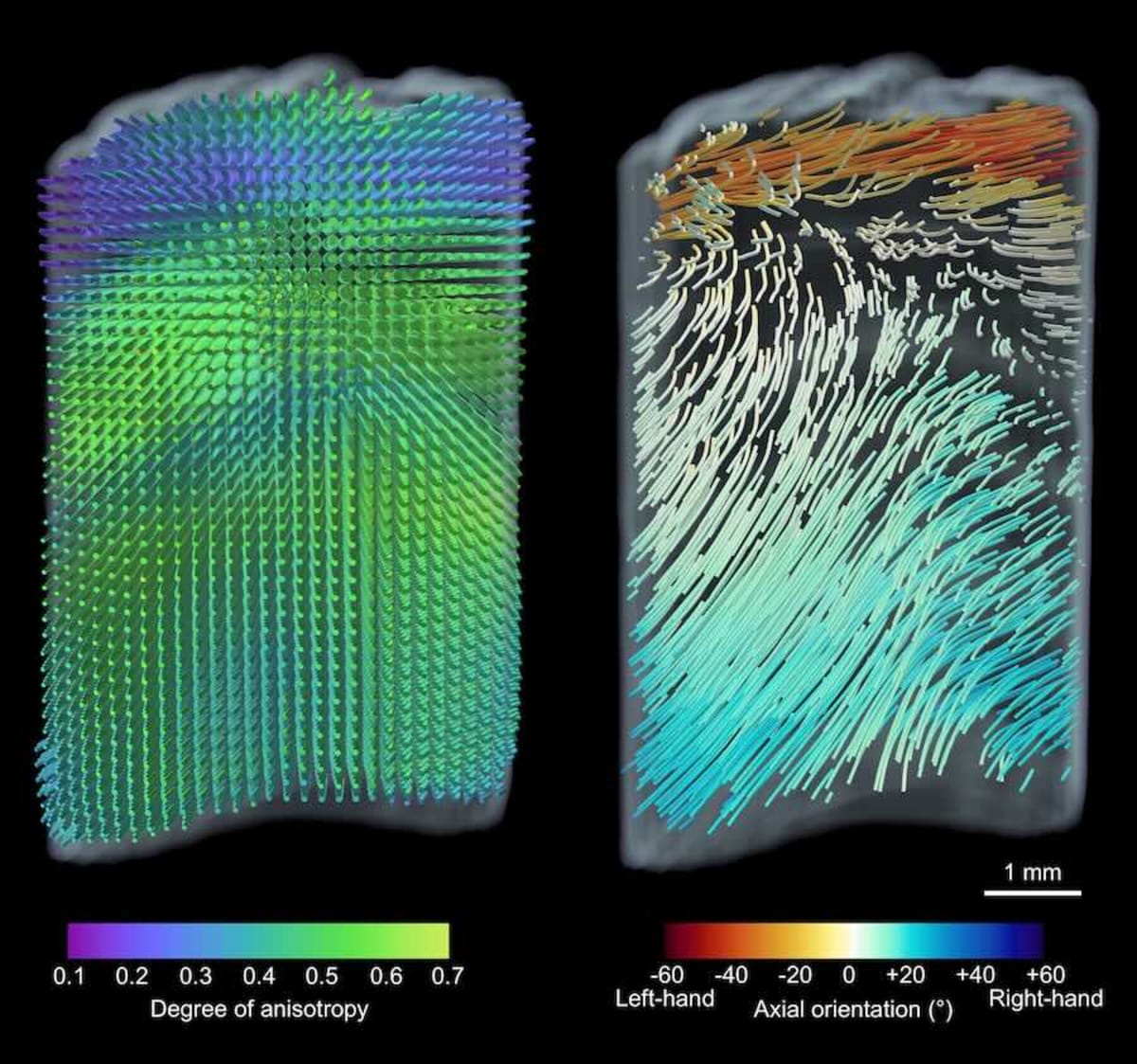
Using the world's most powerful X-ray machines, an international research team discovered that narwhal tusks contain not one spiral, but two. The outer structure twists left while the inner structure spirals right, creating what scientists call a "biological counterbalance" that gives the tusk incredible strength.
Dr. Adrian Rodriguez-Palomo from Denmark's Aarhus University led the groundbreaking study. His team needed three massive synchrotrons (particle accelerators that produce powerful X-rays) across Sweden, Switzerland, and France to map the entire tooth in three dimensions.
The tusk is actually the narwhal's left canine tooth, growing through the jaw and lip to reach over six feet long. Unlike human teeth, it has no enamel but consists of dentin on the inside and cementum on the outside, each spiraling in opposite directions.
To see inside, researchers used a special technique called tensor tomography. This powerful X-ray method revealed how microscopic collagen fibrils (the building blocks that give teeth their strength) are arranged in a twisted pattern throughout the entire structure.
The double spiral stays consistent across the tusk's annual growth layers, similar to tree rings. Since narwhals can live up to 80 years, this means the left-handed growth pattern is genetically programmed and remains stable throughout their entire lives.
Why This Inspires
This discovery goes far beyond satisfying scientific curiosity about Arctic whales. The double-spiral architecture shows how nature builds materials that can withstand enormous force, knowledge that engineers can now apply to real-world problems.
Researchers believe this biological blueprint could inspire new composite materials for construction projects and medical devices. When nature has spent millions of years perfecting a design this strong, there's plenty for humans to learn.
The team is now investigating whether narwhal tusks can reveal environmental changes in the North Atlantic. As the Arctic undergoes rapid transformation, these tusks might serve as historical records of changing ocean conditions over the past eight decades.
A medieval mystery solved with cutting-edge technology is now opening doors to future innovations.
More Images



Based on reporting by Good News Network
This story was written by BrightWire based on verified news reports.
Spread the positivity!
Share this good news with someone who needs it