Scientists Crack Code for Cheaper Clean Energy Fuel Cells
Researchers just discovered a game-changing principle that could make hydrogen fuel cells cheaper and more efficient, potentially accelerating our shift to clean energy. The breakthrough challenges decades of assumptions about how the best catalysts actually work.
Scientists at Tohoku University have unlocked a hidden pattern in fuel cell technology that could finally make clean hydrogen energy affordable for everyone.
The discovery centers on tiny catalysts that power fuel cells, the devices that turn hydrogen into electricity without creating pollution. For years, these fuel cells have relied on expensive precious metals like platinum, making them too costly for widespread use.
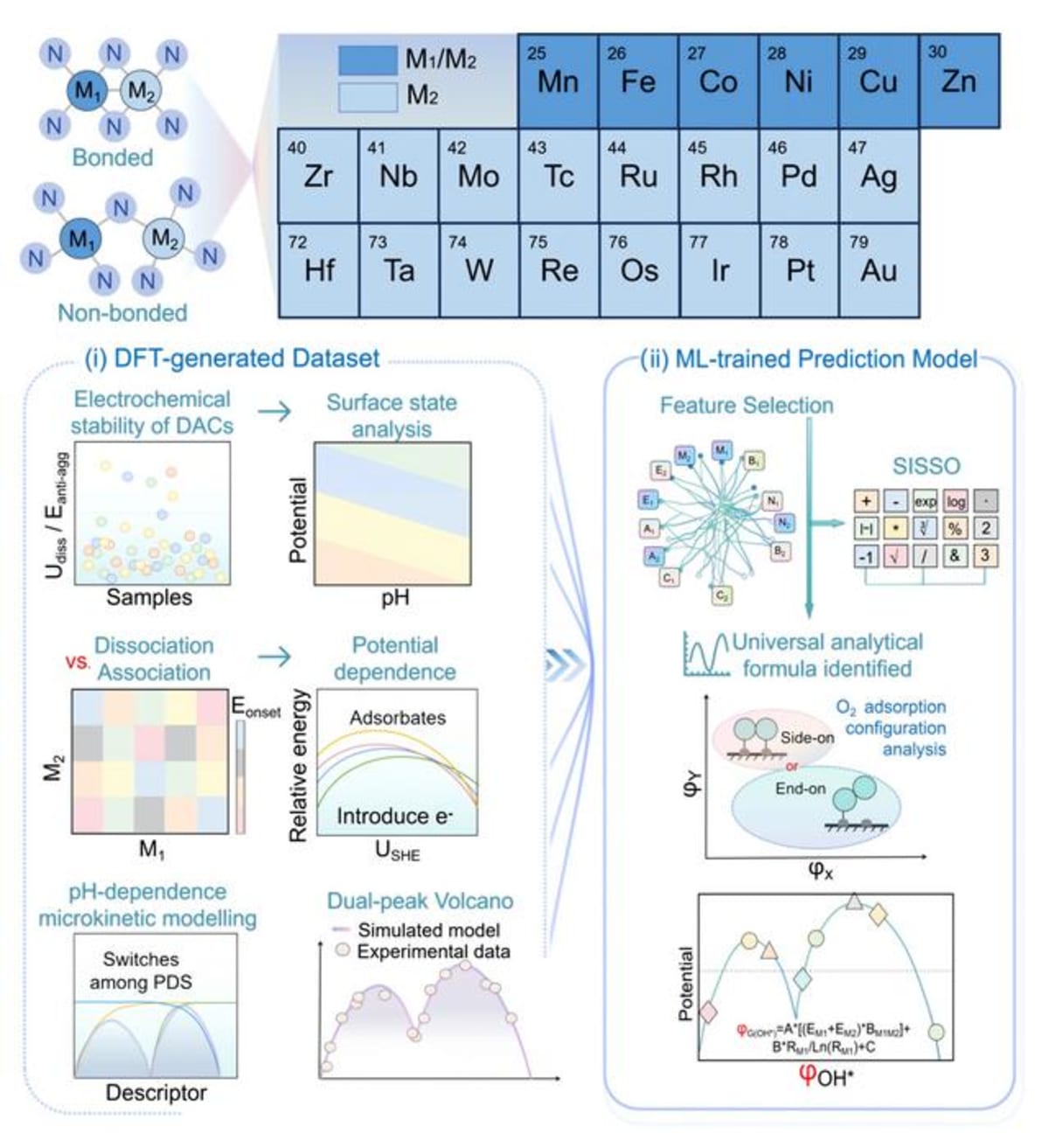
Researchers studying dual-atom catalysts (pairs of metal atoms working together) noticed something unexpected. When they analyzed data from over 200 different catalyst combinations, the performance patterns didn't match what science predicted.
Traditional catalyst theory said there's only one sweet spot where performance peaks. But the team found something completely different: two optimal zones instead of one, a phenomenon they're calling "dual-Sabatier optima."
The reason? These paired atoms follow an entirely different chemical pathway than single atoms do. When two atoms cooperate, they change how oxygen molecules break apart and react during energy conversion.
Professor Hao Li, who led the study, said this changes everything about catalyst design. "For a long time, researchers assumed dual-atom catalysts followed the same rules as single-atom catalysts," he explained. "Our work shows that entirely different mechanisms emerge when two atoms work together."
The Ripple Effect
This breakthrough doesn't just apply to fuel cells. The same principle could improve catalysts used across energy conversion and chemical manufacturing, from producing green fuels to reducing industrial emissions.
The team used artificial intelligence and machine learning to spot these hidden patterns, showing how AI can help scientists discover new principles buried in existing research. Their predictive framework can now rapidly identify promising catalyst structures with high accuracy, dramatically shortening the time needed to develop new materials.
The researchers are already expanding their work to even more complex catalyst systems. They're building a fully autonomous digital platform that combines AI agents with electrochemical simulations to design next-generation catalysts for sustainable energy.
This discovery arrives at a critical moment as countries worldwide push to build low-carbon economies. Making fuel cells affordable could transform transportation, power generation, and industrial processes.
The findings prove that sometimes the biggest breakthroughs come from questioning what everyone assumes is true.
More Images
Based on reporting by Google News - Scientists Discover
This story was written by BrightWire based on verified news reports.
Spread the positivity!
Share this good news with someone who needs it