Scientists Crack Mystery of How Gold Forms in Nature
Chinese researchers watched gold form at the nanoscale for the first time, revealing how ordinary iron minerals create precious metal deposits. This discovery could help find new gold sources and explain how nature concentrates valuable metals.
Scientists just witnessed something no one has ever seen before: gold forming in real time at the atomic level, solving a mystery that's puzzled geologists for generations.
A team from the Chinese Academy of Sciences used powerful electron microscopes to watch what happens when gold-bearing water touches pyrite, the shiny mineral known as "fool's gold." What they found changes everything we thought we knew about where gold comes from.
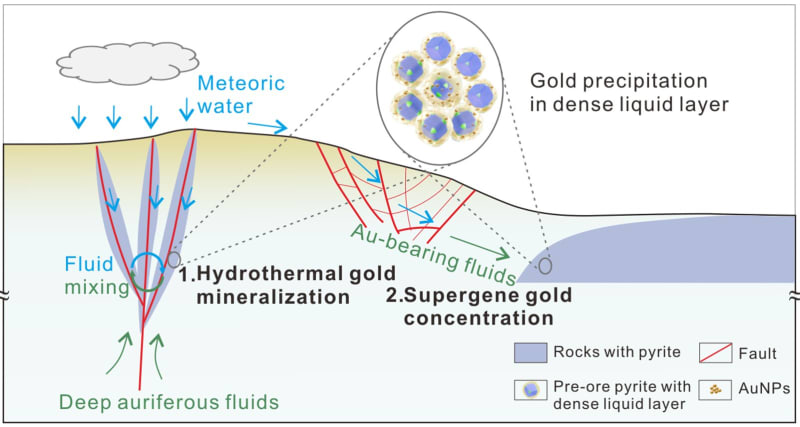
The breakthrough came when researchers created conditions that mimicked nature underground, then zoomed in to see individual gold particles forming. They discovered that pyrite doesn't just attract gold. It creates a special dense liquid layer on its surface that acts like a microscopic gold factory.
Here's the remarkable part: the water touching pyrite had only 10 parts per billion of gold, far too little to form solid gold under normal conditions. But within that dense liquid layer at the pyrite surface, conditions changed dramatically. The pyrite dissolved slightly, reducing oxygen levels just enough to trigger gold precipitation.
Think of it like how frost forms on a cold window even when there's not enough moisture in the room for rain. The surface creates unique conditions that make the impossible possible.
The research, published in the Proceedings of the National Academy of Sciences, explains how both underground hydrothermal systems and surface weathering can concentrate tiny amounts of gold into valuable deposits. When mineral-rich fluids from deep underground mix with rainwater, they become slightly oxidized and gold-bearing. As this fluid flows through rock containing pyrite, those dense liquid layers form and start building gold nanoparticles.
Why This Inspires
This discovery represents years of patient scientific work paying off in ways that matter beyond the laboratory. Understanding how nature concentrates gold could help geologists locate new deposits more efficiently, reducing the environmental impact of exploration.
But the implications reach further than mining. The same principles apply to how other valuable metals concentrate in Earth's crust, from copper to rare earth elements essential for clean energy technology. By learning nature's tricks for concentrating metals, scientists can develop more sustainable extraction methods.
The research also showcases international scientific collaboration at its best, bringing together teams from multiple Chinese institutions working on a fundamental question about our planet. Their patience and precision, watching reactions unfold at the nanoscale, revealed secrets hidden in plain sight for billions of years.
Nature has been creating gold through this elegant chemical dance since long before humans walked the Earth, and now we finally understand how the magic happens.
More Images

Based on reporting by Phys.org - Earth
This story was written by BrightWire based on verified news reports.
Spread the positivity!
Share this good news with someone who needs it