Scientists Create "Electron Lighthouse" Using Only Laser Light
University of Michigan researchers built a device that uses colored lasers to steer electrons like a lighthouse beam, no electrical power needed. This quantum breakthrough could transform how we build sensors, cameras, and communication devices.
Imagine steering a beam of electrons through a material using nothing but colored light. Scientists at the University of Michigan just made it happen, creating what they call an "electron lighthouse" that could change how we build everything from smartphones to medical sensors.
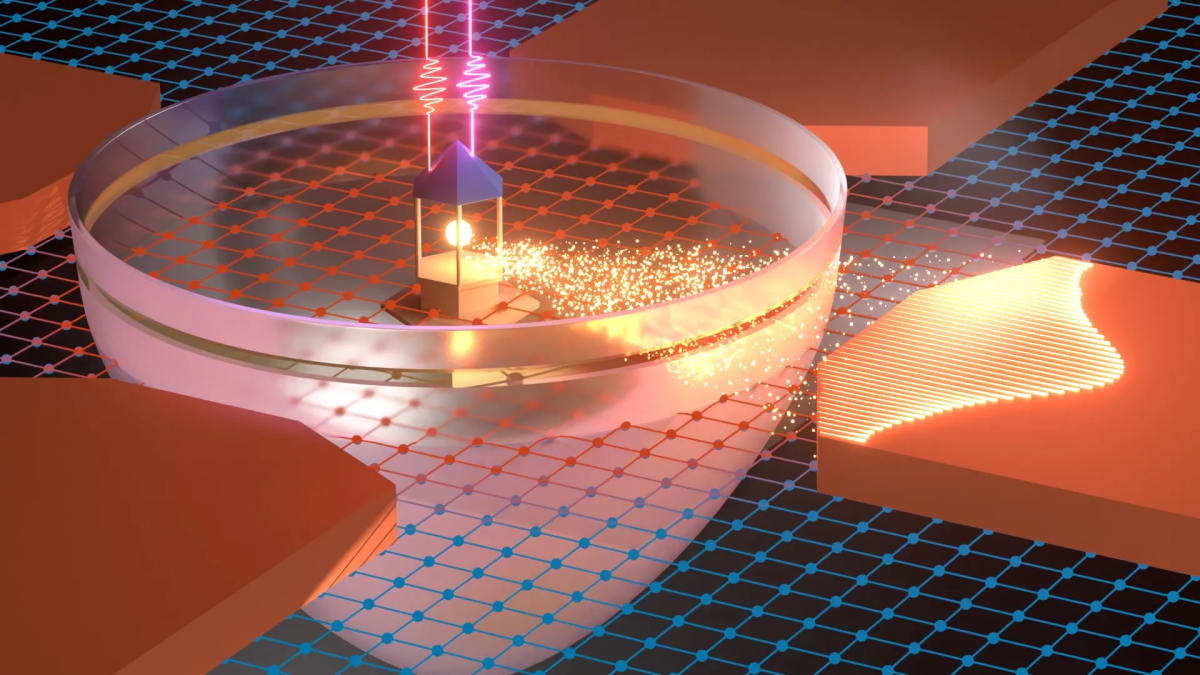
The breakthrough device uses two different colors of laser light to create and direct a narrow stream of electrons through a semiconductor. By adjusting the light's properties, researchers can sweep that electron beam in any direction they choose, just like a lighthouse rotating across the horizon.
"This isn't the way things normally work," said physicist Steven Cundiff, who led the research. Normally, electrons need an electrical field pushing them to move through materials. Here, light alone does the job, "squirting the electrons in a specific direction" without any applied voltage.
The secret lies in quantum interference, where two colors of light send electrons through different pathways that meet at the same destination. Think of it like overlapping ripples in water. When the ripples align, they reinforce electrons moving in one direction. When they clash, they cancel out electrons trying to go other ways.
Former doctoral student Yiming Gong spent months perfecting the manufacturing process at U-M's Lurie Nanofabrication Facility. The trickiest part was building the device without introducing any stray electric fields, which would have ruined the experiment by making it impossible to prove the light alone controlled the electrons.
The device started as pure physics research, testing a prediction made by University of Toronto scientist J.E. Sipe. But the practical applications could be enormous.
Why This Inspires
This discovery shows how curiosity-driven research can spark unexpected innovations. What began as a team testing fundamental physics theory could eventually help create better smartphone cameras, faster internet connections, and more sensitive medical imaging devices.
The technology might also revolutionize how electronic devices talk to each other, combining the speed of light with the power of electronics. Gong notes the device "has the potential to turn into something that measures different aspects of light" in ways current sensors cannot.
The project received support from the National Science Foundation and demonstrates how investing in basic science pays dividends. Gong has since earned his doctorate and now applies the problem-solving skills he developed during this research to machine learning challenges in Chicago.
The electron lighthouse proves that sometimes the most practical breakthroughs come from asking the simplest questions about how nature works.
Based on reporting by Science Daily
This story was written by BrightWire based on verified news reports.
Spread the positivity!
Share this good news with someone who needs it