Scientists Create Floating 'Time Crystal' Using Sound Waves
Physicists at NYU just made styrofoam beads dance through time by suspending them on invisible sound waves, creating a breakthrough that rewrites the rules of physics. This surprisingly simple discovery could one day revolutionize quantum computing and help us understand our own biological clocks.
Imagine beads of styrofoam floating in mid-air, defying gravity while dancing in patterns that repeat through time rather than space. That's exactly what physicists at New York University just created, and it's challenging one of the fundamental laws we all learned in science class.
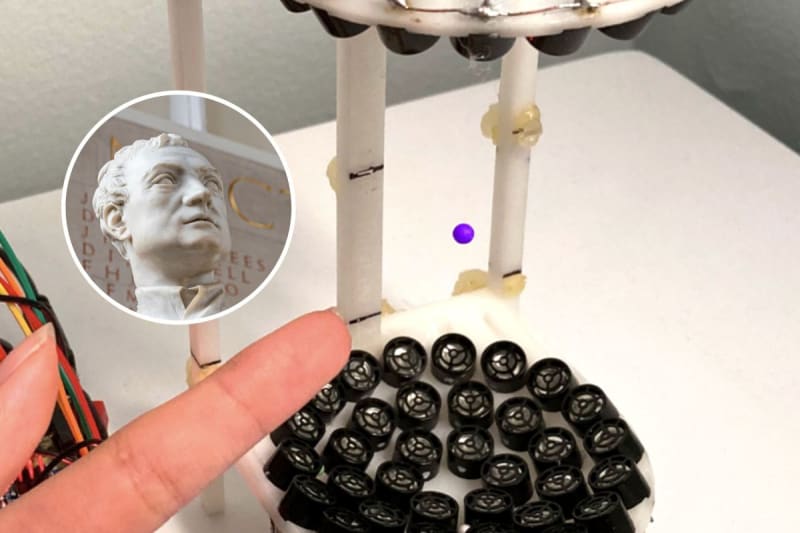
The team developed a new type of "time crystal" by suspending packing beads between two speaker arrays just six inches apart. Unlike regular crystals that repeat patterns across space (think diamonds or salt), time crystals organize themselves into repeating patterns across the dimension of time.
The process sounds almost magical but follows a beautiful logic. Sound waves push on the beads like waves pushing a leaf on a pond's surface, creating enough force to make them levitate. Once floating, the beads interact by exchanging scattered sound waves in a way that breaks Newton's Third Law of Motion.
Here's where it gets interesting. Larger beads scatter more sound than smaller ones, creating unbalanced interactions. Think of two ferries of different sizes approaching a dock. Each creates waves that push the other around, but not equally.
"Our system is remarkable because it's incredibly simple," said NYU physicist David Grier. Time crystals were first proposed in 2012 by Nobel Prize winner Frank Wilczek, but they seemed impossibly exotic and complicated. Until now.
Why This Inspires
This discovery proves that groundbreaking science doesn't always require billion-dollar equipment or years of complex calculations. Sometimes the biggest breakthroughs come from playing with simple materials like styrofoam beads and speakers. The team turned everyday objects into something that challenges fundamental physics.
The real promise extends far beyond floating beads. These time crystals could revolutionize quantum computing and advanced data storage. Even more fascinating, they might help us understand our own bodies better.
Some biochemical networks in our bodies, like the systems that break down food or regulate our circadian rhythms, also interact nonreciprocally like these floating crystals. Understanding how time crystals work could unlock mysteries about our biological clocks and internal rhythms.
The research shows how curiosity-driven science can open unexpected doors. What started as an exploration of how sound waves interact with particles became a window into understanding both cutting-edge quantum systems and ancient biological processes.
Science keeps reminding us that the universe still holds beautiful surprises, and sometimes they're hiding in plain sight.
More Images


Based on reporting by Google News - Scientists Discover
This story was written by BrightWire based on verified news reports.
Spread the positivity!
Share this good news with someone who needs it