Scientists Create Groundbreaking Maps of Sun's Atmosphere, Opening New Era of Discovery
In an exciting milestone for space science, researchers have produced the first detailed maps of the sun's outer boundary, revealing a fascinating pufferfish-like structure. This breakthrough achievement promises to revolutionize our ability to predict solar activity and protect vital technology while deepening our understanding of the cosmos.
Scientists have achieved a remarkable breakthrough in solar science, creating the first verified maps of the sun's dynamic outer atmosphere—and the results are as beautiful as they are scientifically significant.
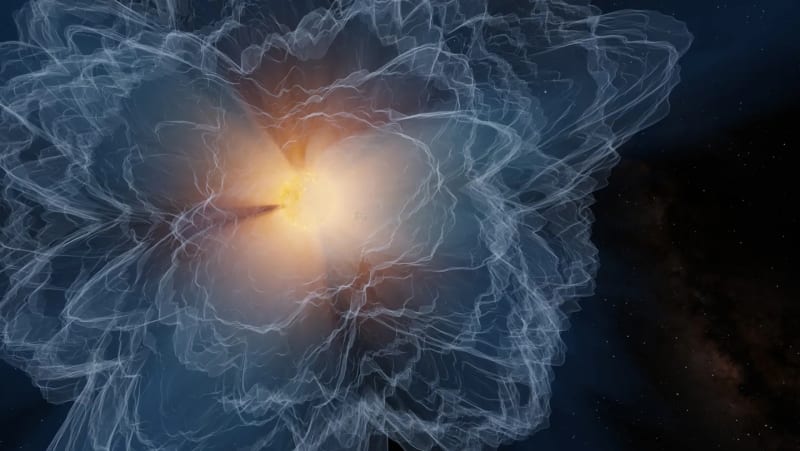
The boundary between the sun and the rest of our solar system resembles a spiky pufferfish, according to heliophysicist Sam Badman and his team at the Harvard-Smithsonian Center for Astrophysics. This discovery marks an exciting new chapter in our understanding of Earth's closest star and how it influences life throughout the solar system.
"The structure is basically this kind of corrugated, spiky shape," Badman explains enthusiastically. The team's findings, published in the December 20 issue of Astrophysical Journal Letters, reveal that as the sun becomes more active, this boundary expands and develops even more pronounced spikes—a fascinating dance of cosmic proportions.
This achievement wouldn't have been possible without NASA's intrepid Parker Solar Probe, which made history in 2021 by becoming the first spacecraft to venture below what scientists call the Alfvén critical surface. Since that pioneering moment, the probe has courageously dipped into the sun's corona sixteen times, swooping to within just 6.1 million kilometers of the solar surface in December 2024.
The Alfvén surface represents a crucial threshold where solar plasma and particles transition from being part of the sun to becoming the solar wind that flows throughout our solar system. It's the invisible line that separates the corona—the stunning halo visible during solar eclipses—from the streams of particles that eventually interact with Earth's atmosphere to create spectacular auroras.
What makes this research particularly exciting is its potential to improve life here on Earth. By understanding how this boundary shifts and changes, scientists can better predict solar activity that affects our satellites, communications systems, and even the health of humans and animals. The ability to forecast space weather with greater accuracy means we can better protect our increasingly technology-dependent civilization.
The research team tracked how the Alfvén surface transformed over half of the sun's eleven-year magnetic cycle, watching it expand and become more complex as the sun moved from its quiet phase to its more active period. These observations are painting a comprehensive picture of our star's behavior that was previously impossible to obtain.
Looking ahead, researchers are eagerly anticipating the next five years of observations as Parker continues its mission, repeatedly crossing this cosmic boundary while the sun returns to its quieter phase. Each crossing provides invaluable data that enhances our understanding of solar physics.
The implications of this research extend far beyond our solar system. Scientists are now applying these insights to understand planets orbiting other stars, particularly those very close to their parent stars. This knowledge helps astronomers assess the habitability of distant worlds and understand the diverse planetary environments throughout our galaxy.
This groundbreaking work exemplifies the power of human curiosity and technological innovation. As we continue to explore our cosmic neighborhood with increasingly sophisticated tools, each discovery opens new doors to understanding our place in the universe and improving life on our home planet.
Based on reporting by Reddit - Science
This story was written by BrightWire based on verified news reports.
Spread the positivity! 🌟
Share this good news with someone who needs it
More Good News
 🚀 Innovation
Scientists Make Exciting Progress in Quest to Discover Leonardo da Vinci's DNA
 🚀 Innovation
Revolutionary Telescope Discovers Record-Breaking Spinning Asteroid in Breakthrough Achievement
 🚀 Innovation
Clemson Researcher's Space Fire Safety Work Could Protect Future Moon and Mars Explorers
Joke of the Day
Why don't scientists trust atoms?
Explore Categories
Quote of the Day
"The only way to do great work is to love what you do."
— Steve Jobs