Scientists Create Material That's Solid Then Melts On Command
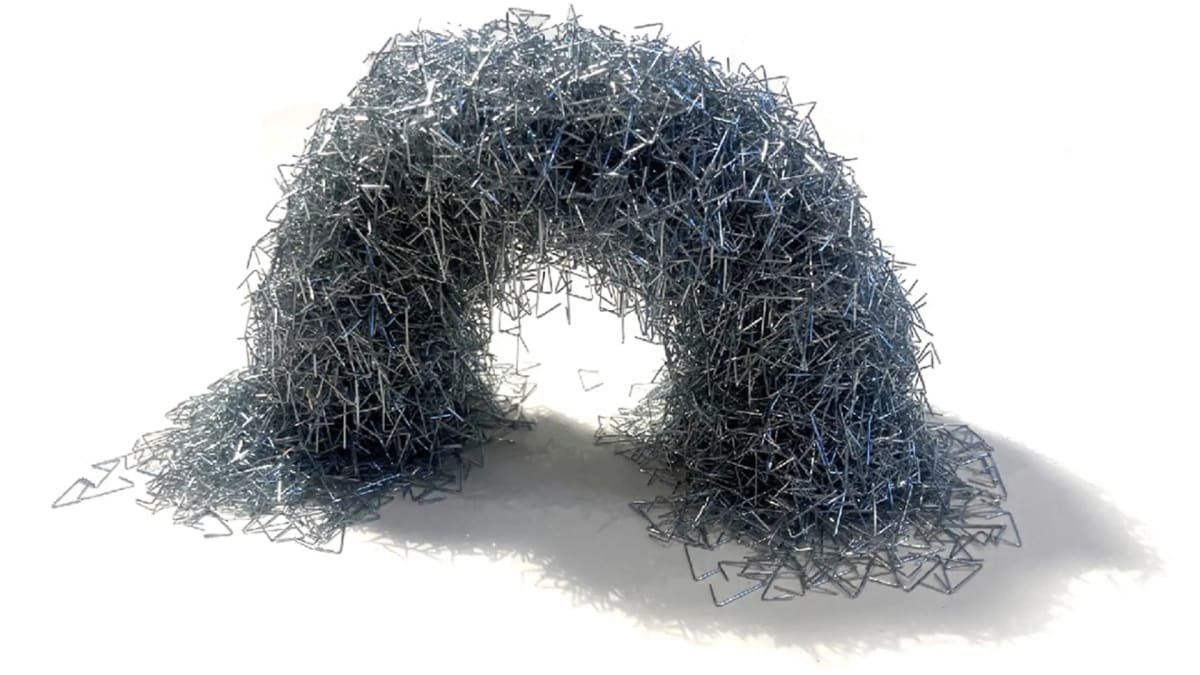
Researchers at CU Boulder have developed a revolutionary material made from staple-shaped particles that can lock together into strong structures, then instantly fall apart with simple vibrations. The breakthrough could transform how we build and recycle everything from bridges to robots.
Imagine a bridge that assembles itself when needed, then quietly disassembles into reusable parts when its work is done.
Scientists at the University of Colorado at Boulder have moved one step closer to making this vision real. They've created a remarkable material that acts solid one moment and effortlessly separates the next, all controlled by vibrations.
The inspiration came from an unlikely source: office staples. Professor Francois Barthelat and his team noticed that compressed bundles of staples behave strangely. The tangled mass resists being pulled apart like a solid object, yet the right shake can make it instantly separate into individual pieces.
The researchers wondered if they could harness this behavior on purpose. Using computer simulations, they tested thousands of particle shapes to find which ones would interlock most effectively.
The winner was a two-legged shape resembling a staple. When these particles come together, they form strong connections through entanglement, much like twigs in a bird's nest or proteins in bone. But unlike traditional materials, gentle vibrations make them lock tighter while stronger vibrations make them let go.
PhD student Saeed Pezeshki explains the material combines two qualities rarely found together: tensile strength and toughness. "It's obviously not a liquid. However, it's also not quite solid," says Barthelat. "This opens new and intriguing engineering possibilities."
The team can now control exactly how the particles behave just by changing vibration patterns. Think of it like having a volume knob for a material's strength.
The Ripple Effect
The technology could revolutionize construction and sustainability. Buildings and bridges might be assembled from these entangled materials, then completely disassembled and reused at the end of their life instead of being demolished into waste.
The applications extend beyond construction. Researchers are exploring uses in swarm robotics, where small robots could link together to complete a task, then separate and reconfigure for the next challenge. Barthelat playfully compares it to the shape-shifting T-1000 from Terminator 2.
The team is already testing their next design: particles with additional protruding legs that resemble sticky burrs. Early results suggest even stronger entanglement is possible.
While scaling up the technology remains expensive and challenging, the researchers believe they've unlocked a fundamental principle. By changing particle shape, they can dramatically change how materials behave.
The future might include structures that adapt to our needs, then gracefully return to their components when we're done with them.
Based on reporting by Science Daily
This story was written by BrightWire based on verified news reports.
Spread the positivity!
Share this good news with someone who needs it