
Scientists Create Perfect Random Numbers Using Quantum Tech
Researchers at ETH Zurich have achieved true randomness for the first time, a breakthrough that could make everything from encryption to digital security virtually unbreakable. Using quantum physics and supercooled chips, they've solved a problem that has plagued computers since their invention.
Creating truly random numbers sounds simple, but it's one of the hardest problems in computing—and scientists in Switzerland just cracked it.
Researchers at ETH Zurich have demonstrated the first certified generation of perfect randomness using quantum physics. Led by professors Renato Renner and Andreas Wallraff, the team used entangled superconducting qubits to produce number sequences that contain absolutely no hidden patterns or biases.
Why does this matter? Every random number generator we've ever built carries tiny biases that make certain numbers appear more often than others. For most everyday uses, those biases are harmless. But in cryptography, where security depends on unpredictability, even the smallest pattern becomes a dangerous weakness that hackers can exploit.
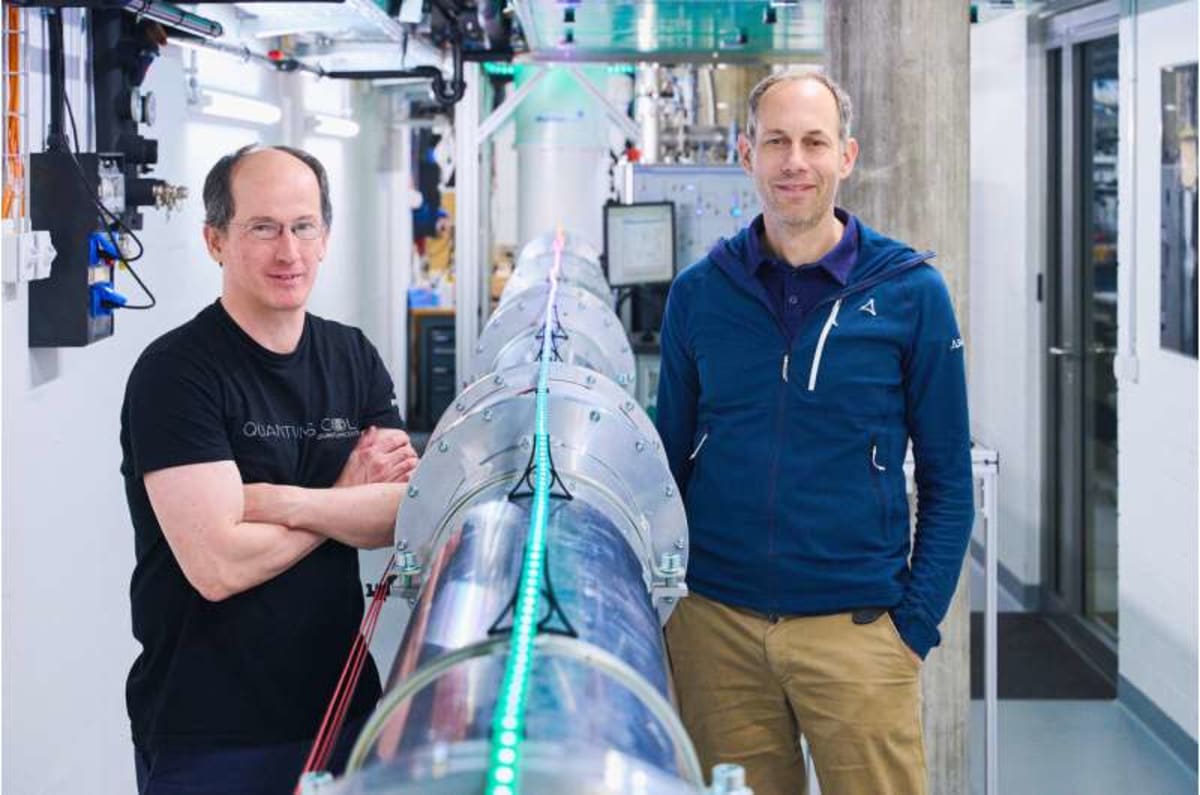
The experiment works by cooling two superconducting chips to near absolute zero and connecting them with a 98-foot tube. Each chip acts as a qubit, the quantum version of a computer bit. Microwave photons travel through the tube, creating quantum entanglement between the chips—that "spooky" phenomenon where measuring one particle instantly affects another.
By keeping the qubits nearly 100 feet apart, the team ensured that even light-speed signals couldn't travel between them fast enough to corrupt the measurements. They started with an imperfect random number generator to choose how to measure the qubits, then used a special algorithm to amplify the randomness. The quantum system cleanses all bias from the input, producing outputs that are certifiably random.
The computational advantage is huge. Traditional pseudo-random number generators require intensive processing power. This quantum method generates randomness simply by measuring quantum bits, making the computational cost negligible.
Why This Inspires
The researchers compare their achievement to the atomic clock—a fundamental reference point that other systems can trust completely. Just as atomic clocks revolutionized timekeeping and navigation, perfect randomness could transform digital security.
The applications are already taking shape. Future encrypted messages could become unbreakable. Digital identities could be protected with unprecedented security. Lottery systems could guarantee absolute fairness. Blockchain operations could gain new levels of trust.
Renner envisions networks where every node connects to a quantum randomness server, creating a web of perfect unpredictability. The method doesn't just improve on what came before—it achieves something that was theoretically impossible with conventional technology.
After decades of trying to eliminate bias from random number generation, scientists have finally found the answer in the strange laws of quantum mechanics.
More Images


Based on reporting by Live Science
This story was written by BrightWire based on verified news reports.
Spread the positivity!
Share this good news with someone who needs it


-1788313452597.jpg)