Scientists Create Tiny Arteries to Predict Stroke Risk
Researchers at the University of Sydney have developed miniature 3D-printed copies of patients' arteries that can predict stroke risk with unprecedented accuracy. The breakthrough could help doctors identify who's most at risk and choose the best treatment for each person.
Doctors may soon predict your stroke risk by watching how your blood flows through a tiny 3D-printed copy of your own artery.
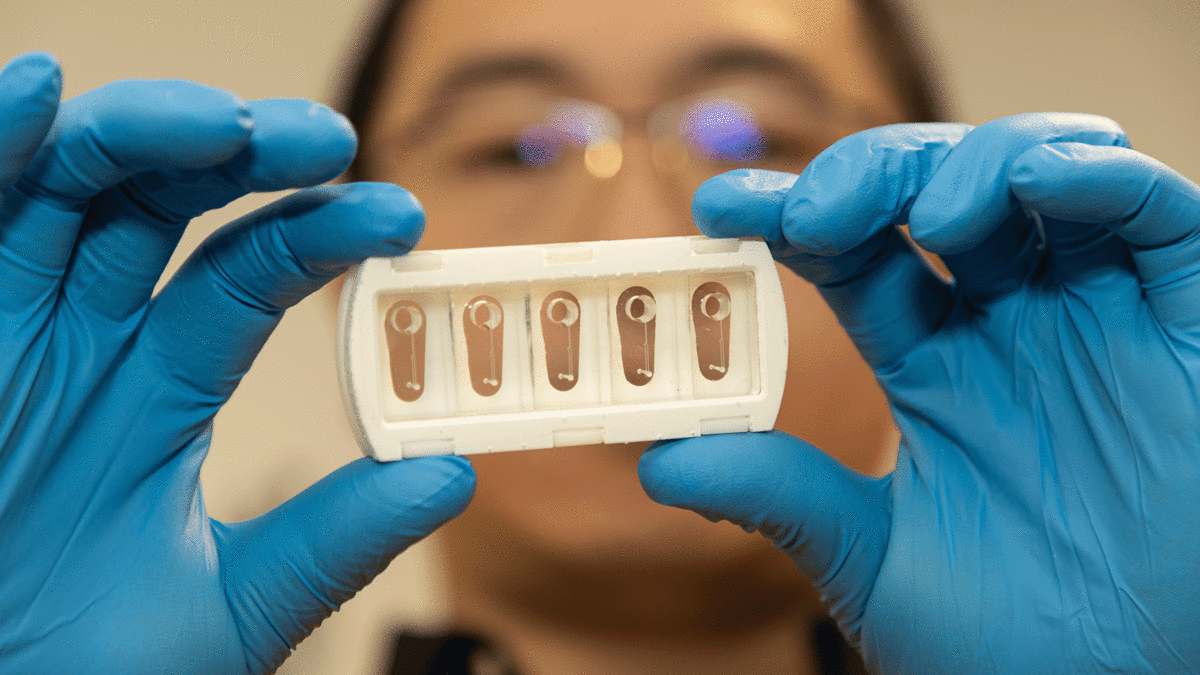
Researchers at the University of Sydney have created what they call "arteries-on-a-chip," miniature replicas of patients' carotid arteries that could revolutionize how doctors prevent strokes. The breakthrough allows medical teams to see exactly how dangerous blood clots form and break apart in each individual patient.
Here's how it works: Scientists take a patient's existing CT scan and use it to 3D print a plastic replica of their carotid artery, the blood vessel that carries oxygen to the brain. They coat the inside with the same materials found in real arteries, then flow actual blood through it at body-like speed and pressure.
The team can watch in real time as clots form, grow, and sometimes break apart. That last part matters most because loose clot fragments traveling to the brain cause most strokes.
"Clinically, we are very good at imaging how narrow an artery is, but narrowing alone does not tell us exactly how a clot will behave," explained Charles Zhao, a doctoral student who led the research published in Cell Biomaterials.
The innovation fills a critical gap in stroke prevention. Ischemic stroke, caused by blocked arteries in the brain, ranks as the second leading cause of death worldwide after heart disease. Roughly one in five of these strokes stems from fatty plaque buildup in arteries.
What surprised researchers most was discovering that two patients with nearly identical artery damage could face vastly different risks. The three-dimensional shape of each person's unique artery creates different blood flow patterns, making some people more prone to dangerous clot fragments than others.
The Bright Side
While still in proof-of-concept stage, this technology opens exciting new doors for personalized medicine. Doctors could use these miniature arteries to test different medications and see which works best before giving anything to the patient.
"I see this approach being most relevant to difficult clinical cases," Zhao said. "For example, patients who have experienced recurrent events despite treatment, or cases where clinicians have several possible treatment strategies but limited functional information to distinguish between them."
The research team tested their models on six patients with different types of arterial damage. By combining precise measurements of blood flow with observations of real clotting behavior, they built a far more complete picture of stroke risk than medical scans alone could provide.
Someday soon, your doctor might 3D print a copy of your arteries to keep you safer.
More Images

Based on reporting by Live Science
This story was written by BrightWire based on verified news reports.
Spread the positivity!
Share this good news with someone who needs it