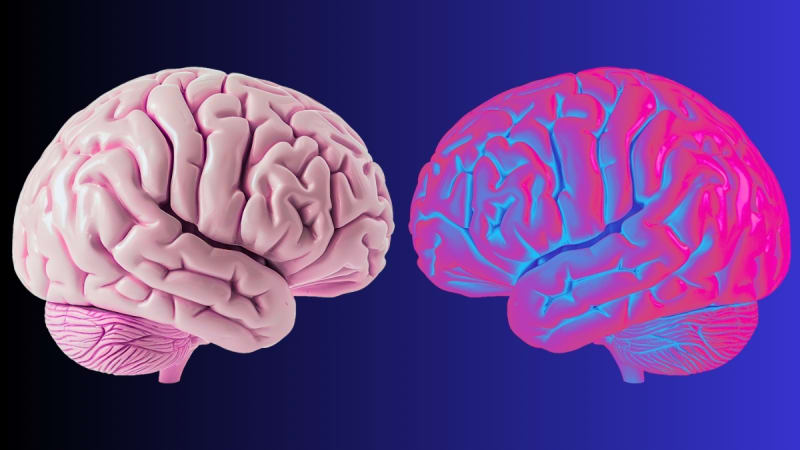
Scientists Discover Brain Waves That Define Your Body Sense
Swedish and French researchers have identified the specific brain waves that help us tell where our body ends and the world begins. The breakthrough could transform treatments for phantom limbs and make prosthetics feel more real.
Your brain performs an invisible miracle every second: it knows exactly where "you" end and everything else begins.
Scientists at Sweden's Karolinska Institute and French research partners have cracked the code behind this sensation. They discovered that alpha waves in a brain region called the parietal cortex control how we sense our body's boundaries.
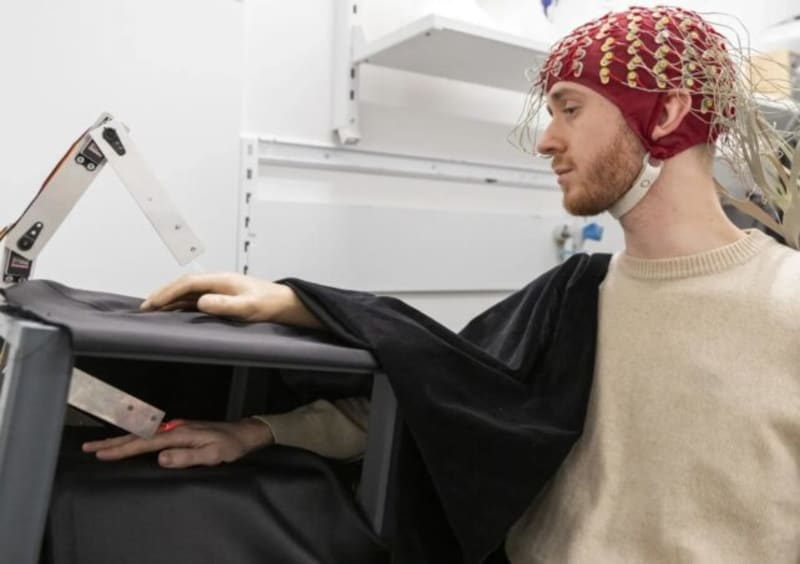
The team studied 106 people using the famous rubber hand illusion. They hid each person's real hand and replaced it with a fake one, then tapped both hands at the same time. When the timing matched perfectly, people felt the rubber hand was actually part of their body.
Here's where it gets fascinating. Brain scans revealed that people with faster alpha waves could instantly tell when the fake hand didn't belong to them, even with tiny timing differences. People with slower alpha waves were easier to fool, accepting the fake hand as real even when the taps were slightly off.
Lead researcher Mariano D'Angelo wanted to know if these brain waves actually controlled the sensation or just reflected it. So the team used gentle electrical stimulation to speed up or slow down participants' alpha waves. The results were clear: faster waves made people more precise about sensing their body, while slower waves blurred the boundary between self and world.
The Ripple Effect
This discovery reaches far beyond a clever party trick with rubber hands. The findings could revolutionize care for amputees who experience phantom limb sensations, where the brain still feels a missing arm or leg.
The research also opens new paths for people with schizophrenia, a condition where the sense of self can become confused. Understanding these brain waves might lead to treatments that help restore a clearer sense of body ownership.
Engineers designing prosthetic limbs now have a roadmap for making artificial arms and legs feel genuinely real. Virtual reality developers could use these insights to create more immersive experiences where digital worlds feel as natural as physical ones.
The parietal cortex acts like the brain's mapmaker, constantly updating where your body is in space and what sensations belong to you. These alpha waves function as the timing mechanism that keeps everything synchronized.
"We have identified a fundamental brain process that shapes our continuous experience of being embodied," D'Angelo explains. It's the difference between knowing intellectually that something is yours and actually feeling it as part of you.
The research appears in Nature Communications, one of the world's leading scientific journals. Henrik Ehrsson, the study's senior author, notes that their findings explain how the brain integrates countless signals from the body to create one unified sense of self.
What seems automatic actually requires precise neural orchestration happening thousands of times per day, and now we finally understand how.
More Images

Based on reporting by Google News - Science
This story was written by BrightWire based on verified news reports.
Spread the positivity!
Share this good news with someone who needs it