Scientists Discover Quantum Systems Can Stay Cool Against All Odds
Researchers have made an exciting breakthrough showing that quantum systems can defy classical physics by refusing to heat up even when continuously driven with energy. This discovery, rooted in the remarkable properties of quantum coherence, could pave the way for more stable and reliable quantum computers and technologies.
In a thrilling development that challenges our understanding of physics, scientists at the University of Innsbruck have discovered something truly remarkable: quantum systems can remain surprisingly cool and orderly, even when you'd expect them to heat up and fall into chaos.
We all know from everyday experience that repeated force creates heat. Rub your hands together and they warm up. Keep stirring your coffee and the spoon gets warm. It's one of those fundamental rules we learn simply by living in the world. Scientists have long assumed the same principle applies at the tiniest scales of quantum physics. But this groundbreaking experiment proves that assumption beautifully wrong.
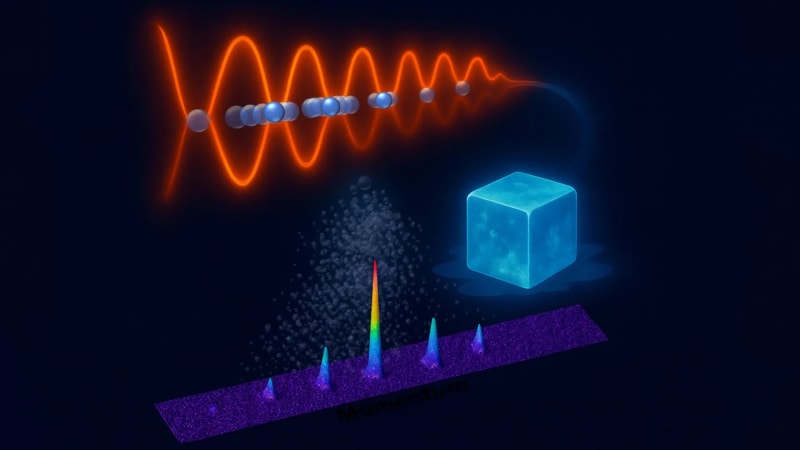
Led by Professor Hanns Christoph Nägerl's team, researchers created an ultra-cold quantum fluid from atoms cooled to just billionths of a degree above absolute zero. They then repeatedly "kicked" these atoms using pulses of laser light, fully expecting the system to absorb energy continuously and heat up, much like someone bouncing higher and higher on a trampoline.
What happened instead left the scientists delightfully surprised. After a brief initial period, something extraordinary occurred: the atoms simply stopped absorbing energy. Their momentum froze in place, and despite being continuously driven and strongly interacting with each other, the system entered what scientists call "many-body dynamical localization."
"We had initially expected that the atoms would start flying all around," admits lead author Yanliang Guo with evident wonder. "Instead, they behaved in an amazingly orderly manner."
The secret behind this unexpected stability? Quantum coherence—one of the most fascinating and useful properties of quantum mechanics. This quantum effect essentially allows the system to maintain its cool composure and resist the chaos that classical physics would predict.
To confirm how special this state really was, the researchers introduced some randomness into their laser pulses. The localization immediately disappeared, and the atoms returned to conventional behavior, heating up as expected. This elegant test proved that quantum coherence was indeed the hero of the story.
The implications of this discovery extend far beyond satisfying scientific curiosity. One of the biggest hurdles in developing practical quantum computers and quantum simulators is preventing unwanted heating that destroys the delicate quantum states these devices depend on. This research offers hope that we can harness nature's own mechanisms to keep quantum systems stable and functional.
"This experiment provides a precise and highly tunable way for exploring how quantum systems can resist the pull of chaos," explains Guo enthusiastically.
Theory collaborator Lei Ying from Zhejiang University in China emphasizes the significance: "What's striking is the fact that in a strongly driven and strongly interacting system, many-body coherence can evidently halt energy absorption. This reveals a remarkable stability rooted in quantum mechanics."
The findings, published in the prestigious journal Science, open exciting new pathways for understanding how quantum systems behave when pushed far from equilibrium. They challenge long-held assumptions and demonstrate that nature still has wonderful surprises in store for us.
As quantum technologies continue advancing toward practical applications, discoveries like this bring us closer to realizing the full potential of quantum computing, offering hope for revolutionary advances in medicine, materials science, communication, and countless other fields.
Based on reporting by Science Daily
This story was written by BrightWire based on verified news reports.
Spread the positivity! 🌟
Share this good news with someone who needs it
More Good News
 🚀 Innovation
China's Fusion Reactor Smashes 30-Year Energy Barrier in Hefei Breakthrough
 🚀 Innovation
Astronomers Discover Cloud-9: A Cosmic Fossil That Unlocks Universe's Secrets
 🚀 Innovation
Breakthrough Battery Technology Promises Safer, Longer-Lasting Energy Storage
Joke of the Day
Why did the dog apply for a job at the bank?
Explore Categories
Quote of the Day
"The greatest thing you'll ever learn is just to love and be loved in return."
— Moulin Rouge (from the film, popularized by Ewan McGregor)