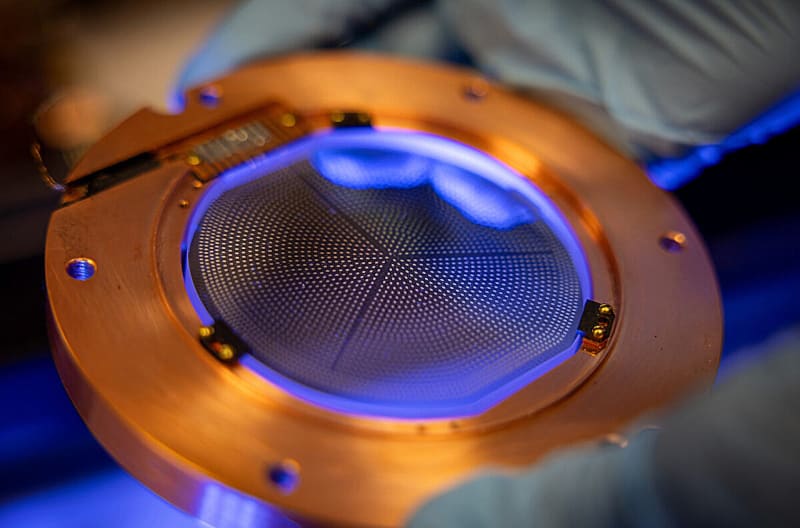
Scientists Edge Closer to Universe's Greatest Mystery With Breakthrough Detectors
Researchers at Texas A&M University are developing revolutionary quantum detectors that could finally unlock the secrets of dark matter, which makes up 95% of our universe. These ultra-sensitive devices represent a thrilling leap forward in humanity's quest to understand the cosmos.
Imagine holding a key that could unlock the greatest mystery in the universe. That's exactly what Dr. Rupak Mahapatra and his team at Texas A&M University are working toward, and they're making remarkable progress.
In one of the most exciting frontiers of modern science, these brilliant researchers are developing detectors so extraordinarily sensitive they can detect whispers of particles that interact with our world only once in a decade. It's like having a conversation with the universe itself, and we're finally learning to listen.
The quest centers on dark matter and dark energy, which together comprise an astonishing 95% of everything that exists. While we can only directly observe 5% of the universe, scientists are optimistic that breakthrough technologies will soon reveal what's been hidden in plain sight all along.
"It's like trying to describe an elephant by only touching its tail," Mahapatra explains warmly. "We sense something massive and complex, but we're only grasping a tiny part of it." This humility coupled with determination perfectly captures the spirit of this groundbreaking work.
The team's achievements are already turning heads in the scientific community. Their work with the innovative TESSERACT detector represents a quantum leap forward in detection capabilities. "It's about innovation," Mahapatra shares enthusiastically. "We're finding ways to amplify signals that were previously buried in noise."
What makes this research particularly thrilling is its 25-year foundation of continuous advancement. In 2014, Mahapatra and his colleagues introduced a game-changing technique called voltage-assisted calorimetric ionization detection, dramatically expanding our ability to detect elusive dark matter candidates. This wasn't just an incremental improvement—it opened entirely new possibilities for exploration.
The implications extend far beyond academic curiosity. Understanding dark matter could revolutionize our grasp of fundamental physics and potentially lead to technologies we haven't even dreamed of yet. "If we can detect dark matter, we'll open a new chapter in physics," Mahapatra says with palpable excitement.
The collaborative spirit of this research is equally inspiring. Texas A&M stands among an elite group of institutions worldwide working together on TESSERACT experiments, combining different detection strategies to solve this cosmic puzzle. Graduate students and engineers work side by side, polishing semiconductor crystals to flatness measuring 1/100th the thickness of a human hair—a testament to human precision and dedication.
These detectors don't just search for dark matter; they also detect reactor neutrinos, contributing to nuclear non-proliferation efforts and demonstrating how pure research can yield practical benefits for global security.
"No single experiment will give us all the answers," Mahapatra acknowledges. "We need synergy between different methods to piece together the full picture." This collaborative, multi-pronged approach reflects the best of human ingenuity—scientists across the globe working together toward a common goal.
As these ultra-sensitive quantum sensors continue to push boundaries, we're standing on the threshold of potentially answering questions humanity has pondered for generations. The universe is vast and mysterious, but thanks to dedicated researchers like Mahapatra and his team, we're closer than ever to understanding our place within it.
The search continues, and the future has never looked brighter.
Based on reporting by Phys.org
This story was written by BrightWire based on verified news reports.
Spread the positivity! 🌟
Share this good news with someone who needs it
More Good News
 🚀 Innovation
Australian Researchers Create Game-Changing Tool to Protect Water From Toxic Chemicals
 🚀 Innovation
SK On and Seoul National University Make Exciting Battery Breakthrough
 🚀 Innovation
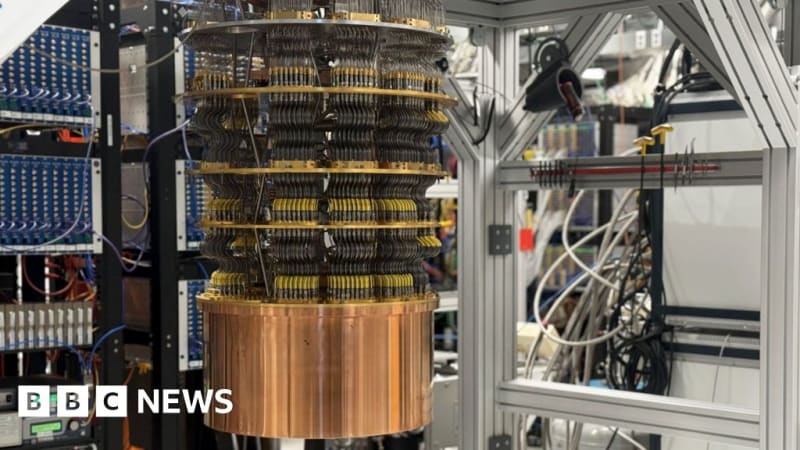
Revolutionary Quantum Computer Could Solve Humanity's Biggest Challenges
Joke of the Day
Why did the librarian get kicked out of class?
Explore Categories
Quote of the Day
"Do not go where the path may lead, go instead where there is no path and leave a trail."
— Ralph Waldo Emerson