Scientists Etch Einstein Portrait Using Only Light
Researchers discovered a crystal that can be reshaped permanently with simple light, no expensive equipment needed. This breakthrough could transform everything from smartphone security to augmented reality glasses.
Imagine drawing permanent patterns on glass using nothing but a laser pointer. That's essentially what scientists just achieved with a special crystal, opening doors to technologies we've only dreamed about.
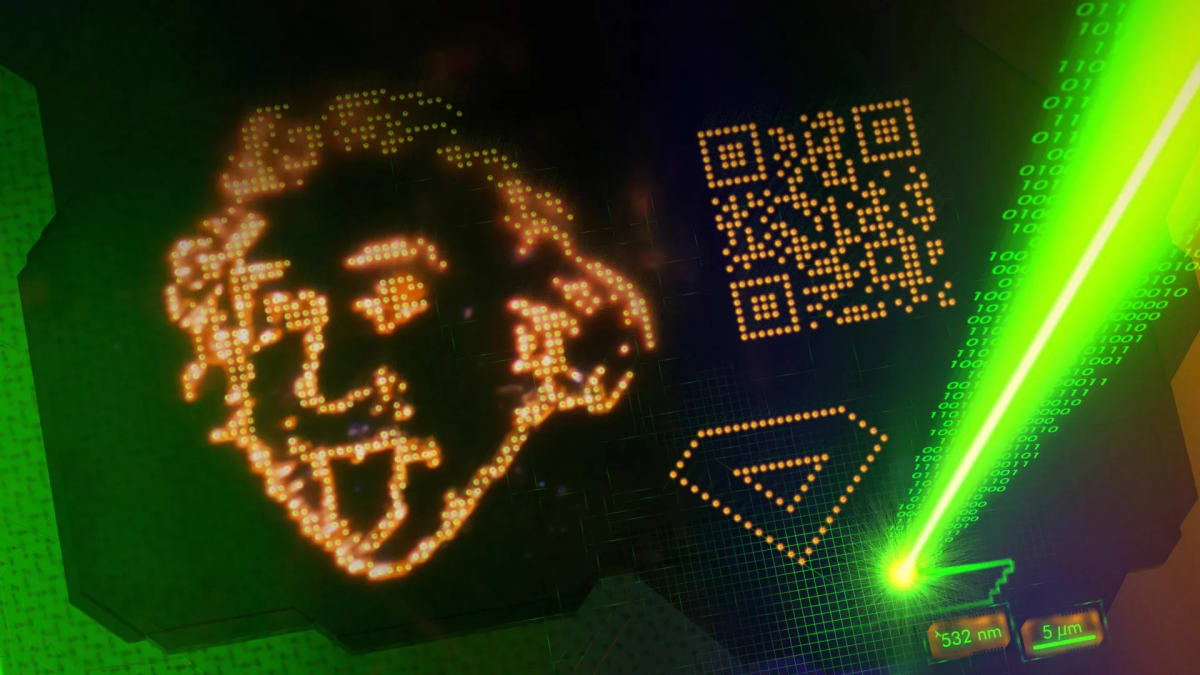
Researchers working with Nobel Prize winner Konstantin Novoselov discovered that arsenic trisulfide crystals can be permanently reshaped using ordinary continuous-wave light. To prove it works, they etched a microscopic portrait of Albert Einstein onto the crystal with points just 700 nanometers apart.
The crystal responds to light in an unusually powerful way. When light hits it, the material changes how it bends and slows other light passing through, a property called the refractive index. This change is three times stronger than what scientists see in other well-known materials.
What makes this discovery special is its simplicity. Most nanoscale manufacturing requires expensive cleanroom facilities and sophisticated laser systems costing millions of dollars. This technique works with standard lasers you might find in a research lab.
The material also physically expands up to 5% when exposed to light. This allows researchers to create tiny lenses and optical structures directly on its surface, perfect for building the next generation of augmented reality glasses and even smart contact lenses.
Why This Inspires
This isn't just about making tiny Einstein portraits. The patterns created in the crystal act like optical fingerprints that are nearly impossible to copy, offering new ways to fight counterfeiting and verify authentic products.
The technology could revolutionize how we build optical sensors, improve telecommunications networks, and create more compact imaging devices. Instead of complex manufacturing processes, engineers could simply write optical circuits with light itself.
Valentyn Volkov, Chief Technology Officer at XPANCEO, calls this discovery a fundamental building block for technology driven entirely by light rather than electricity. The crystal belongs to a special family called van der Waals materials, which scientists believe hold enormous untapped potential.
The researchers achieved resolution as fine as 50,000 dots per inch, creating patterns with strong optical contrast that are easy to detect. These embedded features remain permanently in the transparent material, making them ideal for security applications.
From advanced sensors to holographic authentication systems, this light-responsive crystal represents a significant leap forward in controlling light for practical applications. The team's work shows that sometimes the most revolutionary technologies come from discovering what natural materials can already do.
The future of photonics just got a lot brighter, and it only took a little light to get there.
Based on reporting by Science Daily
This story was written by BrightWire based on verified news reports.
Spread the positivity!
Share this good news with someone who needs it