Scientists Find 125M-Year-Old 'Spiny Dragon' With Porcupine Quills
Chinese paleontologists discovered a juvenile dinosaur with never-before-seen hollow spikes and skin so well-preserved that individual cells are still visible after 125 million years. The breakthrough offers scientists an unprecedented window into how ancient creatures protected themselves and evolved.
Scientists just uncovered a porcupine-covered dinosaur with skin preserved so perfectly they can see individual cells from 125 million years ago.
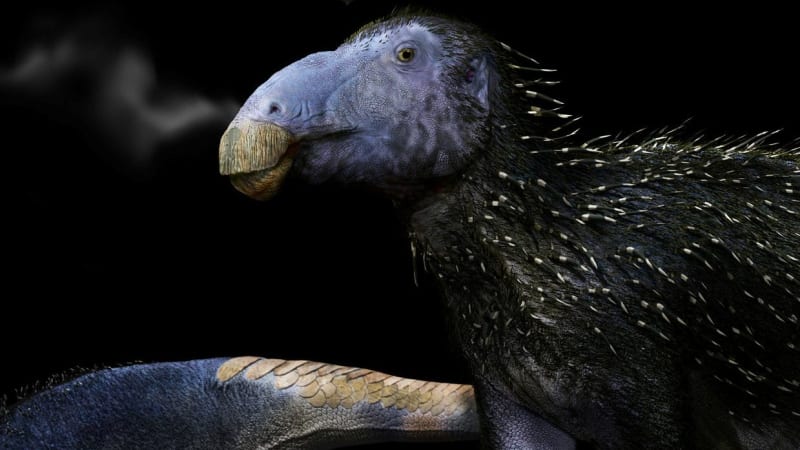
A team led by China's Anhui Geological Museum and Belgium's Institute of Natural Sciences identified the new species, nicknamed the "spiny dragon." The juvenile herbivore, officially named Haolong dongi, represents something paleontologists have never documented before: a dinosaur covered in hollow, porcupine-like spikes.
The fossil came from northeastern China and belongs to the iguanodontian family, ancestors of the famous duck-billed dinosaurs. But what makes this discovery special isn't just the species itself—it's the remarkable condition of its remains.
"Finding skin preserved at the cellular level in a dinosaur is extraordinary," said Pascal Godefroit, senior paleontologist at the Institute of Natural Sciences. "It gives us a window into the biology of these animals at a level that we never thought possible."
The dinosaur's body was covered in overlapping scales along its tail and different-sized spikes across its frame. Advanced imaging revealed these weren't just bony protrusions—they were cornified structures, similar to fingernails or horns, representing a unique evolutionary experiment.
Researchers believe the spikes served as armor against predators, making Haolong much harder to swallow. The hollow structures may have also helped with temperature regulation or even sensory perception, giving the young dinosaur multiple survival advantages.
Why This Inspires
This discovery reminds us that Earth still holds countless secrets waiting to be uncovered. After two centuries of studying dinosaurs, scientists are still finding entirely new ways these creatures adapted and survived.
"Two centuries after the naming of Iguanodon, we are still rewriting the story of these iconic herbivores," said Wu Wenhao, co-author from Jilin University. His team's work proves that even well-studied dinosaur families can surprise us with innovations we never imagined.
The cellular-level preservation opens doors for future discoveries. If scientists can see individual skin cells after 125 million years, what other biological details might be hiding in fossils we thought we understood?
"The complexity of dinosaur skin is far greater than we imagined," added Huang Jiandong, the study's first author. Each fossil discovery doesn't just add a new name to the dinosaur catalog—it rewrites our understanding of how life adapts, protects itself, and thrives against the odds.
Nature's experiments continue to reveal themselves, reminding us that wonder and discovery never stop.
More Images
Based on reporting by Google News - Scientists Discover
This story was written by BrightWire based on verified news reports.
Spread the positivity!
Share this good news with someone who needs it