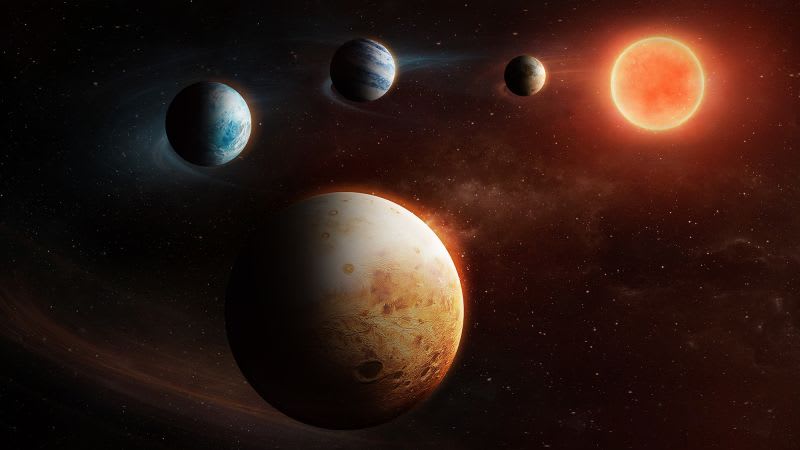
Scientists Find 'Backwards' Solar System 116 Light-Years Away
Astronomers discovered a solar system that breaks all the rules of planet formation, with rocky planets sandwiching gas giants in a pattern never seen before. The finding could rewrite our understanding of how planets form around the most common stars in the universe.
A solar system 116 light years from Earth is flipping everything scientists thought they knew about how planets form.
Four planets orbit a red dwarf star called LHS 1903, but they're arranged in a way that shouldn't exist according to current theories. The system starts with a rocky planet, followed by two gaseous planets, and then ends with another rocky planet on the outside.
That's the opposite of what we see in our solar system and across the galaxy, where rocky planets like Earth huddle close to their stars while gas giants like Jupiter orbit farther out. There's a good reason for that pattern: planets form from disks of gas and dust around young stars, and only materials that can handle extreme heat near the star can clump into rocky worlds.
"This is the first time in which we have a rocky planet so far away from its host star, and after these gas-rich planets," said Thomas Wilson, an assistant professor at the University of Warwick who led the study published in the journal Science. The discovery came from NASA's planet-hunting TESS telescope and the European Space Agency's Cheops satellite.
The outer rocky planet, called LHS 1903 e, is about 1.7 times the size of Earth. Wilson and his team tested whether it could have formed through planetary collisions or lost a gaseous atmosphere, but neither scenario fit the evidence.
Instead, they believe the planets formed in reverse order compared to our solar system, starting from the inside and moving outward over millions of years. By the time the outermost planet formed, most of the gas and dust had already been used up or blown away, leaving only rocky materials to work with.
The finding offers "some of the first evidence for flipping the script on how planets form around the most common stars in our galaxy," according to MIT professor Sara Seager, a study coauthor. Red dwarf stars like LHS 1903 make up the majority of stars in the universe, so understanding how their planetary systems form matters for the bigger picture of how common Earth-like worlds might be.
Why This Inspires
This discovery reminds us that the universe still has plenty of surprises waiting. Just when scientists think they've figured out the rules, nature shows them a new way things can work. The finding opens doors to understanding planetary systems we haven't even imagined yet, and it all happened because researchers were curious enough to look closely at something that didn't make sense.
Even in a maturing field of study, we're still learning how the universe builds the worlds around other stars.
More Images

Based on reporting by Google News - Science
This story was written by BrightWire based on verified news reports.
Spread the positivity!
Share this good news with someone who needs it

%2Fhttps%3A%2F%2Ftf-cmsv2-smithsonianmag-media.s3.amazonaws.com%2Ffiler_public%2F58%2F0a%2F580a77b9-7590-43c5-b70d-e3a590810348%2Fsmithmag-rockwell-edit.jpg)