Scientists Find Brain Link May Unlock Lung Cancer Treatment
Multiple research teams discovered that aggressive lung cancer cells form actual connections with brain neurons, and drugs that block these connections slow tumor growth in mice. The breakthrough could lead to new treatment options for one of the deadliest cancers.
Scientists just discovered something unexpected about the deadliest form of lung cancer: it talks to the brain, and blocking that conversation might save lives.
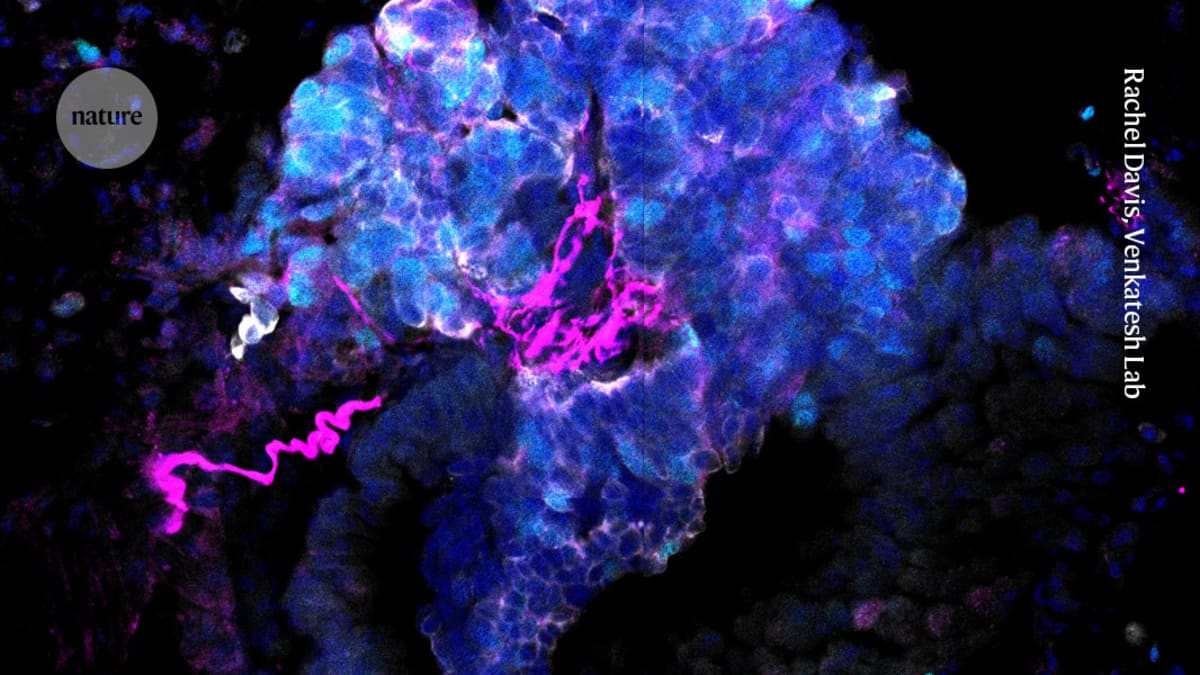
Three independent research teams found that small-cell lung cancer (SCLC) cells form actual synapses with neurons, the same connections brain cells use to communicate. When researchers tested drugs that interrupt these signals in mice, tumor growth slowed down.
Cancer biologist Filippo Beleggia at the University of Cologne wasn't even looking for brain connections. He ran genetic screens three times because he didn't believe the results kept pointing to neuron-related genes.
Meanwhile, Michelle Monje at Stanford University and Humsa Venkatesh at Harvard University were investigating why SCLC loves the brain so much. Up to 80% of SCLC patients eventually develop brain tumors, making it the most common brain cancer.
What they all found changed how we think about this disease. The cancer cells weren't just near neurons; they were forming true synaptic connections and receiving signals that accelerated tumor growth.
SCLC accounts for only 15% of lung cancers, but it's the most aggressive. Five-year survival rates sit below 10% because the disease spreads so fast and treatment options remain limited.
The discovery means existing drugs that reduce synaptic signaling could potentially help. "This opens up a new realm of potential helper medicines," Monje says.
Leanne Li at the Francis Crick Institute in London took it further. Her team confirmed that neuroendocrine-like SCLC cells fire action potentials just like real neurons do.
She also found that acetylcholine, a neurotransmitter released by the vagus nerve in the lungs, makes these cancer cells fire more frequently. Cigarette smoke contains nicotine, which mimics this effect, potentially explaining how smoking promotes early tumor growth.
The Ripple Effect
This research represents more than one cancer breakthrough. The methods these teams developed could help scientists understand whether other cancers use similar neural communication strategies.
Sage, who has studied SCLC for 20 years, notes that his team already showed in 2023 that SCLC cells communicate with astrocytes, another type of brain cell. The cancer essentially makes friends wherever it goes, creating supportive environments for growth.
The best part? Researchers don't need to invent entirely new drugs. Medications that affect synaptic signaling already exist, potentially shortening the path from laboratory discovery to patient treatment.
For patients facing one of medicine's toughest diagnoses, these converging discoveries offer something that's been in short supply: hope backed by science.
More Images


Based on reporting by Nature News
This story was written by BrightWire based on verified news reports.
Spread the positivity!
Share this good news with someone who needs it