Scientists Find Hidden Link to Australia's Mineral Riches
Australian researchers discovered that billion-year-old gold and platinum deposits share a common origin, potentially revolutionizing how we find critical minerals for green technology. The breakthrough could make mineral exploration more efficient and sustainable.
Finding the minerals we need for batteries, electronics, and clean energy just got easier thanks to a groundbreaking discovery in Western Australia.
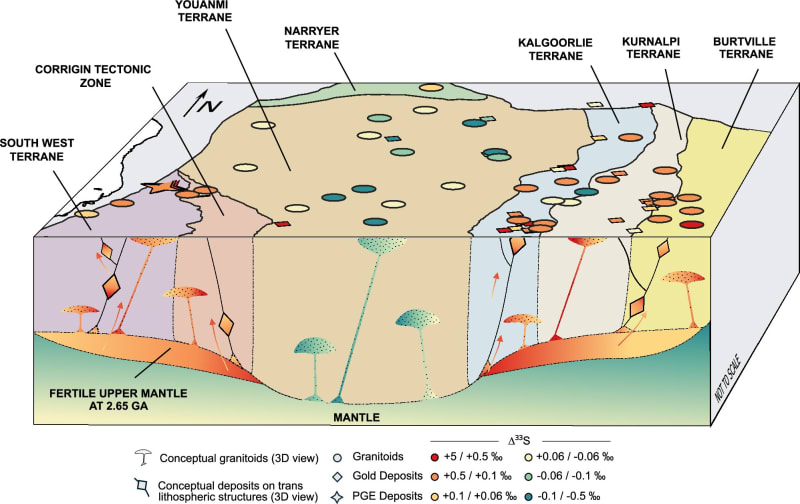
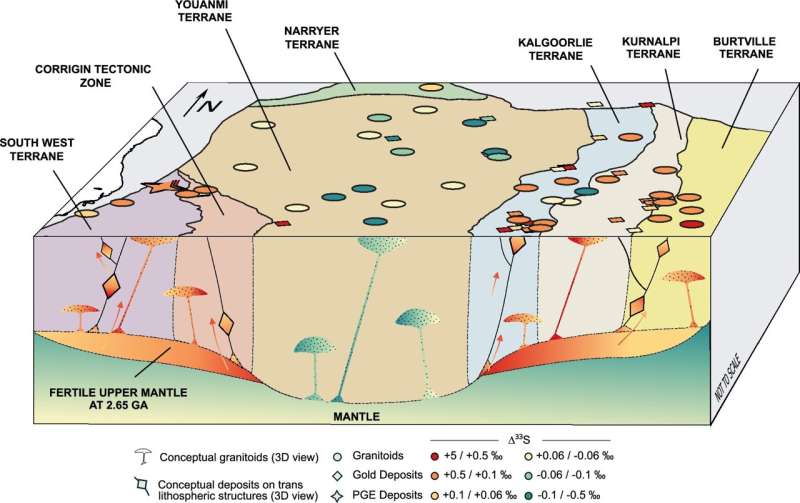
Researchers at The University of Western Australia uncovered something remarkable: gold deposits near Kalgoorlie and platinum-nickel deposits hundreds of kilometers away aren't separate geological accidents. They formed at the same time over 2.6 billion years ago and came from the same enriched source deep in Earth's mantle.
Ph.D. student Matthew Demmer led the study published in Nature Communications. His team challenged the conventional wisdom that different types of mineral deposits form through completely unrelated processes.
"In geology, we usually consider different deposit types as unrelated, but we took a different approach," Demmer explained. Instead of treating each deposit as its own puzzle, his team looked for connections.
The results were striking. Both deposit types shared identical isotopic signatures and metal compositions. They also traced back to a water-rich mantle layer that had been enriched with metals and volatile compounds over geological time.
The Ripple Effect
This discovery could transform how mining companies search for critical minerals needed for the green energy transition. Rather than hunting for individual deposits using separate models, geologists can now adopt what Demmer calls a "bottom-up" approach.
Understanding which mantle processes create metal-enriched zones and when they occurred helps predict where deposits might appear on the surface. It's like finding the recipe instead of just looking for the finished dish.
The timing couldn't be better. Global demand for platinum, palladium, and nickel is surging as the world shifts toward electric vehicles and renewable energy. These metals are essential for batteries, catalytic converters, and hydrogen fuel cells.
Western Australia's Yilgarn Craton, where the research focused, is already one of the world's premier mining regions. This new understanding could unlock additional deposits that were previously overlooked because they didn't fit traditional exploration models.
The research also promotes more sustainable exploration practices. By targeting areas with higher success probabilities based on deep mantle processes, mining companies can reduce unnecessary drilling and environmental disturbance.
Demmer's work represents a fundamental shift in geological thinking. Instead of viewing Earth's crust as a collection of isolated mineral deposits, scientists can now see the connected systems that created them.
This breakthrough reminds us that sometimes the biggest discoveries come from asking different questions about what we thought we already understood.
More Images

Based on reporting by Phys.org - Earth
This story was written by BrightWire based on verified news reports.
Spread the positivity!
Share this good news with someone who needs it


%20-%202.png)