Scientists Find How One Cell Builds a 170 Billion Cell Brain
Researchers discovered brain cells may organize themselves using a surprisingly simple rule: stick close to your cellular relatives. This breakthrough could help explain how a single cell transforms into a functioning human brain.
Scientists just cracked a major mystery about how our brains build themselves, and the answer is beautifully simple.
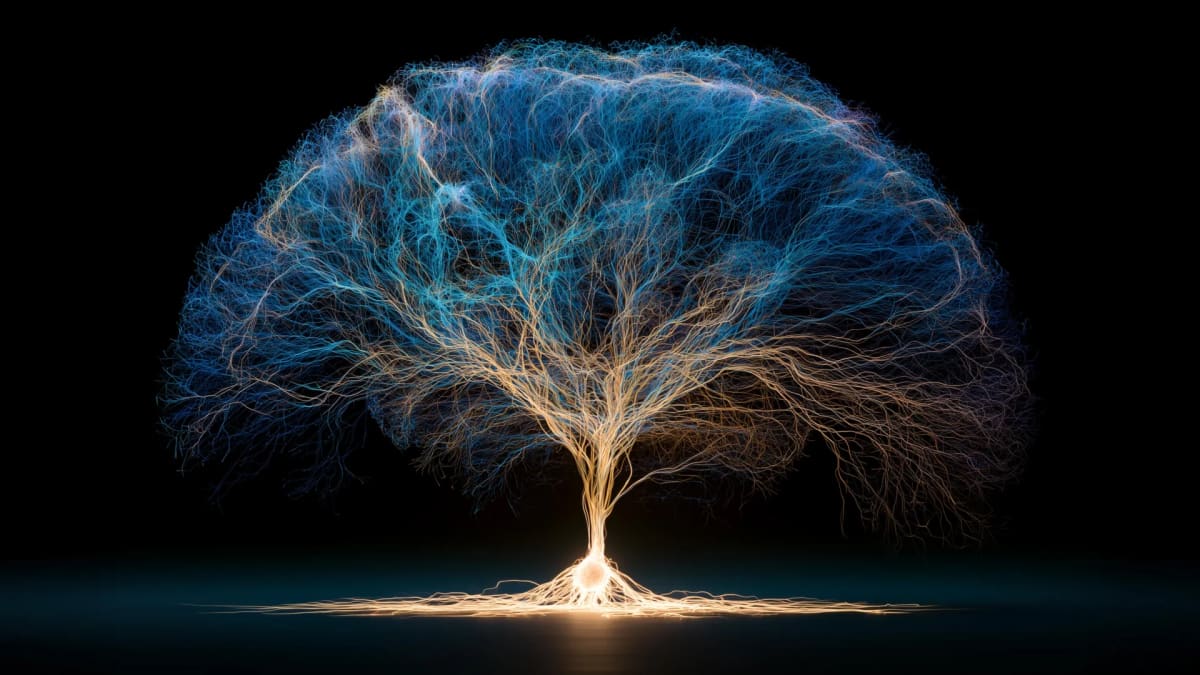
Researchers at Cold Spring Harbor Laboratory discovered that brain cells might organize themselves by staying close to their cellular ancestors, much like how human families settle near each other across generations. This elegant solution helps explain how a single cell transforms into a brain containing 170 billion precisely organized cells.
The challenge facing every developing brain cell is huge. Each one must figure out where it is and what it needs to become, using only information from itself and its immediate neighbors. Get it wrong, and the brain doesn't develop properly.
For decades, scientists believed cells relied solely on chemical signals to navigate during development. That theory works fine for small systems with fewer cells, but it struggles to explain how billions of brain cells find their correct positions. Chemical signals weaken as they travel, making them unreliable guides for cells deep inside a growing brain.
Stan Kerstjens, a postdoctoral researcher who led the study, explains the new theory with a simple comparison. "Consider how human populations spread across a country over generations," he says. "Descendants settle near their parents, so people who share ancestry end up in neighboring regions." The same principle appears to guide developing brain cells.
The team tested their lineage-based model using theoretical calculations, then examined gene expression patterns in developing mouse brains. They found the same organizational principle at work in zebrafish, suggesting this mechanism operates across different brain sizes and species.
Why This Inspires
This discovery represents more than just understanding brain development. The underlying principle could apply to other developing tissues and might even influence how future AI systems organize themselves.
The research reveals that nature doesn't always need complicated solutions for complex problems. Sometimes the most sophisticated outcomes emerge from simple rules applied consistently. Cells don't need elaborate navigation systems or long-range chemical signals. They just need to remember their family tree and stay close to home.
Perhaps most exciting is what this tells us about intelligence itself. Understanding how a single cell orchestrates the construction of something as remarkable as a human brain brings scientists closer to answering fundamental questions about consciousness and capability. Each discovery like this adds another piece to the puzzle of what makes us who we are.
The brain somehow accumulated the ability to make us intelligent, not just over our individual lifetimes, but across millions of years of evolution. Now we're one step closer to understanding how.
Based on reporting by Google News - Scientists Discover
This story was written by BrightWire based on verified news reports.
Spread the positivity!
Share this good news with someone who needs it