Scientists Find 'Just Right' Size for Reusable Catalysts
Researchers discovered that rhodium clusters of about 10 atoms work better than single atoms or large particles for making plastics and detergents. This breakthrough could make chemical manufacturing cheaper and more sustainable.
Scientists just solved a puzzle that could make manufacturing greener and more affordable by finding the perfect size for a crucial industrial catalyst.
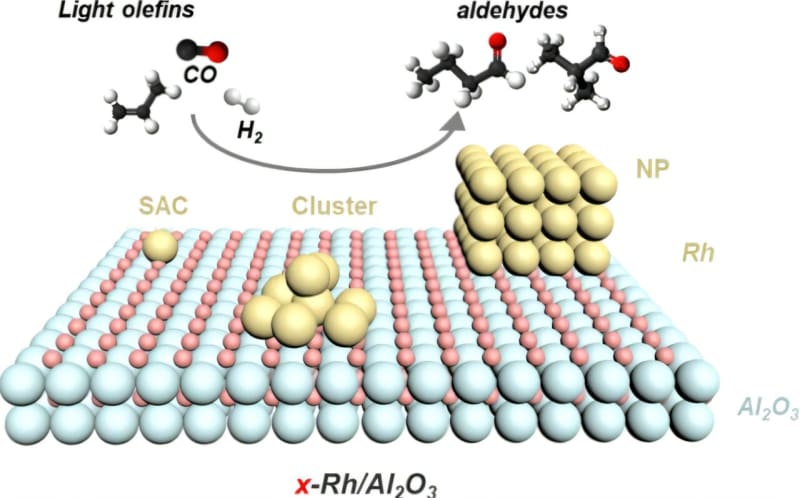
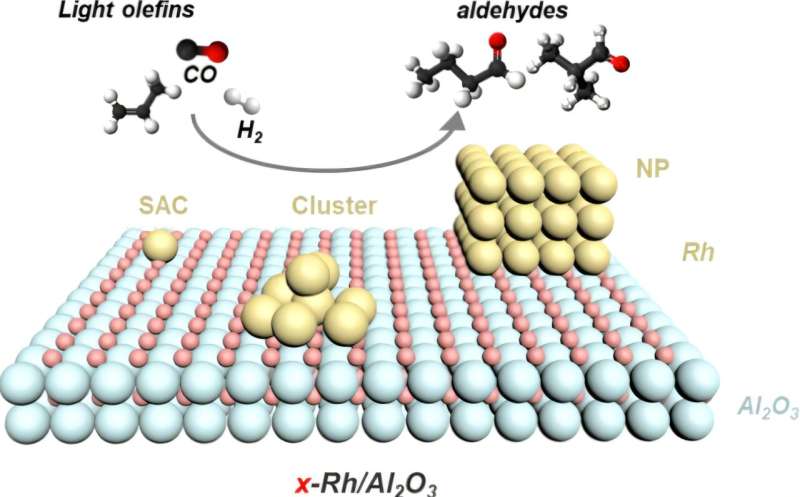
A team from South Korea's UNIST and Seoul National University discovered that rhodium clusters containing roughly 10 atoms perform better than any other size in hydroformylation, a key chemical process used to create raw materials for plastics, detergents, and countless everyday products. The research appeared as the cover story in ACS Catalysis.
The discovery challenges long-held assumptions in the chemical industry. For years, scientists believed that spreading rhodium into individual atoms would be most effective because it maximizes surface area for reactions.
But Professor Kwangjin An and his team found something unexpected. Mid-sized clusters hit a sweet spot that single atoms and larger nanoparticles both miss.
The secret lies in how these clusters interact with carbon monoxide, a key ingredient in the hydroformylation process. Single rhodium atoms grip CO molecules too tightly, essentially strangling the reaction before it can complete. Larger nanoparticles hold CO too loosely, making reactions sluggish.
Clusters of about 10 atoms bind CO with just the right strength, like Goldilocks finding the perfect porridge. This optimal grip allows the crucial step of inserting CO into reaction intermediates to proceed smoothly without blocking what comes next.
The breakthrough addresses a major industrial headache. Currently, most rhodium catalysts dissolve in liquids, making them difficult and expensive to separate and reuse after reactions complete. The new solid catalysts attached to alumina supports can be easily recovered and reused, cutting waste and costs.
The team tested their theory by preparing catalysts with different rhodium concentrations, creating single atoms, clusters, and nanoparticles. They combined laboratory experiments with theoretical calculations to understand exactly why the medium-sized clusters excelled.
The Ripple Effect
This discovery extends far beyond one chemical reaction. The insights into how catalyst size and electronic properties influence reaction pathways provide a template for designing better catalysts across numerous industrial processes.
Making catalysts reusable and more efficient means lower production costs for everyday items while reducing chemical waste. The approach could help industries shift away from harder-to-recycle dissolved catalysts toward solid versions that work better and last longer.
The research also demonstrates how questioning basic assumptions in science can lead to unexpected breakthroughs that benefit everyone.
Sometimes the answer isn't found at the extremes but right in the middle, where balance creates the most powerful results.
More Images
Based on reporting by Phys.org
This story was written by BrightWire based on verified news reports.
Spread the positivity!
Share this good news with someone who needs it