Scientists Find Master Clock That Controls Human Growth
Researchers discovered a biological timekeeper that controls every stage of development in living organisms. When this clock stops working, growth halts entirely, revealing new clues about developmental disorders.
Scientists have identified what could be the body's master alarm clock, a biological timer that tells cells exactly when to grow, develop, and move to the next stage of life.
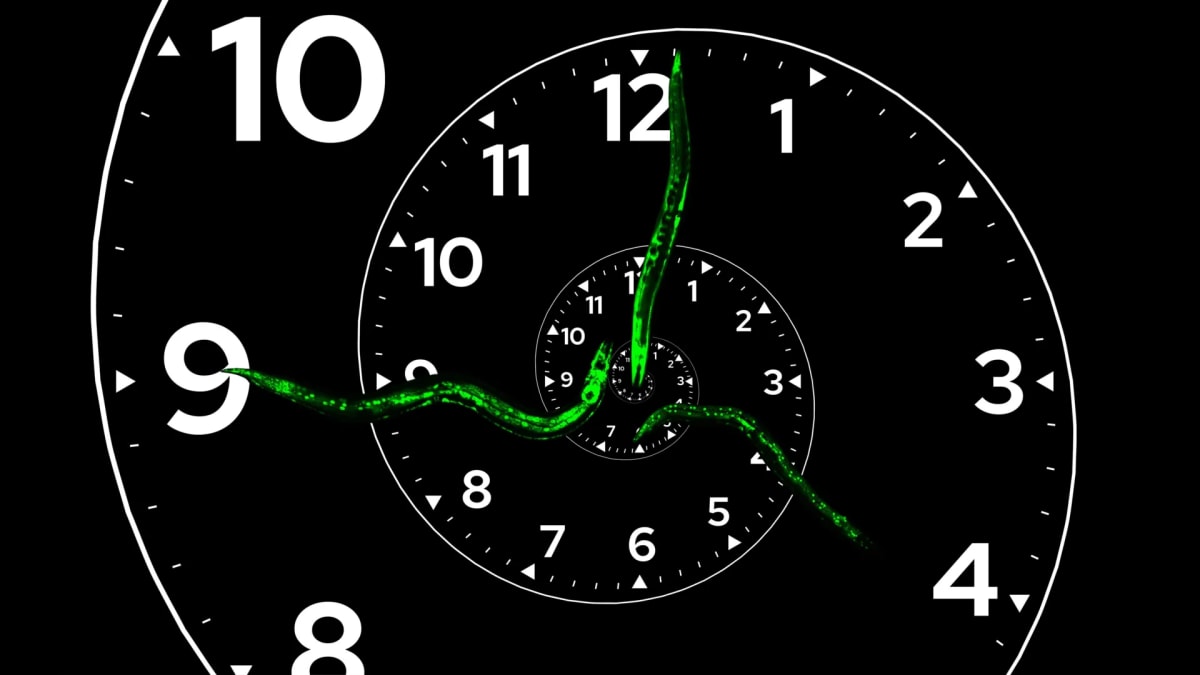
Researchers at Cold Spring Harbor Laboratory found two proteins, MYRF-1 and LIN-42, work together like a perfectly synchronized timekeeper inside tiny worms called C. elegans. These proteins control bursts of genetic activity that push organisms through each phase of development, from birth to adulthood.
Think of it like a train conductor who knows exactly when to blow the whistle for departure. If the conductor's watch stops, the train never leaves the station. The same thing happens when MYRF-1 and LIN-42 fail. Development simply stops.
Professor Christopher Hammell, who led the research, explains this is the first biological clock ever discovered that moves in only one direction. Unlike your sleep cycle that repeats every 24 hours, this developmental clock ticks forward through childhood stages that happen only once.
The discovery came after years of puzzle solving. Hammell's team had previously found that development happens in timed pulses of gene activity. But they didn't know what controlled the timing until now.
Using DNA sequencing, protein analysis, and artificial intelligence, the researchers watched MYRF-1 act like both the trigger that starts each developmental stage and the checkpoint that marks its completion. Once MYRF-1 kicks off a growth phase, it activates LIN-42, which then controls how intense and how long that genetic burst lasts.
When scientists blocked MYRF-1 in their experiments, everything broke down. Development hit a wall and couldn't move forward.
Why This Inspires
This discovery opens a window into understanding why some children experience developmental delays or growth disorders. If scientists can map how these cellular clocks work and stay synchronized across billions of cells, they might eventually help children whose internal timekeepers aren't working properly.
The research team now wants to answer an intriguing question: Do these cellular clocks talk to each other? Every cell appears to stay perfectly in sync during normal development, but nobody knows if they're actually communicating or just following the same internal rhythm.
Understanding this biological timekeeper could eventually point toward treatments for conditions where normal development gets disrupted. The findings remind us that even the tiniest organisms hold secrets that could unlock solutions for human health challenges.
Based on reporting by Google News - Scientists Discover
This story was written by BrightWire based on verified news reports.
Spread the positivity!
Share this good news with someone who needs it

%3Amax_bytes(150000)%3Astrip_icc()%3Afocal(999x0%3A1001x2)%2Fmichael-j-fox-1-16107b4a149a485e83a78fedd03d5096.jpg)