
Scientists Find Planet Born From a Dying Star's Ashes
Astronomers discovered the first-ever planet born from materials a dying star cast off, solving a 27-year mystery from Hubble telescope data. The rare "second-generation" planet orbits a white dwarf and will remain in the habitable zone for millions of years.
When NASA's Hubble telescope captured mysterious data from a distant dying star in 1999, scientists couldn't explain what they were seeing. Now, 27 years later, astronomers have cracked the code and discovered something extraordinary: evidence of a planet literally born from a star's death.
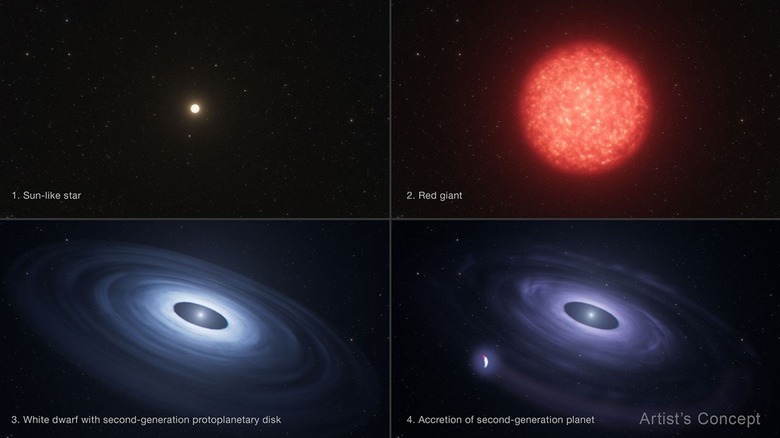
A team led by University of Warwick astronomers published their findings in Nature, revealing that white dwarf HS 0209+0832 hosts what could be the first confirmed second-generation planet ever found around this type of star. Unlike Earth and every planet in our solar system, which formed from materials present when the sun was born, this planet formed from the ashes of a dying star.
White dwarfs are what remain after stars like our sun exhaust their hydrogen fuel and expand into massive red giants that typically consume nearby planets. After burning through their nuclear fuel and shedding their outer layers, they leave behind an ultra-dense core. Finding a planet that survived this violent process and formed afterward was completely unexpected, according to lead researcher Jamie Williams.
The breakthrough came when Williams compared Hubble's decades-old observations to an updated chemical database. Those 100 unidentified chemical features matched niobium, an element that only forms in the exotic conditions inside dying stars. The system contains niobium levels 1,000 times higher than our sun, pointing directly to planet formation from the star's cast-off materials.
Second-generation planets are incredibly rare. Scientists have mostly suspected they exist only around pulsars, the highly magnetic, rapidly spinning remnants of dead neutron stars. White dwarfs are far more common, making this discovery even more significant for understanding how planetary systems can survive stellar death and rebirth.
The planet faces intense conditions right now. The white dwarf still burns hot enough to blast away the planet's outer layers. But the research team believes the planet will endure this harsh environment and remain stable.
Why This Inspires
This discovery rewrites what we thought possible about planetary survival and formation. A planet born from stellar death and positioned to remain in the habitable zone for millions of years shows that cosmic second chances are real, not just theoretical.
The finding also demonstrates the lasting value of scientific observations. Data collected in 1999 sat waiting for technology and knowledge to catch up, proving that today's mysteries might be tomorrow's breakthroughs.
Perhaps most hopeful: if planets can form from the ashes of dying stars and find stable, potentially habitable orbits, the universe might create far more opportunities for life than we ever imagined.
More Images


Based on reporting by Google News - Scientists Discover
This story was written by BrightWire based on verified news reports.
Building Something New? Try the BrightWire Tech Stack Advisor
Compare modern frameworks, cloud hosting, and AI tools tailored to your project budget and scale.
Spread the positivity!
Share this good news with someone who needs it


