Scientists Find "Spiral Ice" Inside Uranus and Neptune
Deep inside distant ice giants, carbon and hydrogen atoms may be dancing through each other in a stunning new pattern never seen before. This discovery could finally explain why these planets have such strange magnetic fields.
Scientists just discovered that the hearts of Uranus and Neptune might contain a truly bizarre form of matter where atoms move in spiral patterns like cosmic corkscrews.
Researchers Cong Liu and Ronald Cohen from the Carnegie Institution for Science used powerful computer simulations to peek inside these distant ice giants. What they found challenges everything we thought we knew about how matter behaves under extreme conditions.
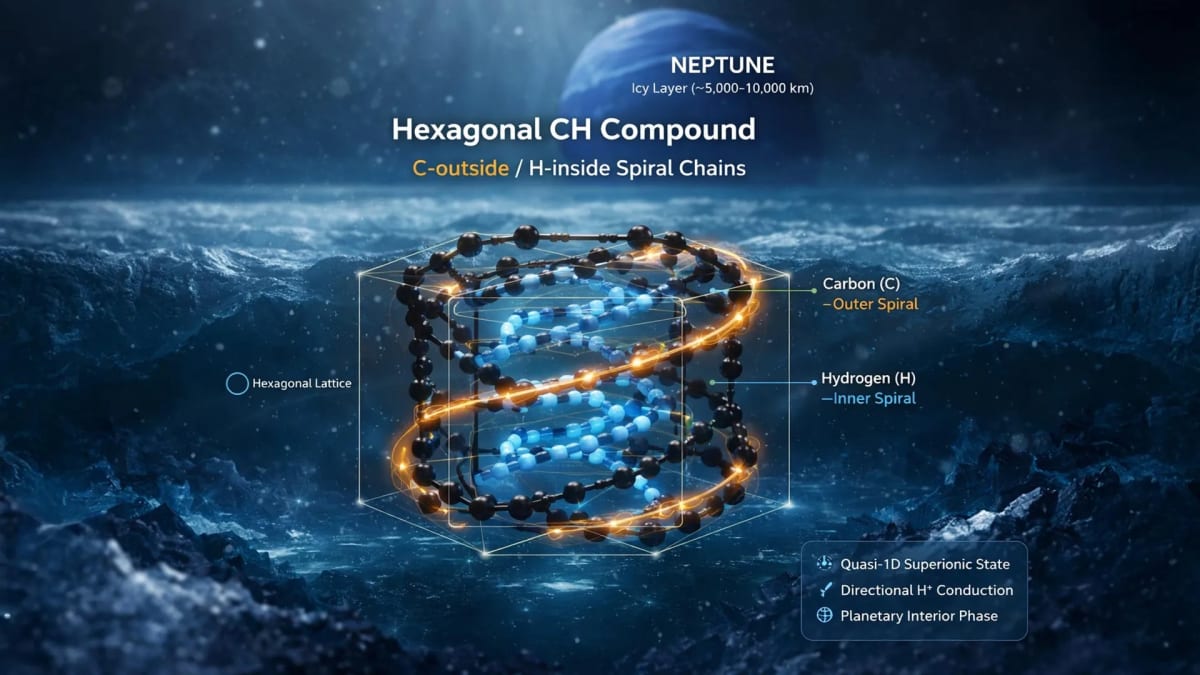
Picture this: carbon atoms locked into a rigid honeycomb framework while hydrogen atoms weave through them along spiral highways. It's part solid, part liquid, and completely unlike anything we have on Earth.
The team simulated conditions found deep beneath these planets' surfaces, where pressures reach nearly 30 million times Earth's atmosphere and temperatures soar above 10,000 degrees Fahrenheit. Under these crushing extremes, simple compounds like methane transform into something extraordinary.
This strange state of matter is called "quasi-one-dimensional superionic." The name sounds complex, but the concept is fascinating: one type of atom stays frozen in place while another flows freely through it, following specific spiral paths rather than moving randomly in all directions.
Why This Inspires
The discovery matters far beyond just understanding distant planets. With over 6,000 exoplanets discovered so far, scientists need to understand what's happening inside these worlds to assess which ones might support life.
The spiral movement of hydrogen atoms could completely change how heat and electricity flow through planetary interiors. This might finally solve the mystery of why Uranus and Neptune have such unusual magnetic fields compared to other planets in our solar system.
What's truly inspiring is how even the simplest, most abundant elements in the universe can surprise us. Carbon and hydrogen, the building blocks of life itself, can organize into intricate patterns we never imagined possible.
This research shows that we're still discovering fundamental secrets about how our universe works. Every simulation and experiment brings us closer to understanding not just distant ice giants, but the incredible diversity of worlds waiting to be explored.
The findings remind us that nature's creativity extends far beyond what we can see or touch on Earth.
Based on reporting by Science Daily
This story was written by BrightWire based on verified news reports.
Spread the positivity!
Share this good news with someone who needs it