Scientists Grow Breakthrough Material for Future Electronics
Chinese researchers have successfully created ultra-thin films of a special magnetic material that could revolutionize how our phones and computers store data. The breakthrough makes it possible to build faster, more efficient electronic devices. ##
Imagine electronics that work faster and waste less energy. That future just got closer thanks to a team of Chinese scientists who figured out how to grow an exotic material called iron germanide in layers thinner than a human hair.
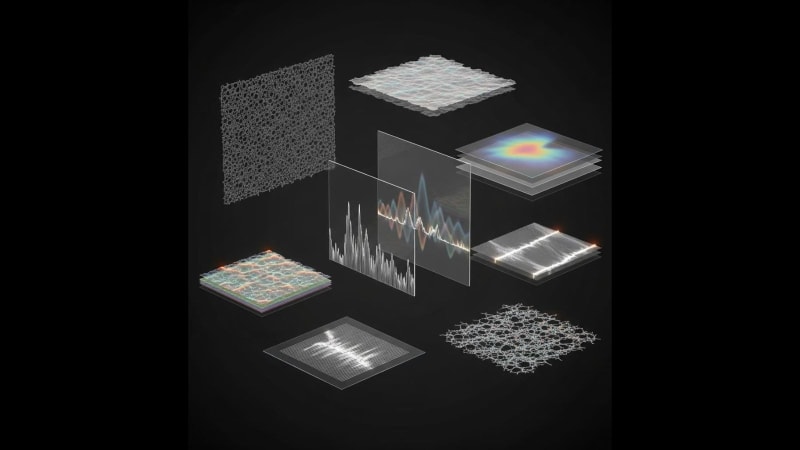
The material belongs to a family called kagome metals, named after a traditional Japanese basket-weaving pattern. The atoms arrange themselves in this distinctive geometric shape, giving the material unusual electronic and magnetic properties that scientists have been eager to harness.
Until now, researchers could only study iron germanide in bulky crystal form. The Beijing team from the State Key Laboratory of Semiconductor Physics and Chip Technologies changed that by growing smooth, high-quality films on sapphire substrates. They used a precise technique called molecular beam epitaxy, placing atoms layer by layer with incredible accuracy.
The process involved three careful steps. First, they deposited an ultra-thin seed layer just 2 nanometers thick at high temperatures. After rapid cooling, they added a thicker 15-nanometer layer at lower temperatures. Finally, they heated the film again for two hours to perfect its crystal structure.
Testing confirmed the films maintained their special atomic structure and stayed smooth. Adding a thin iron buffer layer made the surface even flatter, critical for real-world applications.
The best news? The material stays magnetically stable well above room temperature, at 397 Kelvin (about 252°F). This makes it practical for everyday devices, not just laboratory experiments.
Why This Inspires
This breakthrough matters because it opens doors to spintronic devices, an emerging technology that uses electron spin instead of charge to store and process information. These devices could be much faster and more energy-efficient than current electronics.
The flat, thin films can be easily integrated into existing semiconductor technology. Scientists can now manipulate them with strain, electric fields, or light, something nearly impossible with bulky crystals. That flexibility means researchers can experiment with new device designs and applications.
The team also detected intriguing changes in electrical behavior around 100 Kelvin, suggesting the presence of charge density waves. These patterns of electron arrangement could unlock even more capabilities as scientists learn to control them.
Because the films work with standard manufacturing processes, tech companies could potentially adopt them without rebuilding entire production lines. The high magnetic stability means devices could operate reliably in normal conditions, from your pocket to your desk.
The researchers plan to study the charge density wave behavior more closely and refine their understanding of how electrons move through the material. Each discovery brings practical applications closer to reality.
From faster smartphones to more powerful quantum computers, the ability to grow these kagome metal films marks a genuine step forward in electronics innovation.
##
Based on reporting by Indian Express
This story was written by BrightWire based on verified news reports.
Spread the positivity!
Share this good news with someone who needs it