Scientists Invent Heat Pumps That Could Replace Fossil Fuels
Researchers have developed breakthrough heat pump technology that works at temperatures up to 2,400°F, hot enough to replace fossil fuel burning in factories. These ultra-efficient systems could slash industrial emissions while cutting energy costs.
Scientists just cracked one of clean energy's toughest challenges: getting factories off fossil fuels without breaking the bank.
An international team led by Slovenia's University of Ljubljana has developed revolutionary heat pump technology that reaches temperatures up to 2,400°F. That's hot enough to power steel mills, cement plants, and other heavy industries that currently have no choice but to burn coal and gas.
"At around 1,750°F, conventional heat pump solutions are typically replaced by direct fuel combustion or electrical resistance heating," explained researcher Katja Klinar. The new technologies can achieve twice the energy efficiency of burning fuel, making them cheaper to run once installed.
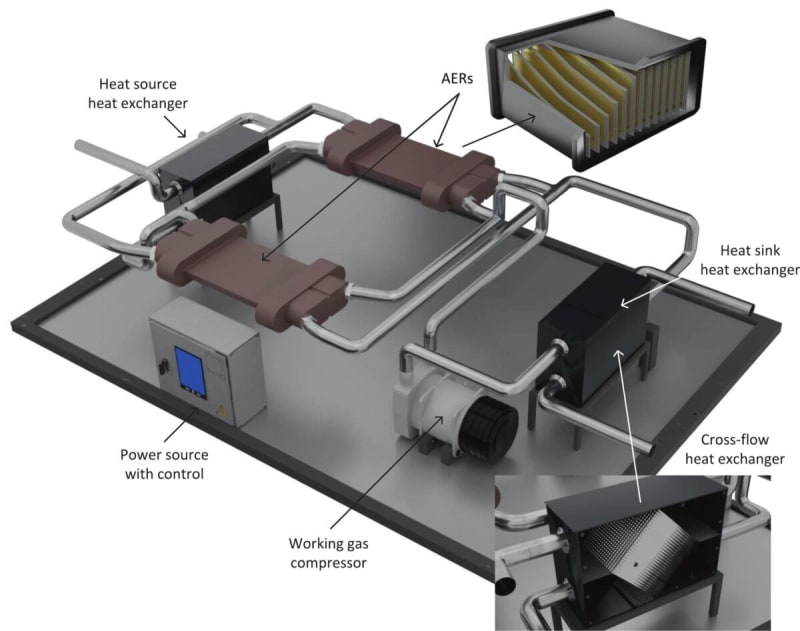
The breakthrough involves seven different approaches using solid materials or gases instead of traditional refrigerants. Some use sound waves to heat and cool gas. Others exploit how certain materials change temperature when exposed to magnetic fields, electric fields, or mechanical pressure.
The team pioneered the concept of electrocaloric heat pumps for ultra-high temperatures, an idea never before described in scientific literature. They've completed computer simulations and are now planning to build the first prototype.
These systems eliminate the leakage risks of conventional heat pumps because they use solid materials or inert gases. Many designs have no moving parts, reducing maintenance needs and extending lifespan.
The research team evaluated each technology's maturity and mapped out development timelines through 2040. The most advanced systems, like reverse Brayton heat pumps, are already demonstrated in real-world conditions. Others, like electrocaloric systems, are still in early concept stages.
The Ripple Effect
The timing couldn't be better. Industries like steel, cement, and chemical manufacturing account for roughly one-fifth of global carbon emissions. Most have struggled to decarbonize because they need extreme heat that renewables couldn't efficiently provide until now.
Because these heat pumps run on electricity, they can be powered entirely by solar panels and wind turbines. That means factories could eliminate fossil fuels completely while actually reducing their energy bills.
By 2040, researchers project these systems will achieve efficiencies of 60% or higher for most designs. Power outputs will scale from small 100-watt units for laboratories up to massive 1,000-kilowatt systems for industrial complexes.
The development involves researchers from Slovenia, China, Spain, the Netherlands, Croatia, and the United Kingdom, published in the prestigious journal Nature Energy. This global collaboration signals serious momentum behind making the technology commercially viable.
Heavy industry has long been considered the hardest sector to decarbonize, but these heat pumps offer a genuine path forward that's both cleaner and more economical than the status quo.
More Images

Based on reporting by PV Magazine
This story was written by BrightWire based on verified news reports.
Spread the positivity!
Share this good news with someone who needs it