Scientists Make Extraordinary Discovery That Could Revolutionize Our Understanding of the Universe
Canadian-led astronomers have made a thrilling discovery of the earliest and hottest galaxy cluster ever observed, challenging our cosmic models in the most exciting way. This groundbreaking find opens new doors to understanding how the universe's largest structures formed, showcasing the power of human curiosity and international scientific collaboration.
In a stunning breakthrough that highlights the incredible capabilities of modern astronomy, an international team of scientists led by Canadian researchers has discovered something truly extraordinary: a blazing hot galaxy cluster that's rewriting what we thought we knew about the early universe.
The remarkable finding, published in the prestigious journal Nature, reveals a galaxy cluster glowing with scorching gas just 1.4 billion years after the Big Bang—far earlier and hotter than anyone predicted. Rather than being a problem, this surprising discovery represents an exciting opportunity to deepen our understanding of cosmic evolution.
"We didn't expect to see such a hot cluster atmosphere so early in cosmic history," shared Dazhi Zhou, a PhD candidate at the University of British Columbia, with evident excitement. After months of careful verification, the team confirmed that this ancient gas is at least five times hotter than predicted, rivaling even the temperatures found in many present-day clusters.
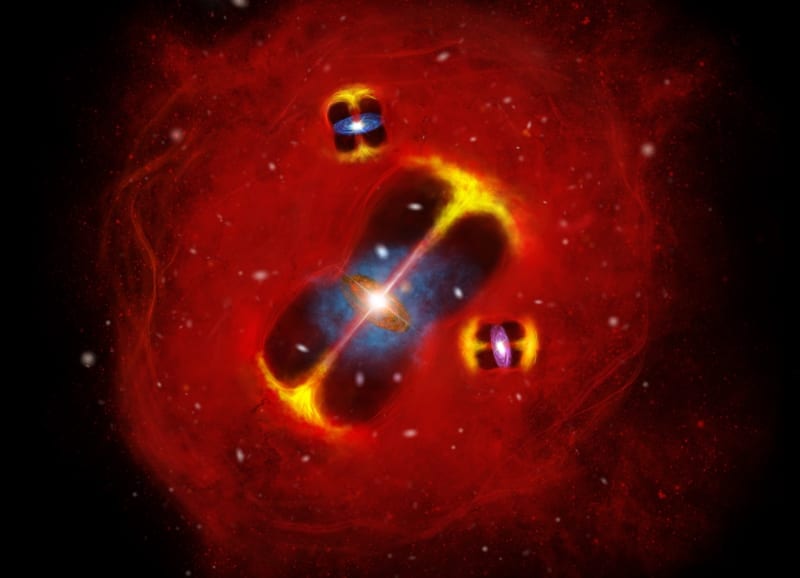
What makes this discovery particularly fascinating is what it tells us about the dynamic early universe. The research suggests that three recently discovered supermassive black holes in the cluster were already pumping enormous amounts of energy into their surroundings, actively shaping their cosmic neighborhood much earlier and more vigorously than scientists had imagined.
The team focused their attention on SPT2349-56, affectionately termed a "baby" galaxy cluster, using the remarkable Atacama Large Millimeter/submillimeter Array (ALMA) in Chile. This infant cluster is impressively massive for its youth, spanning about 500,000 light years across and containing more than 30 active galaxies. Most astoundingly, it's forming stars more than 5,000 times faster than our own Milky Way—all within a remarkably compact region.
"Understanding galaxy clusters is the key to understanding the biggest galaxies in the universe," explained Dr. Scott Chapman, a professor at Dalhousie University and UBC affiliate professor. His enthusiasm for the discovery is palpable, as it opens new avenues for understanding how massive galaxies evolve within their cluster environments.
This discovery suggests that the birth of galaxy clusters is far more explosive and dynamic than previously thought, challenging scientists to rethink the sequence and speed of cosmic evolution. Rather than seeing this as an obstacle, the research community views it as an exhilarating puzzle waiting to be solved.
Looking ahead, the team is eager to investigate how all these cosmic pieces fit together. "We want to figure out how the intense star formation, the active black holes and this overheated atmosphere interact," Zhou explained with anticipation. The questions raised by this discovery promise to keep astronomers engaged in fascinating research for years to come.
This breakthrough beautifully demonstrates the power of international scientific collaboration, advanced technology, and human curiosity working together. It reminds us that the universe still holds countless surprises, and each discovery brings us closer to understanding our cosmic origins and the magnificent structures that fill the cosmos.
Based on reporting by Reddit - Science
This story was written by BrightWire based on verified news reports.
Spread the positivity! 🌟
Share this good news with someone who needs it
More Good News
 🚀 Innovation
Australian Researchers Create Game-Changing Tool to Protect Water From Toxic Chemicals
 🚀 Innovation
SK On and Seoul National University Make Exciting Battery Breakthrough
 🚀 Innovation
Revolutionary Quantum Computer Could Solve Humanity's Biggest Challenges
Joke of the Day
Why did the librarian get kicked out of class?
Explore Categories
Quote of the Day
"Do not go where the path may lead, go instead where there is no path and leave a trail."
— Ralph Waldo Emerson